

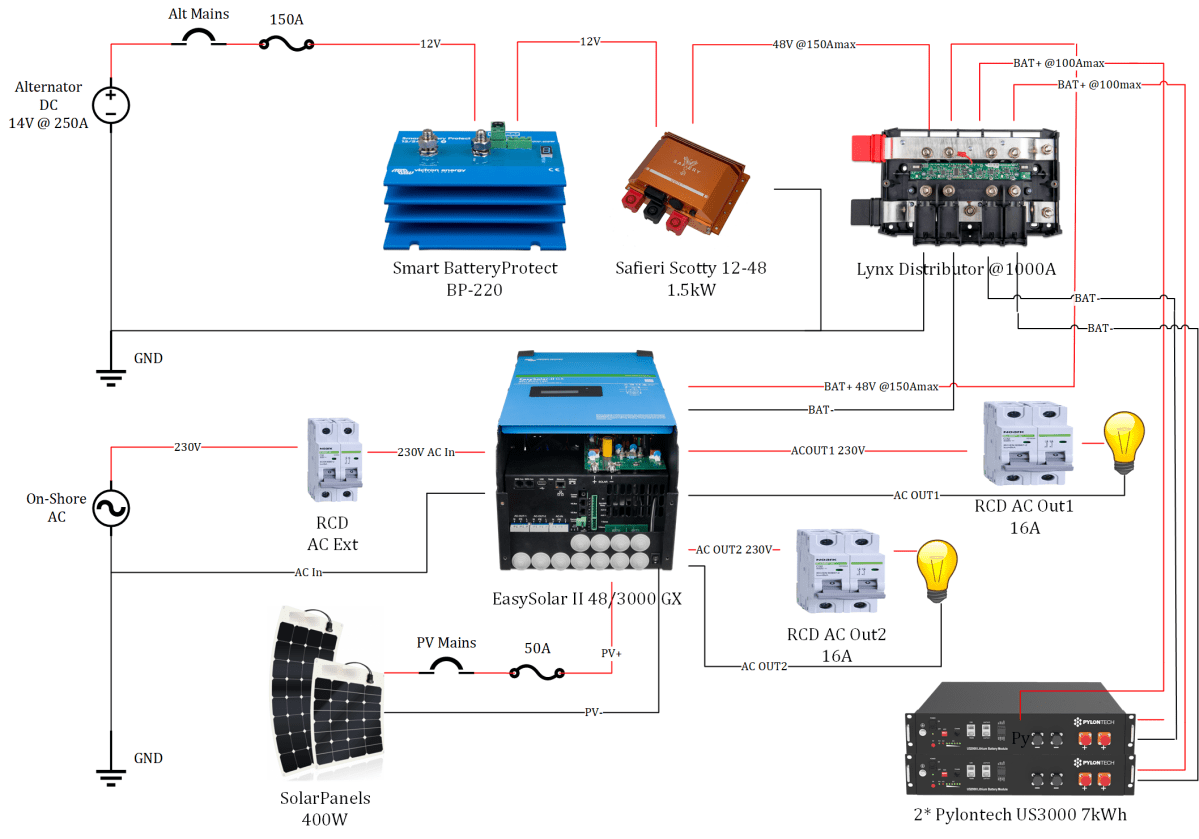
In one of our last posts we wrote about the upcoming, yet to be built, electricity setup in the vNext Car.
And now we changed our plans – slightly. Before deciding definitely for the Pylontech as the battery supplier, we thought we would install and test a comparable setup with both BYD and Pylontech.
Why did we do that? Having a look at the US3000C specs, we see that the recommended (dis)charge current is considerably lower than those from BYD (37A vs 65A). Of course, both batteries supply higher currents than that (74A vs 90A). But the cables sizes of the Pylontech box only supports a maximum of 2*100A, whereas the B-Box supports up to 250A. This maximum recommended current makes a difference when only having 2 batteries at your disposal, as the maximum surge current of the Victron MultiPlus II 48/3000 inverter is 5500W. So with Pylontech I can only support 2* 37A * 48V = 3552W without going over the recommended current and with BYD I can draw 2 * 65A * 48V = 6240W which is over the supported maximum of the inverter. So this is an advantage for BYD. Plus the overall capacity of BYD is higher (and comes at a larger weight).
Consequences and some calculation
But of course this has a drawback, as I want to use a DC Circuit Breaker with an integrated isolator, instead of a mains switch and a regular one-time fuse for the batteries. Most of the DC breakers only work up to a 63A and the larger ones are considerably more expensive.
On the other hand, the guarantee and fine-print with BYD declares indicated values are only achieved at a 0.2C rating, meaning that I could only constantly draw a 8000Wh * 0.2C = 1600W anyway, if I wanted to make use of the whole capacity (100% DoD).
Unfortunately I could find no C rating for Pylontech. However, in their warranty, Pylontech writes that the denoted values are only achieved when (dis)charging at 10A per battery (95% DoD). If I calculate this correctly, this would be an equivalent of roughly 2* 10A / (2 * 3374Wh / 51.2V) = 0.15C. In both cases the inverter should only much less than needed to support an induction cooktop and frankly any two devices at a time.
As a side note: Interestingly the B-Box seems to be cheaper per kWh than the Pylontech (as long as you stick with a single battery group).
So what does this mean?
In either case I will overrun the C rating of both batteries, meaning I will not get the full “official” capacity or life-time out of it. On the other hand, for our car installation this will not make much of a difference, as the Safiery Scotty DC-DC charger will recharge the batteries anytime when needed.
But when designing a complete off-grid system this will make a difference, as there we probably want to achieve a maximum amount of usable capacity and life-time.
But anyway, I will be making two installations and compare them in respect of the ISO25010 main product characteristic categories:
- one installation with BYD Battery-Box LVS Premium 8.0 and
- one with a pair of Pylontech US3000C batteries.
The B-Box has already been ordered. For Pylontech I am still awaiting a confirmation of the quote.
I keep you posted.
Update
Due to the difficulties of getting Pylontech batteries I had to skip the test and go straight for the BYD Battery-Box. See here for how it runs next to our caravan.
But even the delivery time for the BYD was months. So, in the end I decided to build the batteries from EVE LF280K cells myself.
Appendix: Pylontech Documentation
Pylontech Documentation as this does not really seem to be available on their website.
If you read the warranty card carefully, we see that the warranty extension from three to seven years has to be taken with a grain of salt. In addition, the replacement process (even to dead-on-arrive) is not

 Our Journey to Scotland