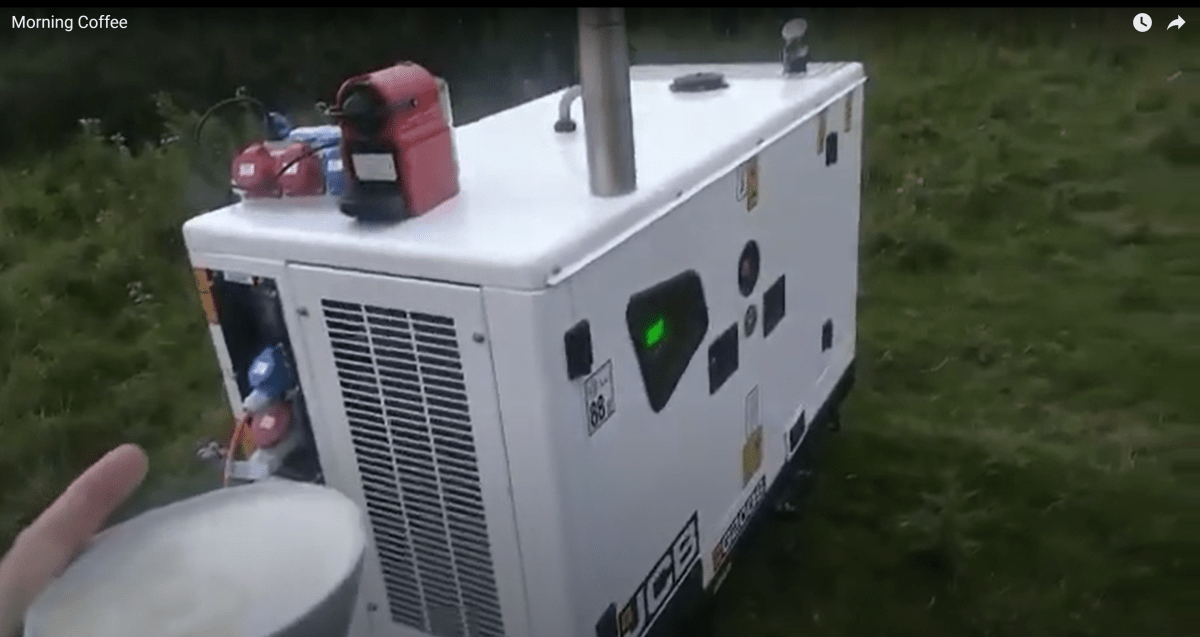
The Caravan we got last year did not come with an inverter, so getting coffee in the morning or running a microwave was only possible when our main generator was running. And the installed battery for 12V support had a rather small capacity. This was clear to us from the beginning, as we eventually wanted to connect the Caravan to our EVE 280Ah cells.
But since we got our Starlink internet and our router did not seem to run easily on DC power, we needed -in addition to the temporary morning AC coffee spike – a more permanent AC solution.
Of course, first I updated the firmware of the inverter and configured it work with the battery:
Setting the AC input to 16A
Setting the battery type to LiFePO4
Setting the charge current to 70A (which is over the recommend amount of 50A, but see below for details)
As I did not want to connect a Cerbo GX to the system, I just used the VictronConnect App. Maybe I add a VE.Bus Smart dongle later on, or I connect some GX nevertheless. Who knows … Until now, it needs a wired connection to the inverter to see its status.
After powering on the generator, I confirmed everything was roughly working as expected. During the first run, the SOC was shown as 100% though the BMS of the battery internal saw it differently. In addition, the reported Amps and temperature were seen differently, as well. So, even that I set the inverter over the recommended maximum of 50A for the battery, the actual charge power was never much higher than the actual maximum).
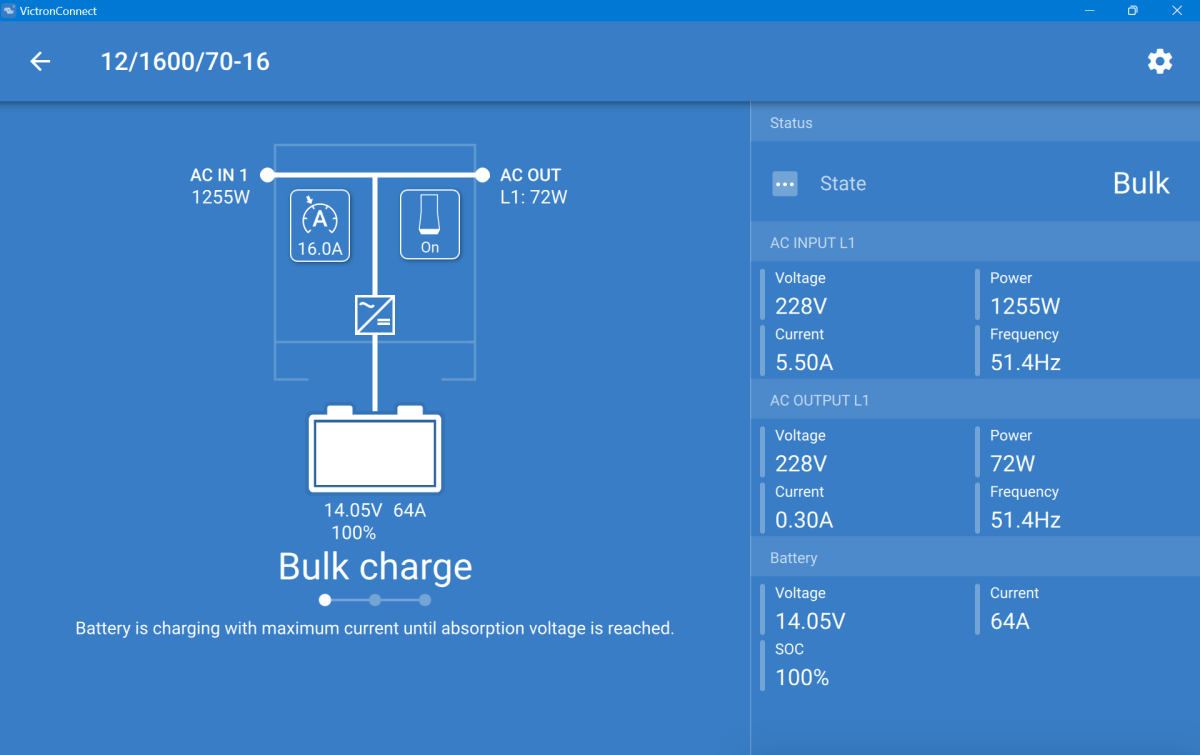
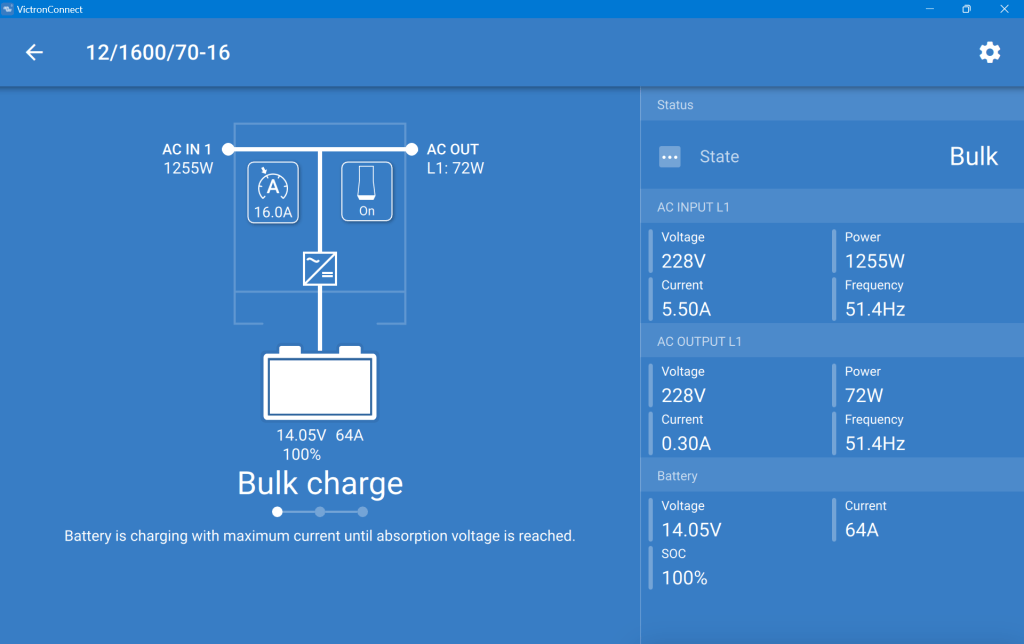
This is what the inverter saw (100% SOC, 14.05V DC cell voltage, charging at 64A):
MultiPlus charging the Liontron battery via the generator
And this is, what the Liontron BMS reported (76% SOC, 13.8V DC cell voltage, charging at 55.5A):
The SOC as seen by the Liontron battery BMS
In the end, the BMS stopped charging when it thought its batteries were full. And the inverter did not complain. However, I noticed that the cells were really not in balance (with a delta of 200mV between the lowest and highest voltage).
Discharging was ok, as well. However, I soon realised that the 100A discharge current could not be achived in my setup. The inverter tried to draw power and the BMS cut off with a “Discharge over-current” (OCD). SO, still no coffee via our Nespresso machine (and no microwave either, for that matter).
So, what is the take away of all this?
It works and now, I can run the Internet all day.
All in all, it is a relatively simple and quick setup.
The Liontron battery does somehow not live up to its specs (and yes, I know the battery could be a size bigger for what I want to achieve; but I did not want to buy an additional battery for this temporary solution).
It is way cheaper and more flexible than to buy this “off the shelf”.
Maybe, I add a Victron SmartShunt to get a more accurate SOC reporting (as I do not see any other way to integrate the BMS with the inverter).
Charging of the battery is quite fast when running the generator.
The foundation works for our barn are progressing, so hopefully the barn will be finished by the end of the year and we can start setting up a workshop – and our main electricity installation.
Last year, when I did a rough planning of our electricity needs and installation I decided to go for a battery system from Pylontech or BYD. But now, it is very hard to find a reseller or dealer that can actually deliver these batteries in the UK.
So our current plan is to “build” the batteries ourselves. And thanks to Stuart Pittaway (support him on Patreon, he created the DIYBMS) I found Fogstar, a company that imports and sells Eve battery cells. And this is where I ordered my 112 Eve 3.2V 280Ah 0.5C cells – to be delivered in late November (hopefully).
In the following sections I will explain why I ordered these cells and how I will connect them. So let’s start …
The generator
Our system will be completely off from the main electricity grid. We only have a JCB G20QS as a backup generator that can produce a constant power of 20kVA or 14.4kW. Running this generator at around 75% capacity is the most energy efficient way and will consume roughly 3.29 l per hour. This means I will have an output of 10.86kW and get a 3.3kW per litre of diesel.
Consumption calculation for JCB G20QS
The load
Despite my previous thoughts I will run the whole system on a single phase. This is due to the nature of “electric showers” in the UK all being single phase and using power between 8kW and 10.5kW. As I will use eneergy from the batteries for heating as well, I plan for a daily power consumption of 16kWh per day with a peak consumption of 12kW.
The batteries
I want to be able to run at least 3 days completely on batteries, resulting in a storage capacity of 48kWh to 64kWh.
Currently available LiFePO4 cells range between 280Ah and 320Ah and have normally a C rating of 0.5C. So if use 4 parallel batteries with 16 280Ah cells each I will end up with a capacity of 4* 16 * 3.2V * 280Ah = 4 * 14’336 VAh = 57’344 VAh.
The maximum current draw would be 4* 140A = 560A with a resulting available power between 28’672VAh and 22’400VAh (when the cells run at 2.5V just before shutting off). As it is hard to find DC breakers for that current rating, I actually restrict the maximum draw to 125A per battery giving me a draw of maximum 500A and a resulting available power range between 25’600VAh and 20’000VAh. This will give me at least 16’000Wh.
Side note: I was not sure, if I should really go for LiFePO4 batteries, as I do have the space and storing weight is not a problem either. But in the end I opted against lead acid batteries as the LiFePO4 has become so much cheaper. Temperature is not a problem for me in Scotland as it does not really get cold and the batteries are not outside below 5°C.
And the main reason why I went for the 280Ah cells (instead of bigger ones) is, that
( a ) I do not need the bigger capacity of 4 batteries with larger Ah, and
( b ) I see the remaining power of the system, when one battery is offline, as too little with a 3 battery system (instead of a 4 battery system), and
( c ) I would need bigger circuit breakers (with the 304Ah cells), and
( d ) I can still draw 15’000VA with only 3 batteries on the 280Ah setup.
Comparison between 280Ah, 304Ah and 320Ah cells
So the whole system is wired as a 4p16s system (instead of a 16s4p). Or was it the other way round? I always mix it up …
The inverters
I will use 3 parallel connected Victron MultiPlus II 48/5000/70-50 inverters that can deliver a constant power of 15’000VA or 12’000W (and peak up to a total of 27’000W).
One good thing about the model 5000 inverters is that they are relatively energy efficient (rated at 96%) and use only 18W per inverter. So during normal operation I might be running only 2 inverters at a time (with 36W), but I can easily add the 3rd inverter (with a total 48W). And given the output the batteries I could also add a 4th inverter later, if I really needed more peak power without having to add another 16s battery.
The connections
For this system I will use the Victron Lynx DC distribution system that is rated for 1’000A. The main fuse in the Lynx Shunt VE.Can (which is also rated for 1’000A) will run with a 500A fuse. The shunt itself is necessary as the Victron Cerbo GX controller cannot handle more than a single BMS. The shunt will tell the GX via the CAN bus the load level of the 4 batteries and thus hiding the individual batteries from the GX.
Charging will be done via the 3 MultiPlus inverters where each inverter can handle a 70A. This is slightly under the 212A that the generator can produce at 75% load (see above).
This means we would theoretically run the generator for 320min to charge all 4 batteries completely (needing roughly 17l of diesel).
If we only used the generator to charge the batteries for the whole year, we would end up with around 540h of running the generator, costing us 2’040GBP (at a current price of 1.15GBP per litre).
Side note: Though the generator is able to run constantly 24/7, the service package covers an 800 h per year. So even with these 540h we are well below this threshold.
Discharging
As already written, I restrict the discharge per battery to 125A, but the realistic discharge current should be between 75A and 98A per battery on full load (so I could actually also use a 100A DC circuit breaker). These number take into consideration the loss of the inverter, reactive power and the minimum cell voltage before shutdown.
With these parameters we could draw 12kW for a period of roughly 3.6h.
The Eve cells claim to have a lifetime of 5’000 cycles. With the estimated power consumption of 16’000W per day, we would end up in 102 full cycles per year and have a theoretical life time of over 49 years. Probably not …
Accessories
As the battery of the generator runs on 12V there will be a 48V/12V charger that will take power from the main batteries and keeps the generator charged.
In addition, I will have a direct 48V connection for additional 48V portable power packs that can be charged from the main battery system.
Scalability
The inverters can be scaled up to 6 parallel systems with a maximum power delivery of 24’000kW. But even better, I could easily change the whole system to a 3-phase system and still scale it up, uilising 3, 6 or nine inverters if needed.
And the batteries could be scaled easily to 8 parallel batteries before hitting the 1’000A rating of the bus bars and the shunt.
And if we went for a bigger bus bar, we could also replace the Lynx Shunt with a Victron 2000A SmartShunt.
Summary
So this is it. Until the cells have not been delivered I will not know if this works or not.
We will find out …
Side note: I am no Victron Shop at all, but like how their products integrate with each other and are still able to play with hardware from other manufacturers.
With the nearest water connection more than 500m away and crossing a main road plus multiple neighbours’ grounds, we decided to go for a rainwater collection and filtration solution.
So be prepared for a lot of numbers in this post.
In order to size such a system, I first tried to find out the demand of (drinking) water we would have on our plot.
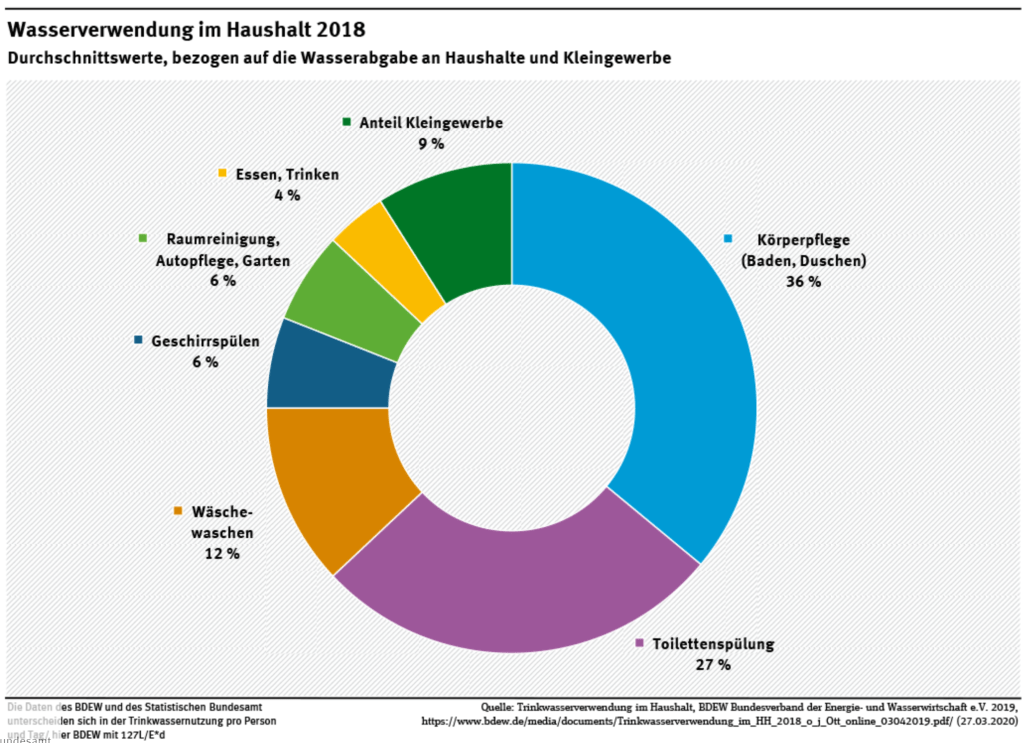
According to a publication of the german Umweltbundesamt every person in Germany used 123l of drinking water per day.
This breaks down to the following parts as seen in the following picture:
Source: BDEW 2019
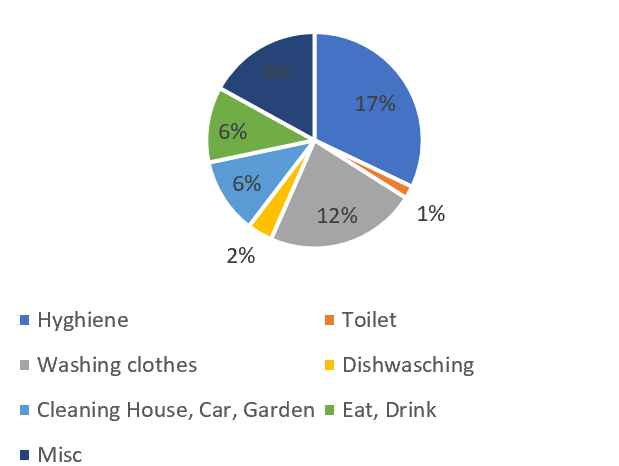
I adjusted the numbers slightly to what I would expect in our environment (for example, as we are using a composting toilet we need nearly no water for the toilet, but I left in the 9% for small enterprises). Percentages in green are estimated less than the provided statistics and percentages in red estimated higher than the statistics:
Summary of water consumption
This gives us a distribution like this:
Estimated Water Consumption Distribution (65l)
I then calculated the demand for 2 people of several periods of time:
Demand and Supply
So I came to the conclusion that our 2 people household would roughly need 50’000l of drinking water per year and that with a standard 1000l IBC we could last approximately 7 days (which I the amount of water we can easily carry in one go with the TeleHandler).
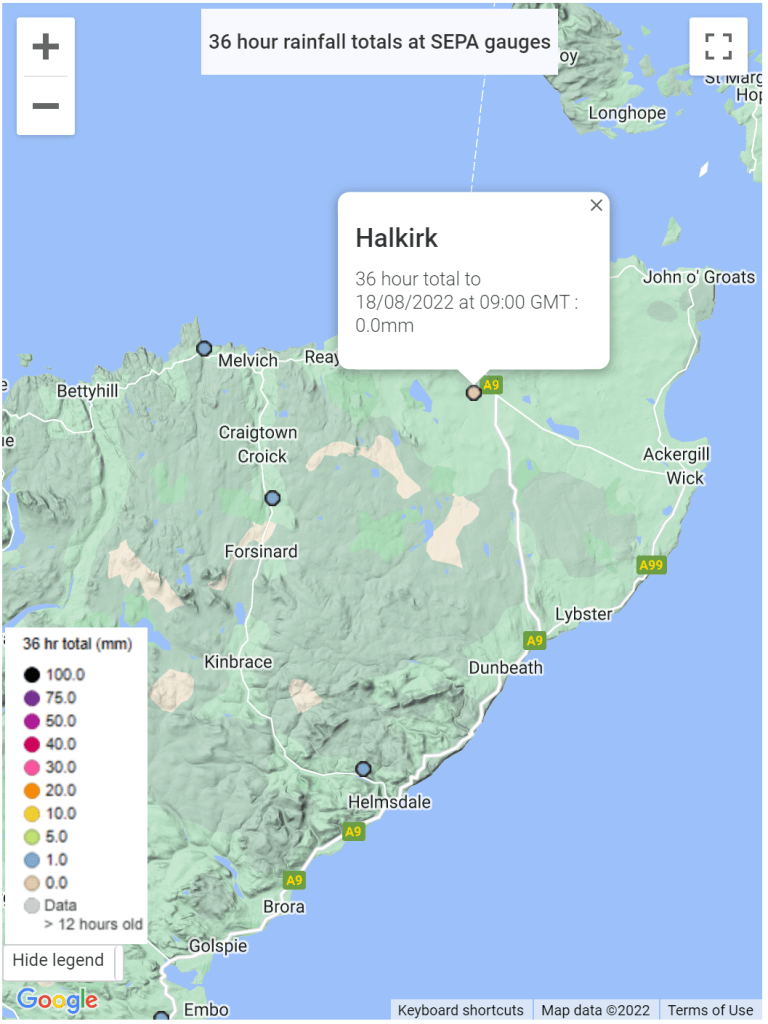
I then went on to the SEPA web site to find information about rainfall data in the area where we are. Unfortunately, the nearest data points on their map are either Halkirk near Thurso or Kilphedir near Helmsdale.
I projected the numbers from this chart to the size of the roof of our barn (roughly 310m2) that would act as our water collection surface:
Estimated rainfall
So even during the last driest months in the last year (June: 8’520l and March: 6’240l), we expect still be more than enough rain (> 4’000l) to supply us with water.
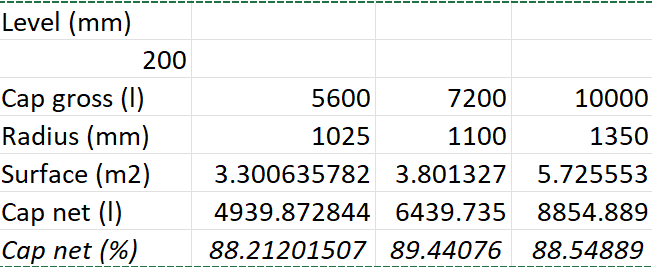
And now to the sizing: As I do not want to empty the tanks completely (there is always some sediment or dirt at the bottom of the tank), I want to be able to leave approx 20cm water level in the tanks.
I looked at the dimensions of water tanks from different suppliers and found these dimensions for the sizes of 5’600l, 7’200l, 10’000l:
Tank sizes and net capacity
So even with a 5’600l tank I could “survive” for a whole month and still had left 20% for increased demand while always leaving 20cm of the water in the tank. And with a lifting capacity of at least 1’250kg we can still move around such a tank if required.
So my sizing conclusion would be to get two of these 5’600l tanks (so one tank could always go into maintenance or act as a backup) and and have two 1’000l IBC tanks for emergency water transport.
Depending on the water tanks and its certification this would cost approx 2’500,00 GBP (without delivery fees or hoses and the like).
Did I miss or forget something? What do you think?
ps – below you find the podcast version of this blog post:
What does it take to run an off-grid Household on Wind and Solar only
Our plot in Caithness is not really what you would call developed. The next water line is 2 miles away, and the electricity lines just connect our distant neighbours to the grid.
When I made an enquiry with Scottish Power to get me a grid connection to my plot, I was quite surprised, that I would become the partial owner of the company. At least, this is what you could think, when looking at their price tag.
For the ridiculous amount of 35’000,00+ GBP I would get a grid connection to a single place on my plot. Any other point on the plot, stretching a couple of 100m meters, would have to be installed and paid separately.
This and the news of rising energy prices for the next couple of years made me think. There must be something else we could do, like installing a miniature nucelear power plant on my plot, of have perpetuum mobile generating all the power thatI would ever need.
With nuclear energy out of fashion, and expected Planning Permission to be very unlikely, I actually found the perfect couple of “perpetuum mobile”, seeming just perfect for what I would need. Wind + Solar.
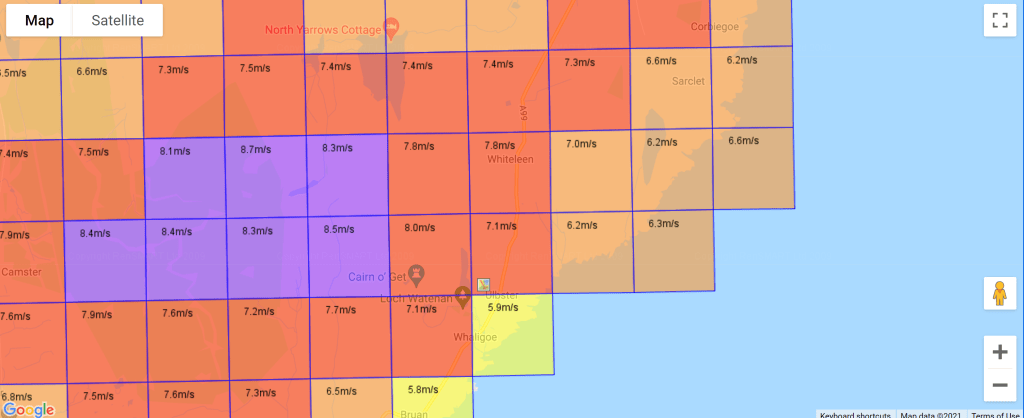
Located at the northern parts of the North Sea, near Wick, wind speed is excellent, as you can see from the map.
Wind Speed m/s @ 10m Height
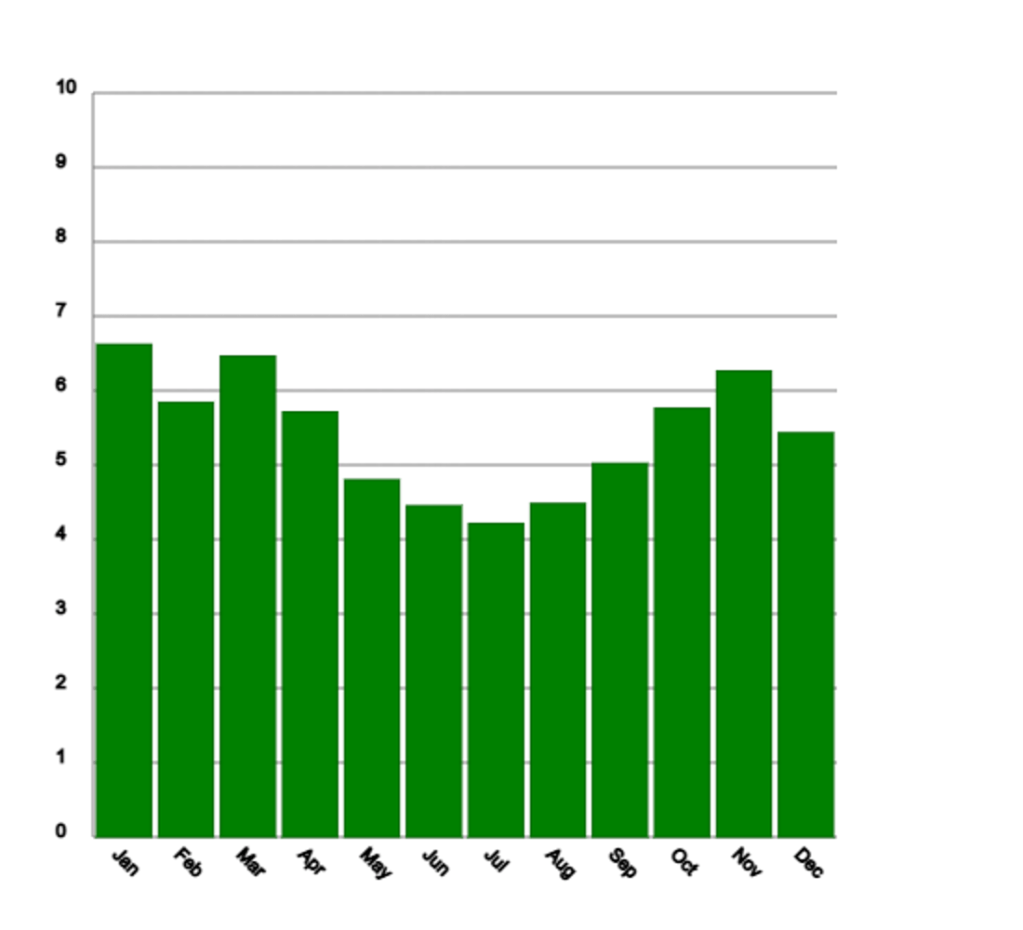
Distribution over the year shows, most of the wind is to be expected during autumn, winter and spring.
Wind Speed m/s per Year
Furthermore, the actual distribution of wind speed reveals, that 60% of all wind speed is in a usage spectrum for wind turbines:
Distribution of Average Wind Speed m/s
The problem however, in the summer months, there is probably not enough wind to sustain the amount of needed energy production. And the star of our solar system comes into play: solar power.
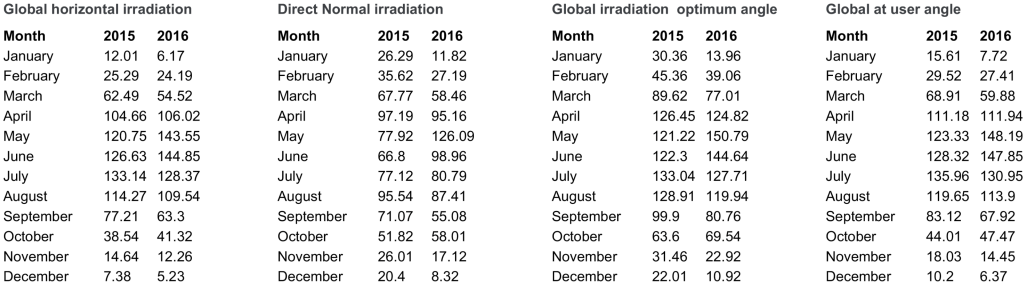
In numbers for the last years 2015 and 2016 that gives some really impressive values:
Local and Global Irradiation monthly kWh/m2
And as we can see from the curve, the sun just starts to shine more when the wind is more asleep.
According to UKPower a medium household in 2019 used 12’000kWh for Gas and 2’900kWh for Electricity, totalling in about 14’900 kWh per year.
This amounts to the following power consumption for a Medium Household:
kWh/year 1’4900
kWh/month 1’241.67
kWh/day 40.83
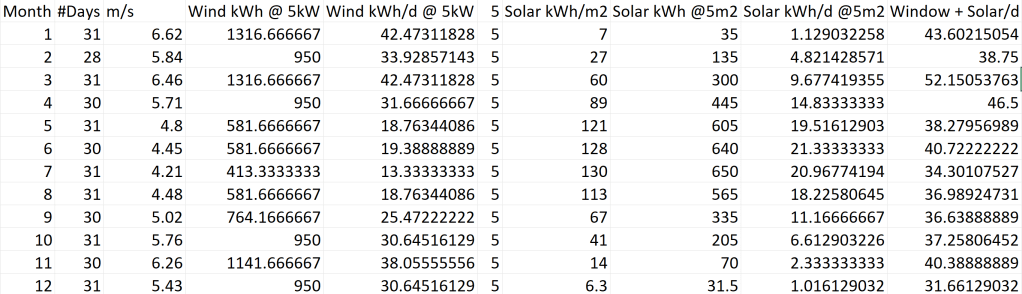
With some calcuIations from the wind and solar database, I figured out, that with a 5kW turbine and 5m2 of solar panels I could roughly produce this amount of energy over the year:
Power Generation from Wind + Solar with 5kW Turbine and 5m2 Solar
So as we can see, this is just not enough to produce enough energy on your own. But it looks very promising. With more Solar, a larger turbine (or more turbines) or just a backup generator this could easily be addressed.
Regarding backup generator. Of course, energy sources like wind and solar are not stable, so we would have to have some battery storage capacity anyway.
A storage capacity for a single day in 3.2kWh blocks would cost roughly 22’500,00 CHF (list price for a Pylontech US3000). Adding the turbine with 40’000,00 CHF, solar panels 5’000,00 CHF and inverters 20’000,00 CHF you easily end up with a total price of 80’000,00 CHF – 100’000,00 CHF.
Electricity costs of roughly 3’500,00 CHF – 4’000,00 CHF per year will take a 25 years to pay off – if at all. And if the energy prices rise (as heard, by 50%), it would still need a 15+ years to reach a break even.
So what does this mean? There is no perpetuum mobile? And better use the grid and pay as you consume?
Probably not. Betting on higher energy prices, rising inflation, smarter and more efficient technology in the future and outages ocurring more often and often, this could really payoff much earlier than one would think.
Plus, it can be taken as an example, that it might actually be possible to produce your own energy without being dependent on anything else than wind and sun.










 Our Journey to Scotland