

With the next Toyota Hiace and the Saurer 2DM around the corner waiting to be converted, I thought it was time for consolidating our vehicular electrical installations.
But before going into details, some history first: In 2019, we started on the VW Calkifornia T6 with a Super B Epsilon 12V90Ah LiFePO4 battery as a simple drop-in replacement and added a Votronic SMI 1200 ST inverter to it. And this was probably where I made my first two mistakes. At that time, I decided for Votronic and against Victron Energy. And I did not pay attention to the non-existing programmability and extensibility features of the Votronic inverter.
And when we later, during the COVID summer of 2020, got our Hymer B-MC I WhiteLine and I installed a Liontron 12V200Ah battery with another Votronic SMI 1700 ST-NVS. And to make things a little more complicated, I added a DC-DC charger: also from Votronic – an emerging pattern.
Once with a vendor stick with that vendor? There a pros and cons to it as we will later see.
When we later prepared our Hilux for our first longer trip to Loch Watenan, I opted for a Liontron 12V200Ah battery again (for the reason Liontron being way cheaper than Super B). And for the inverter/charger, I went for Votronic again (SMI 1200 and the same DC-DC charger 1212-45) .
But when I tried to get the DC-DC charger working, I realised that the D+ signal was not available on the Hilux. All in all, I did not get it to work in any configuration and looked for alternatives – which came in the form of the Victron Orion-Tr Smart DC-DC Charger family. And when I had to add an AC charger (where in the Hymer I could use the existing AC charger) to load the Liontron battery “on-shore”, I chose the Victron Blue Smart IP22 Charger.
So, at that time there was some kind of tie between Victron and Votronic. And the setup was getting more complicated and more complicated. And I am not only talking about the diminishing space in the trunk of the Hilux.
If I had known about the Victron MultiPlus series at that time I could have saved me a lot of headaches and complications.
It was shortly after our first and very successful trip to Loch Watenan, when we got rid of the Hymer and I added the battery from it as a second battery to the Hilux. And I got 2 more Victron DC-DC chargers. But I sticked to my Votronic inverter. And this is how the final layout looked like:

This all worked well end of 2021 when one of the Liontron batteries did not want to charge properly anymore. The combined cell voltage stayed low at 13.1V with no single cell near at 3.5V and the internal BMS still reported 100% SOC.
So it was time for a change. And while doing that eliminting some design shortcomings of the current installation:
- Invertert has a power maximum of 1200W.
- AC charging is limited 30A.
- Both 200Ah batteries are operating separated with one of them feeding the inverter and the other feeding the 12V DC sources.
- Each pair of DC-DC chargers is bound to a single battery.
- The alternator cannot feed all 4 DC-DC but only 3 chargers at the same time.
- The inverter cannot be controlled wirelessly.
- The whole system is not integrated.
- Fuse boxes are unlabelled fuses from AliExperss.
- No bus bars in the system.
So, here is the “new” setup:
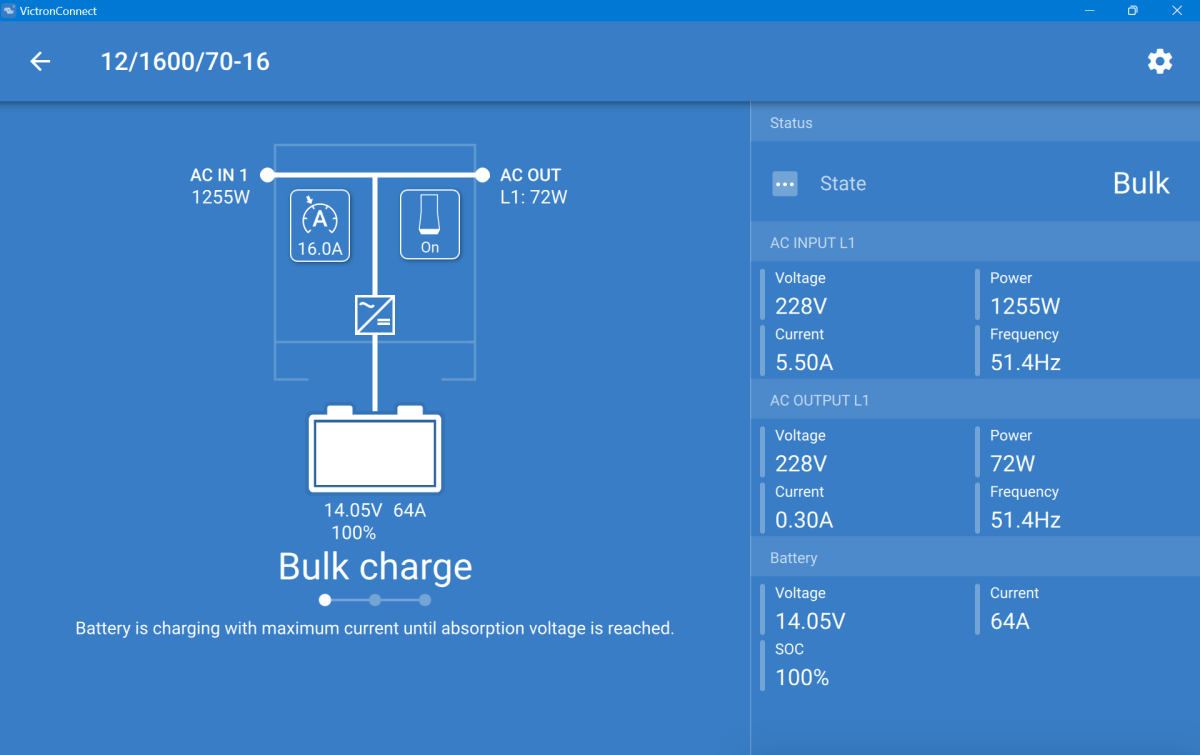
- Replace the Votronic SMI 1200 ST inverter with a Victron MultiPlus 12/1600/70-16 Compact (which happens to have a similar form factor as the Votronic).
- increase AC charging power to 70A
- increase nverter power to 1300W
- Add a Victron 500A SmartShunt to compensate for the lack of BMS integration.
- Remove the 30A AC charger (to gain space for the bus bar, see next).
- Add a Victron 1000A Lynx Distributor bus bar.
- Optionally, add a VE.Bus Smart Dongle or a Cerbo GX / Raspberry with VenusOS.
- Have both batteries run in parallel to feed the inverter and the DC sources at the same time and thus reducing the maximum current at 1300W to 65A (when both batteries are dropping down to the minimu of 4* 2.5V = 10V) or considerably lower when running at 14V (45A) .
But the “best” of it, I then got rid of all the Votronic devices and can integrate and configure more easily with Victron. And I can do the same in the Saurer and HiAce.
I hope I can start with the conversion mid of March and will post updates on the way.
So, what do you think? (And no, I have no affiliation with Victron at all.)

 Our Journey to Scotland