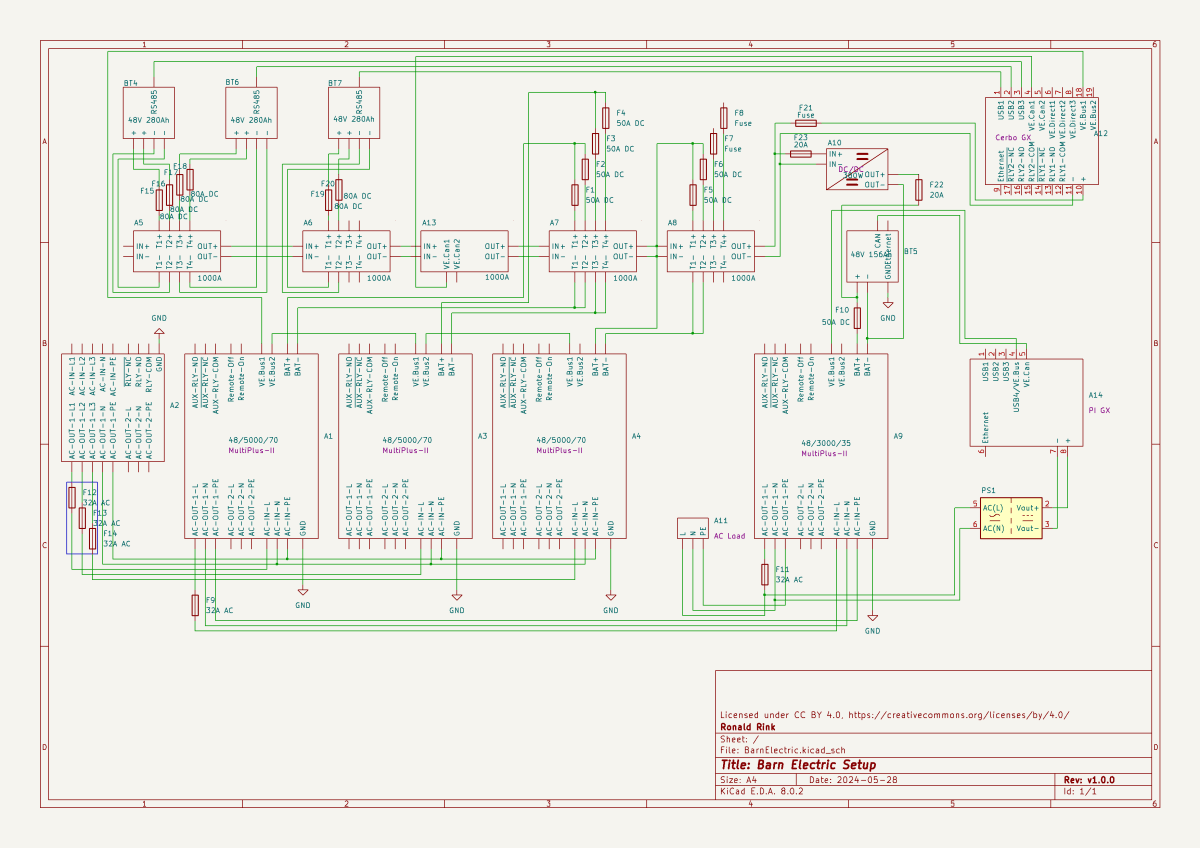
Current state of our electric installation

I recently wrote about our upcoming solar PV adventure. But before updating our system, I thought it was time to document and explain our current setup (with the help of KiCad).

This system is the main electricity for our barn and currently consists of three batteries with an energy (often referred to as “capacity”) of 3* 14.33kWh = 43kWh (battery bank A, A1:A2 on the plan). These batteries are charged by a JCB G20QS (B1) via three MultiPlus-II 48/5000/70 inverters/chargers (B1:C2) which are by default in “Charge Only” mode. The MultiPlus-II are configured in a 3-phase configuration but only turned on when 3-phase is actually needed.

The main power is delivered by a MultiPlus-II 48/3000/35 (B4:C5) that is connected to a separate battery bank (battery bank B, BYD LVS Premium Battery-Box with an energy of 8kWh). This latter MultiPlus-II is connected to L1 of the 3-phase MultiPlus-II. So, whenever the main batteries get charged the cascaded inverter will also be charged. In addition, we can then use PowerAssist to up to supply 8'000VA (= 5'000VA + 3'000VA) when running on batteries and up to 14'500VA (= 6'500VA + 5'000VA + 3000VA) on a single phase.

Though the generator can supply up 14'400W the chargers of the Multiplus-II can only charge with a power of up to 3* 48V* 70A = 10'080W. This is actually an advantage as the optimal efficiency factor of the generator is roughly at 12'000W. So with 210A we are pretty close. If we ever added more chargers to the system we could even slightly increase the charge current to 250A.

System A with the 3-phase inverter configuration is connected to a Lynx bus bar (A1:B4) that also includes a Lynx shunt (B3) used for measuring over all batteries. In addition, there is an islolated Orion-Tr DC-DC charger (A5) that constantly feeds system B.

System A and B are connected to their separate GX:

  • system A
    Cerbo GX, A5:A6
    MultiPlus-II via VE.Bus, Lynx Shunt via VE.Can, JK-BMS via RS485/USB
  • system B
    Raspberry Pi4 running VenusOS, B5:B6
    MultiPlus-II via VE.Bus, BYD BMS via VE.Can (on a Pi GPIO Hat)

And this is it for the electricity installation in our barn.

Note: This cascaded setup is officially not supported by Victron, but it has been working for us without problems for months now. This might be different in your case.
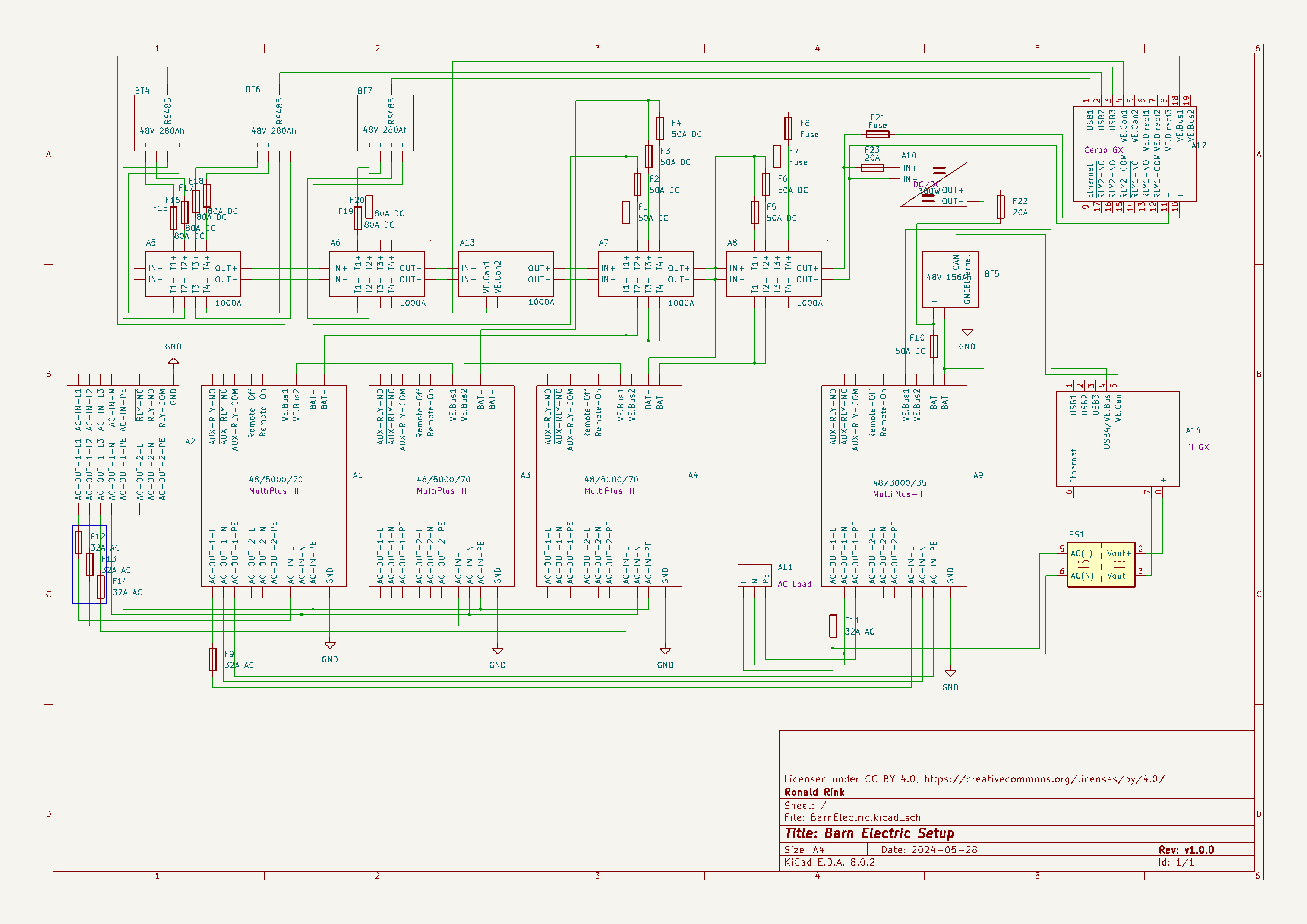
Configuration of electric components

Addendum

./.

Corrigendum

./.

Charging Leisure Batteries at Electric Vehicle Charging Stations

I am not the first and probably not the last, either. With leisure batteries becoming larger and larger, fuel becoming more and more expensive and the EV charging network better and better, I thought it was time to rethink charging leisure batteries in campervans, mobile homes and the like.

For example, in UK the Tesco run EV charging stations currently offer charging at 3700W/16A at 0.288 GBP/kW. This is actually cheaper than the rates I had last year when I rented a flat. And it is still slightly cheaper than the cost of power generation with my JCB generator.

As I restrict the charging of my EVE 280Ah cells to 125A, the maximum power to charge with is either 8* 3.2V * 125A = 3200W for a 8s 24V battery or 16* 3.2V * 125A = 6400W for a 16s 48V battery. But as of now, I only plan for 24V batteries in our vehicles. This means, that even with the lowest single phase Type 2 charger in a EV charging station we get more power (16A * 230V = 3680W) than the battery can be charged with.

With the help from Remo Fleischli of Mobilize I found two adapter cables from Elektroscout:

  1. A single phase Type 2 plug to a Swiss T23 socket, which I ordered with a “loose end” to connect a Neutrik powerCON TRUE1 TOP NAC3FX-W-TOP-L with it;
  2. and a single phase Type 2 socket to a Swiss T23 socket, which they call a “bike adapter” – this comes in handy at charging stations with a 3-phase Type 2 cable.

As a 24/3000 MultiPlus-II (or EasySolar-II) does only support charging of up to 70A (resulting in a nominal charging power of 24V * 70A = 1680W), we would still be 55A “short” of the desired maximum charge current of 125A. With the EasySolar-II GX or the MultiPlus-II GX there is no 24/5000 version and the MultiPlus-II 24/5000 uses considerably more power (18W vs 13W) and is way heavier (30kg vs 26kg [including MPPT charger] vs 20kg). In addition the inverter would be massively oversized as the maximum expected inverter power would be limited to 8* 3.65V * 125A = 3200W (^=4000VA), anyway.

So, I came to the conclusion the least expensive and space/cost-efficient solution would come in the form of a Victron Skylla-TG 24/50A Charger:

  1. Weight: 5.5kg
  2. Price around 500,00 GBP
  3. Dimensions: H 365mm * W 250mm * D 147mm

So, with the combined power of the EasySolar-II and the Skylla-TG (70A + 50A = 120A), I can now theoretically charge at 8 * 3.2V * 120A = 3072W – near the maximum supported power. As the charge current will probably reduce at around 80% SOC, my 24V battery can be charged from 40% to 80% within one hour – at a price of less than 30p per Kilowatt (or 90p the hour)!

Here a comparison with some smaller generators:

  1. a Honda EU10i will deliver 900W with 0.538l
    (around 1671W/l or 0.598l per 1000W)
  2. a Honda EU22i will deliver 1800W with 1.075l
    (around 1675W/l or 0.597l per 1000W)
  3. a Honda EU32i will deliver 2600W with 1.394l
    (around 1865W/l or 0.536l per 1000W)

If one liter of E7 costs roughly 1.50 GBP, the price per 1000W is between 0.80 GBP and 0.90 GBP.

Comparison of different charging options

And with a standard vehicle alternator of 100A the maximum charge current for a battery would not exceed 60A. So, a realistic amount of power to charge the battery with a running engine is around 12V * 60A = 720W. If we expect the vehicle to use 2l per hour running idle, the price for 1000W would sum up to over 4.17 GBP – not cheap.

Only the Honda EU32i comes near to the maximum charging power of 3200W/h. But the initial cost for the inverter and the price per 1000W is far beyond the cost of an additional AC charger, a Type 2 adapter and the energy cost at the EV charging station. And ideally, the energy from the EV charging station is “greener” than the energy from the vehicle or stand-alone generator.

Note: I did not write about solar panels at all. The reason for this is our special “use case” where we are mainly in northern europe where during autumn and winter there are very little hours of sunlight – at a time when we need energy the most. Plus, only two of our vehicles have actually space on the roof for solar panels.

This is my current take on charging larger leisure batteries. What is your opinion on this?

30 Days into using the Victron MultiPlus 12/1600/70-16 inverter and a Liontron 12V 80Ah with our Swift Sprite Caravan

The Caravan we got last year did not come with an inverter, so getting coffee in the morning or running a microwave was only possible when our main generator was running. And the installed battery for 12V support had a rather small capacity. This was clear to us from the beginning, as we eventually wanted to connect the Caravan to our EVE 280Ah cells.

But since we got our Starlink internet and our router did not seem to run easily on DC power, we needed -in addition to the temporary morning AC coffee spike – a more permanent AC solution.

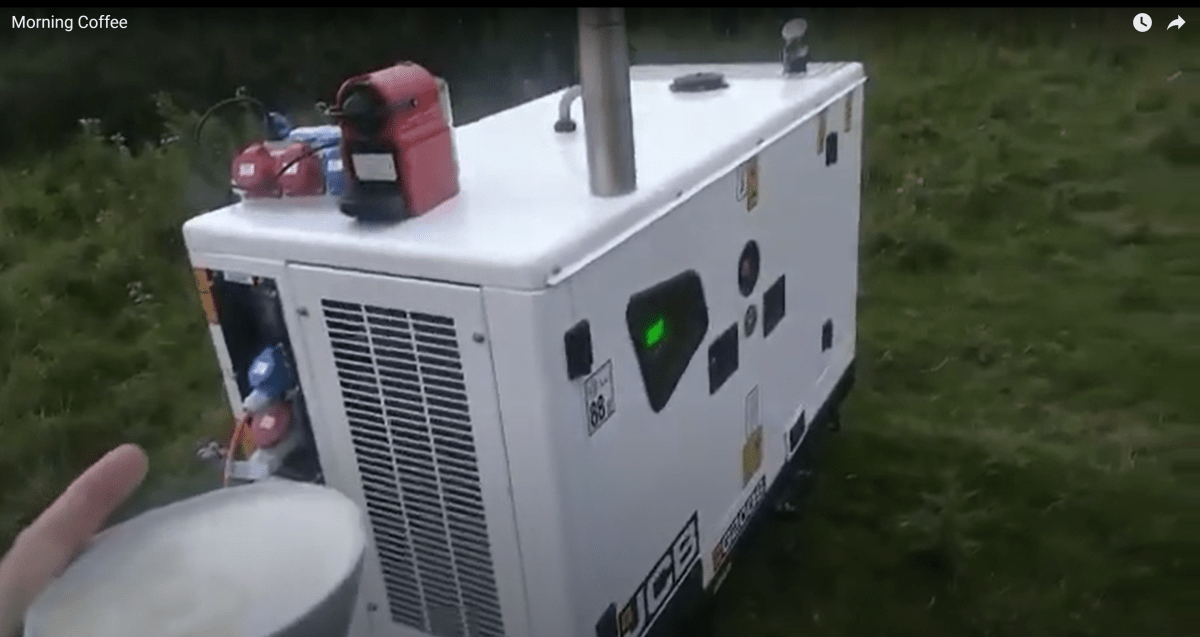
So, I grabbed an existing Liontron 12V 80Ah battery that was sitting on the shelf along with a Victron Energy MultiPlus 12/1600/70-16 charger/inverter and connected the inverter AC Output to the CEE16-1 AC input of the caravan and the inverter AC Input to one of the phases of my JCB G20QS generator (of course, all via Neutrik powerCON TRUE1 TOP connectors and H07RN-F3G2.5 cable).

For the connection between the inverter and the battery I used a 35mm2 cable and Klauke DIN 46235 compression cable lugs on one end and insulated ferrules on the other end. In between, I added Anderson SB 175 connectors with 1383 lugs for quick disconnects and crimped as shown here. For the fuse I used a Schneider Electric 125A DC MCB, as I do not expect higher loads in this setup.

Of course, first I updated the firmware of the inverter and configured it work with the battery:

  1. Setting the AC input to 16A
  2. Setting the battery type to LiFePO4
  3. Setting the charge current to 70A (which is over the recommend amount of 50A, but see below for details)

As I did not want to connect a Cerbo GX to the system, I just used the VictronConnect App. Maybe I add a VE.Bus Smart dongle later on, or I connect some GX nevertheless. Who knows … Until now, it needs a wired connection to the inverter to see its status.

After powering on the generator, I confirmed everything was roughly working as expected. During the first run, the SOC was shown as 100% though the BMS of the battery internal saw it differently. In addition, the reported Amps and temperature were seen differently, as well. So, even that I set the inverter over the recommended maximum of 50A for the battery, the actual charge power was never much higher than the actual maximum).

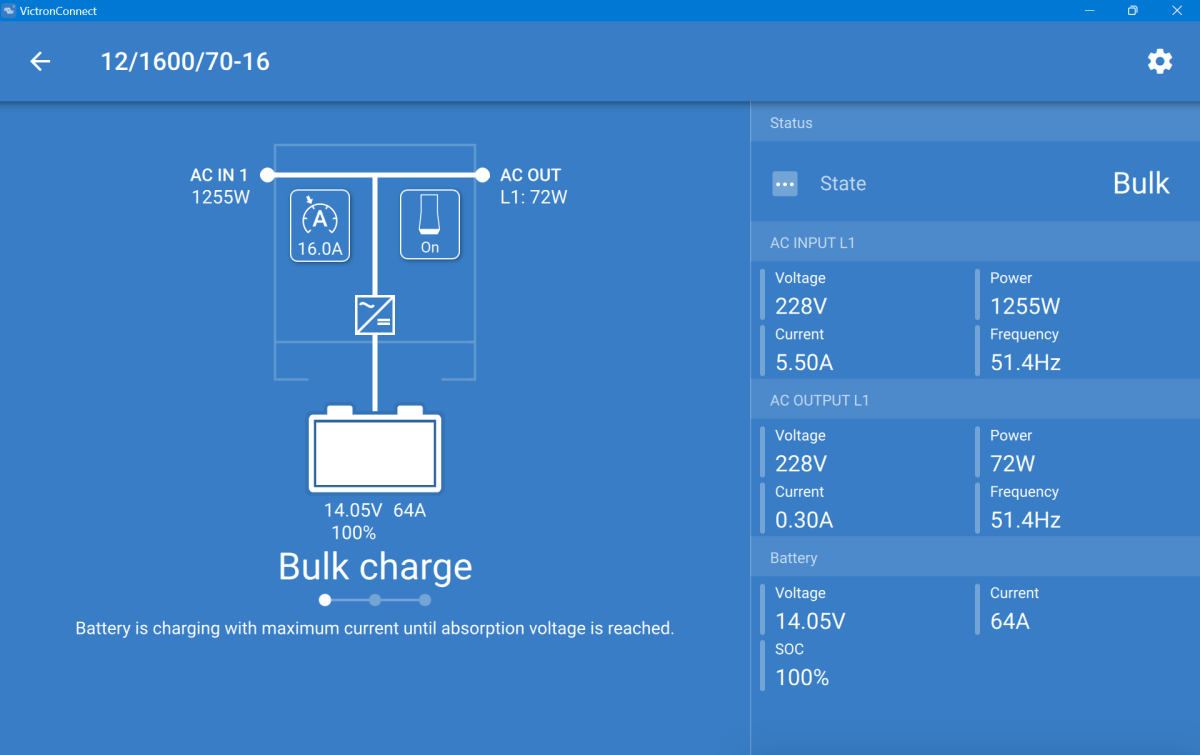
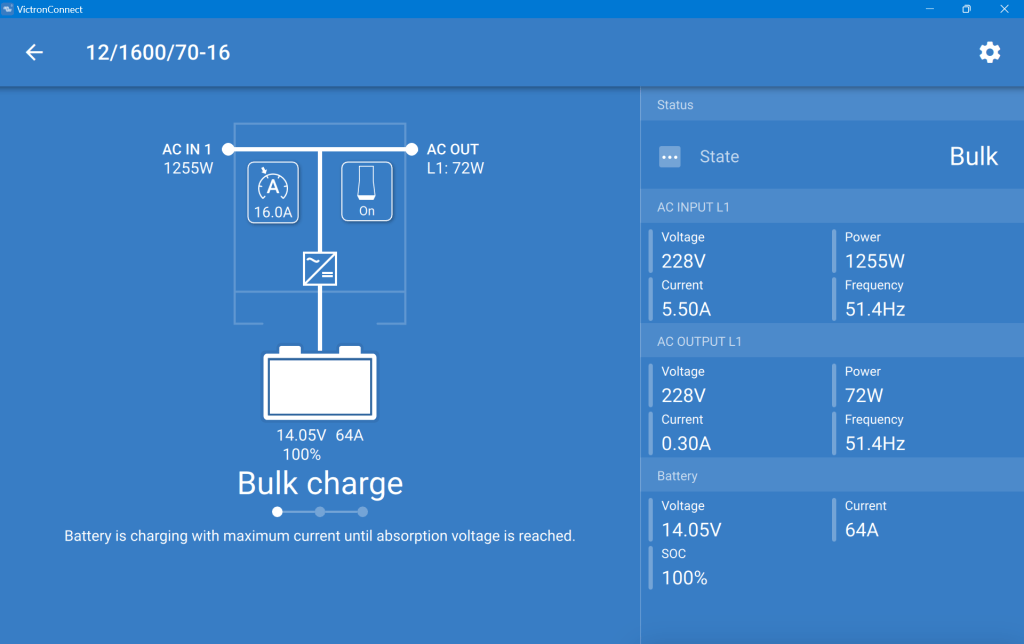
This is what the inverter saw (100% SOC, 14.05V DC cell voltage, charging at 64A):

MultiPlus charging the Liontron battery via the generator

And this is, what the Liontron BMS reported (76% SOC, 13.8V DC cell voltage, charging at 55.5A):

The SOC as seen by the Liontron battery BMS

In the end, the BMS stopped charging when it thought its batteries were full. And the inverter did not complain. However, I noticed that the cells were really not in balance (with a delta of 200mV between the lowest and highest voltage).

Discharging was ok, as well. However, I soon realised that the 100A discharge current could not be achived in my setup. The inverter tried to draw power and the BMS cut off with a “Discharge over-current” (OCD). SO, still no coffee via our Nespresso machine (and no microwave either, for that matter).

So, what is the take away of all this?

  1. It works and now, I can run the Internet all day.
  2. All in all, it is a relatively simple and quick setup.
  3. The Liontron battery does somehow not live up to its specs (and yes, I know the battery could be a size bigger for what I want to achieve; but I did not want to buy an additional battery for this temporary solution).
  4. It is way cheaper and more flexible than to buy this “off the shelf”.
  5. Maybe, I add a Victron SmartShunt to get a more accurate SOC reporting (as I do not see any other way to integrate the BMS with the inverter).
  6. Charging of the battery is quite fast when running the generator.

Updates on the plot

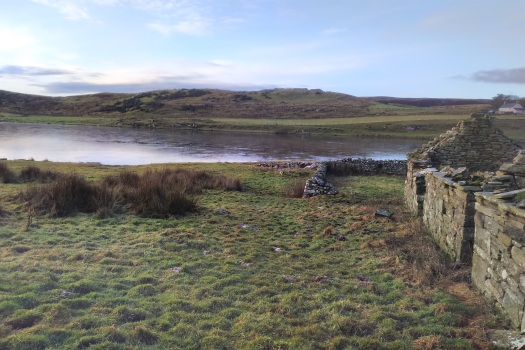
It has been a while since I last wrote about what has been going on the plot. And actually, something has happened.

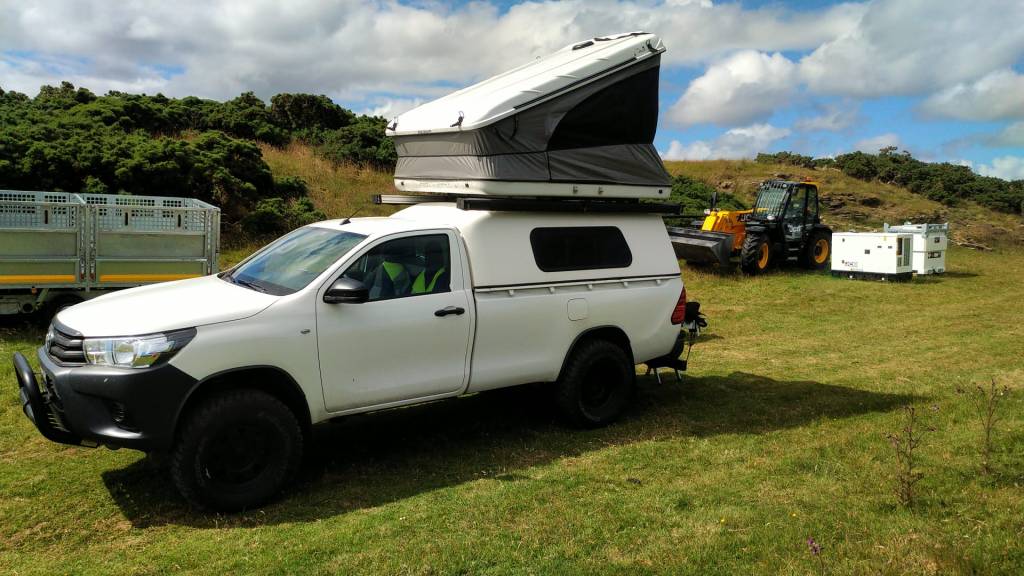
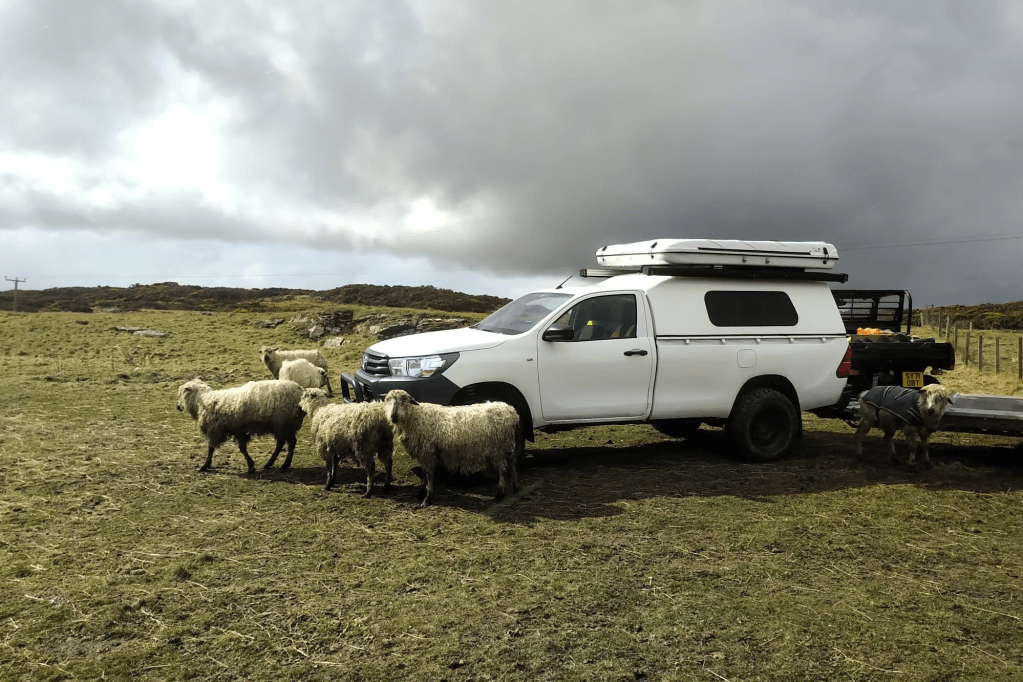
Still with Toyota, trailer and telehandler

Let me briefly explain where we currently stand and maybe I find time to to dive in to details in additional posts.

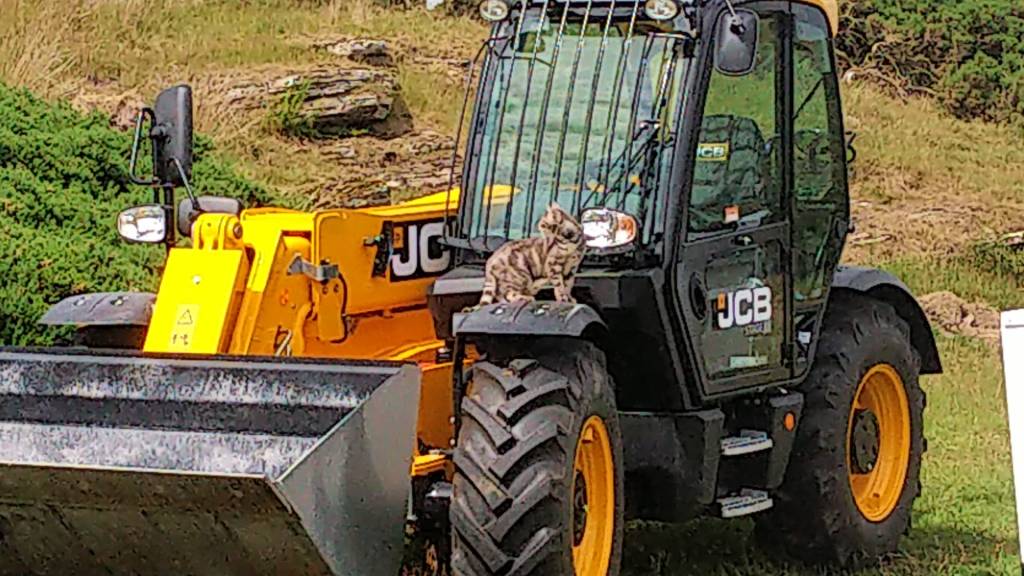
Even the cat likes the telehandler

So what happened?

  1. We got our Telehandler, the JCB 531-70; so we are now able to do some heavy lifting and more …
    Quick note: And yet with this delivery not everything went smoothly, as the brand new machine was not working completely as expected. But we now have a new local technician from Latheronwheel who is very kind and helpful.
  2. The digger finally got fixed. We now even have a quick-hitch, which seem to be not so “quick” (but that is a different story). We were even able to fix a loose track on the excavator. It is easy once you know …
  3. We also now have a 3.5t 13ft tipping-trailer with which we are able to bring more stuff to the plot (such as concrete, gravel – more on this later).
  4. We fixed more parts of our track to the plot (by adding stones to the ground and putting gravel on top of it). This is only a temporary fix, as the ground is still way to weak to hold the weight of the 7t Telehandler or a fully loaded trailer.
  5. We even now a diesel tank from which we can fuel our vehicles and machinery. And refilling it on the main road is as easy as lifting it with the forks of the Telehandler.
  6. Electricity is now much easier as we can run on a generator as long as we have not finished the turibine/battery set up. As the generator runs on diesel we can refill it from the same diesel tank as everything else.
  7. We discovered a quarry on our plot (which has not been used for probably more than 100 years. I have 2 raw short video sequences (no voice, just walking aroung) that are linked below to get a first impression. As you can see, we had to cut through a lot of gorse to actually get there. The only reason I found out that there is a quarry was, that I saw it on some older maps from the scottish national library archive. There is still some work to get done to easily access the quarry or to get some stones from it. But the good news is, that we now would not have to transport that much amount of stones from a different quarry further away.
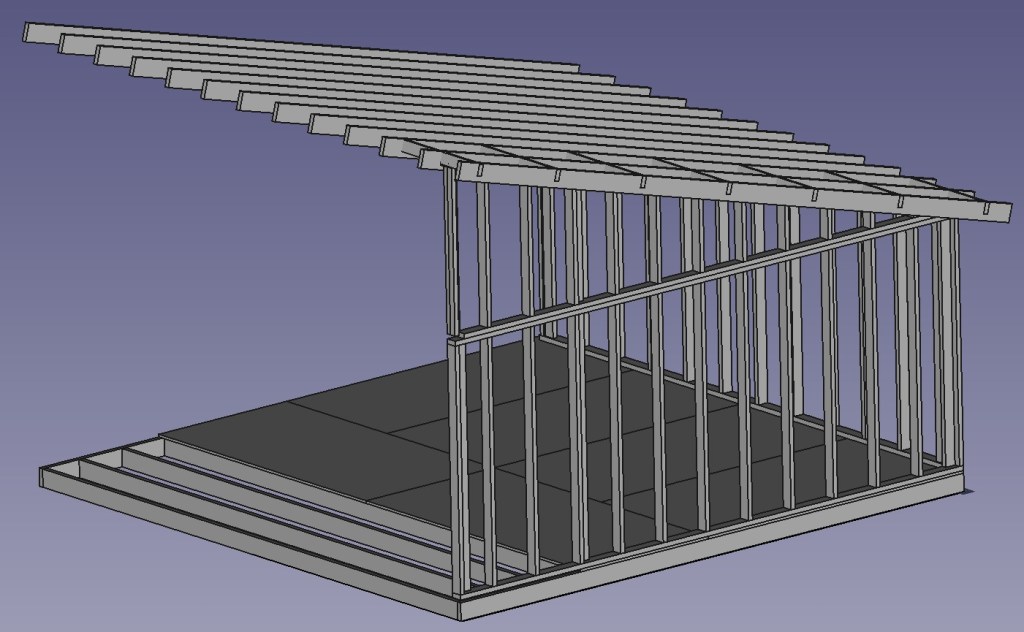
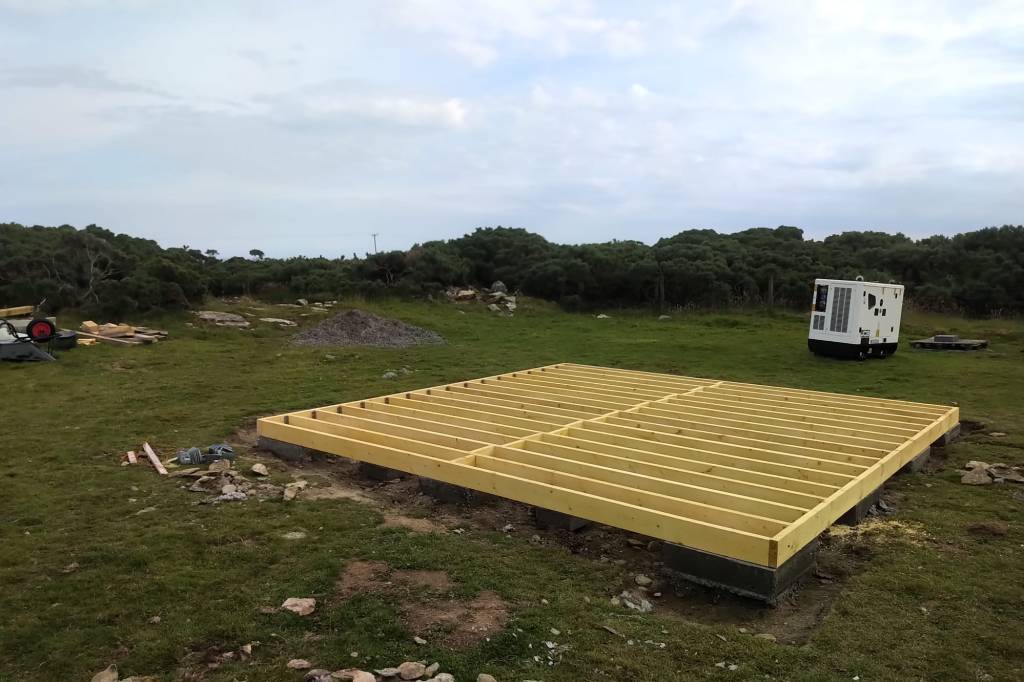
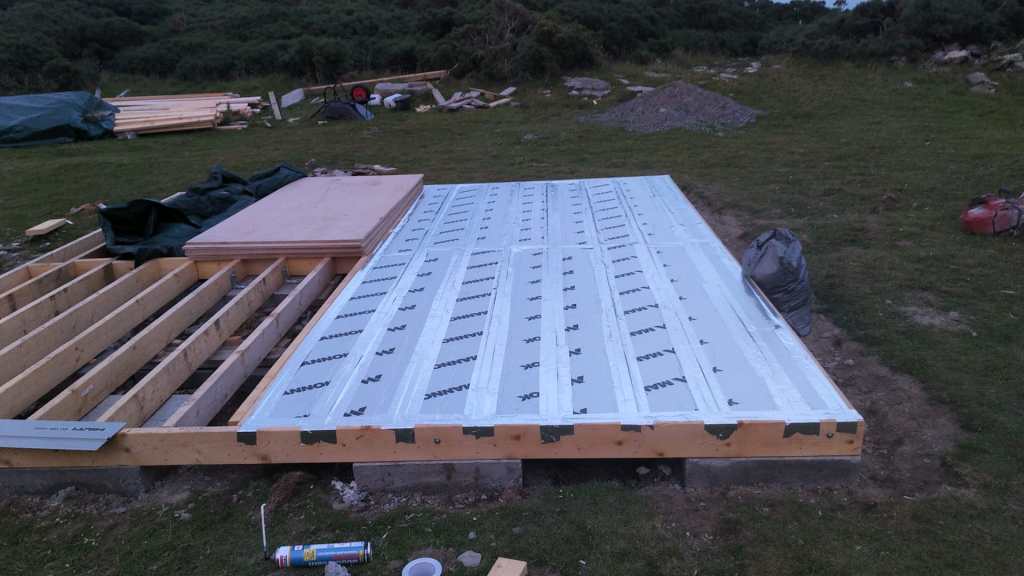
  8. We actually started with our shed; i.e. we did the foundation by pouring concrete for 12 pads and nearly finished the floor insulation. That actually means that the wood *finally* arrived (more than 3 months). Next time I buy the wood somewhere else and not at the Sutherland woodyard in Wick (and yes, I would link a website if they had one).
  9. Planning permission for entrance from the A99 and the barn is still under consideration (*everything* in the Highlands justs takes looonger).
  10. I got myself a pocket calculator Construction Master Pro Trig from “Calculated Industries” to at as a babel fish between the “imperial” surrounding and my “metric” mind. Now I know that 2″ 7/8 are roughly 73mm – so good!
  11. We cut away even more gorse (and still have to wait until autumn to be able to burn it).
  12. I finally admitted to myself that I will have to do a monthly trip to Inverness to be able to buy the stuff I need (the cowboys riding to the city). And here the trailer really comes in handy!
    Side note: and it was actually in Inverness where I got the scaffolding poles for the turbine. No way for me to get them in Wick.
  13. We did some sheep shearing support – first step in becoming real crofters …
Sheep shearing
Shearing sheep

So why am I writing all this? Is everything solved? Far from that.

I am probably more of writing this to remind me that though it seems that nothing really proceeds as planned and barely no progress is visible, some things are still getting done. So there is actually progress (however small it is).

Shedland

Shed plan
Floor frame
Insulation

Quarry videos

Way from quarry to rabbit run 1/2
Way from quarry to rabbit run 2/2

We ordered a new vehicle

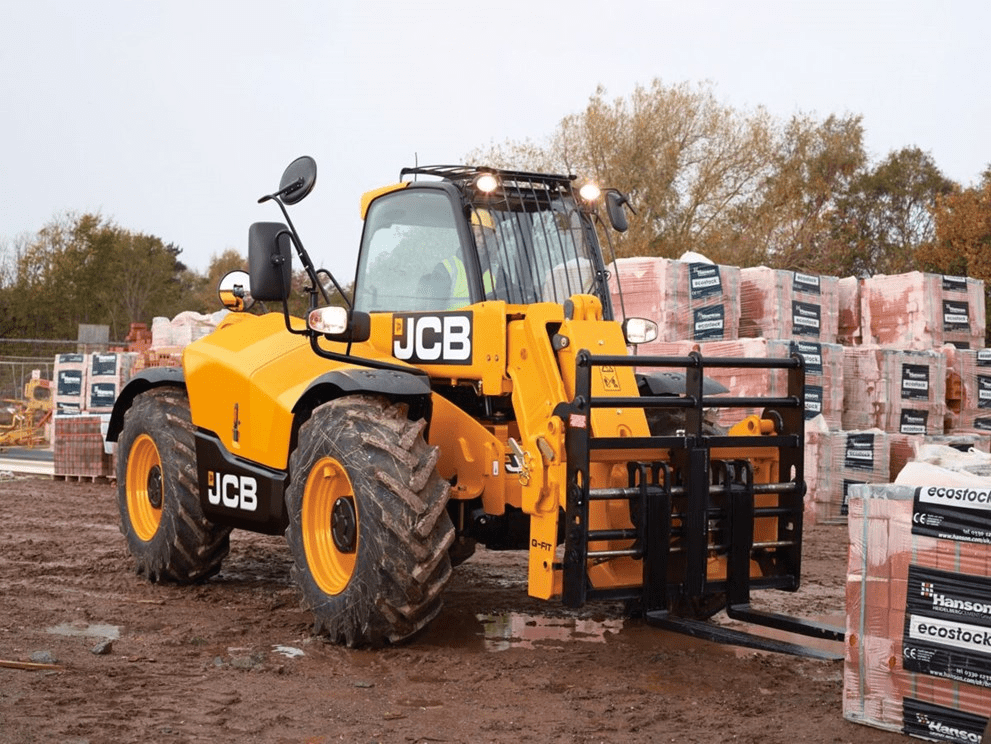
Yesterday was the day, when we finally ordered our all-purpose all-terrain vehicle. It is not exactly the “Car vNext” I wrote about some months ago, but hopefully will serve our needs well. It is a – drum rollJCB 531-70 TeleHandler.

JCB 531-70, image used from jcb.com.
JCB 531-70

Why did we choose this and why that specific model?

Our plot is currently only accessible via an off-road vehicle and the non-existing road is sometimes in such a bad condition that I really have trouble to get there even with my Hilux (this certainly can also be attributed to my driving skills). While our Kawasaki Mule is fine to get back and forth, it lacks the ability to carry larger loads.

In addition, we wanted to lift things to a level of above 5m (as the barn will be that high). And I wanted to be able to move stuff around without needing to buy a Dumper.

Other factors we considered: larger manufacturer sold by a larger distributor “near by” with a technicican that can react in days not weeks.

So this is why I sticked to the JCB guys in Muir of Ord (despite my mixed feelings at the start).

Because of the lifting hight a normal tractor or wheel loader would not really be a good fit, I ended up with looking at tele handlers.

It is the non-agri version with the small engine, as I do not intend to tow larger loads. And the best of all, it is probably the only machine in that size, that is available this year.

I opted for the 5 year / 2000h warranty extension, as I will probably using it for not more than 400h/y. This means, I can keep it for 4 year and still sell it with one-year of warranty, if I feel like it.

In addition to the standard fork, I also ordered a 1m3 bucket, so I do not need to get a Dumper (we will see how this turns out). Plus I swapped the construction tyres to proper agri tyres.

A note regarding pricing: looking at used machines showed me, that even after a couple of years and thousands of hours, they still sell for roughly the half of a new one. And with the current inflation rates rising, I came to the conclusion that a new model will be actually cheaper. As weird as it may sound …

And now for some techie bits:

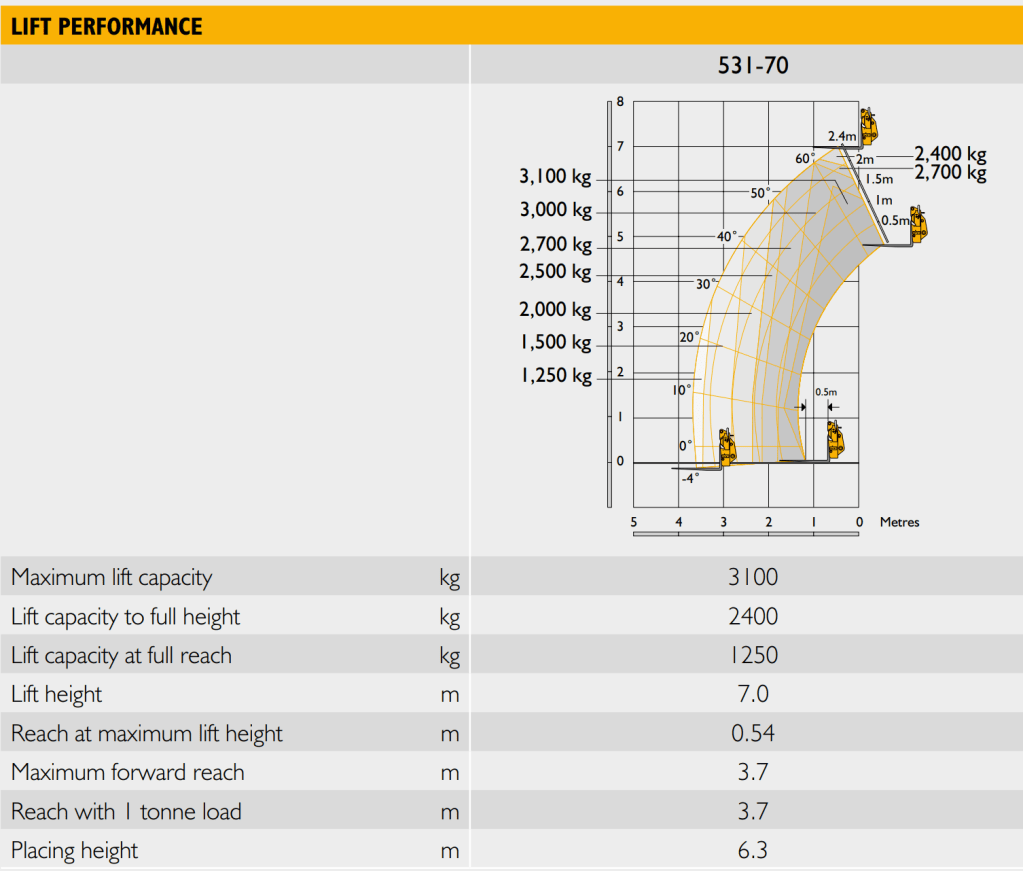
JCB 531-70 Lift Performance

Looking at the chart, lifting stones and a generator should not be a problem at all.

Delivery is scheduled for end of June. So until I keep happily waiting …

What can happen when you buy a used digger

Things that can happen when you buy used machinery.

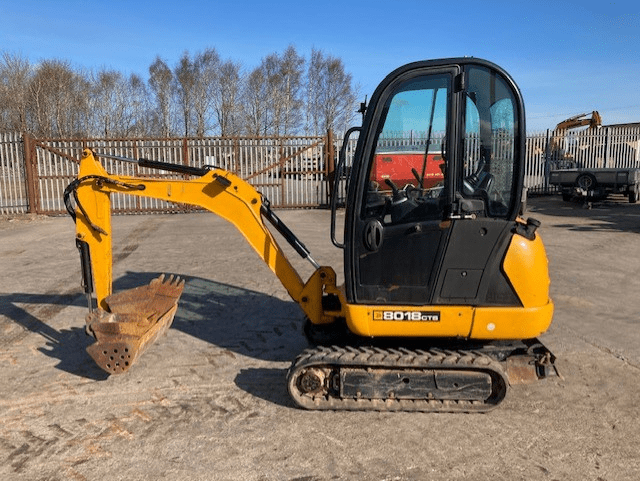
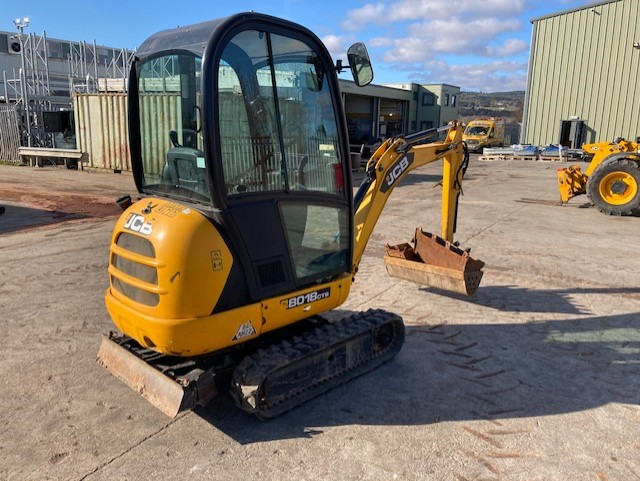
Last time I shared the news that we got ourselves a digger. Now after roughly two weeks, I wanted to share a quick update on the good, the bad and the ugly.

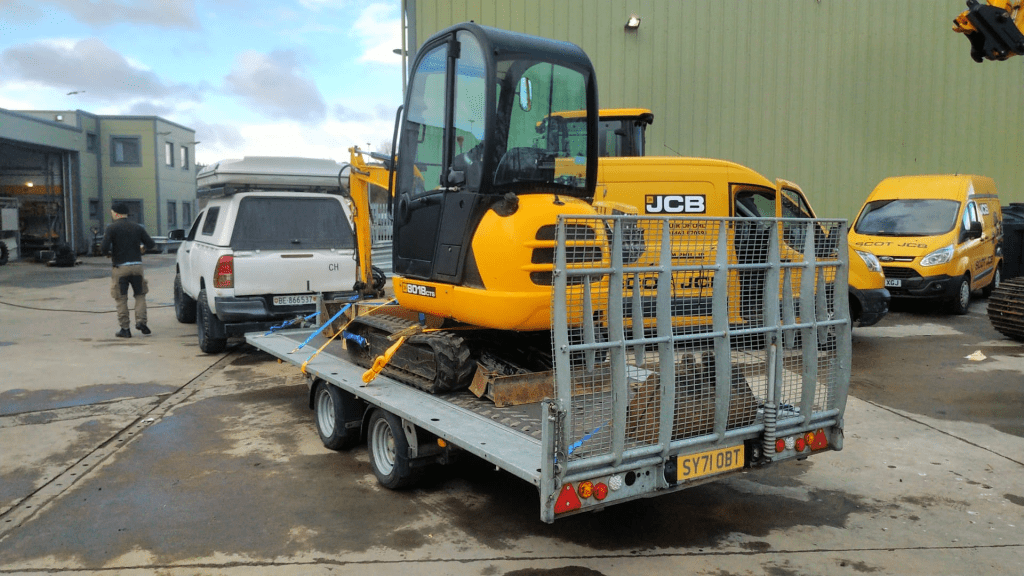
So, on the 8th of April we went to the JCB Scot depot in Muir of Ord to pick up our digger. But before we could actually do that, we had to visit the cool guys at Farm & Forestry Equipment in Ardersier to borrow a trailer. When we finally arrived in Muir of Ord, the digger was actually there and the people on site actually sort of knew we were about to collect it. So far so good.

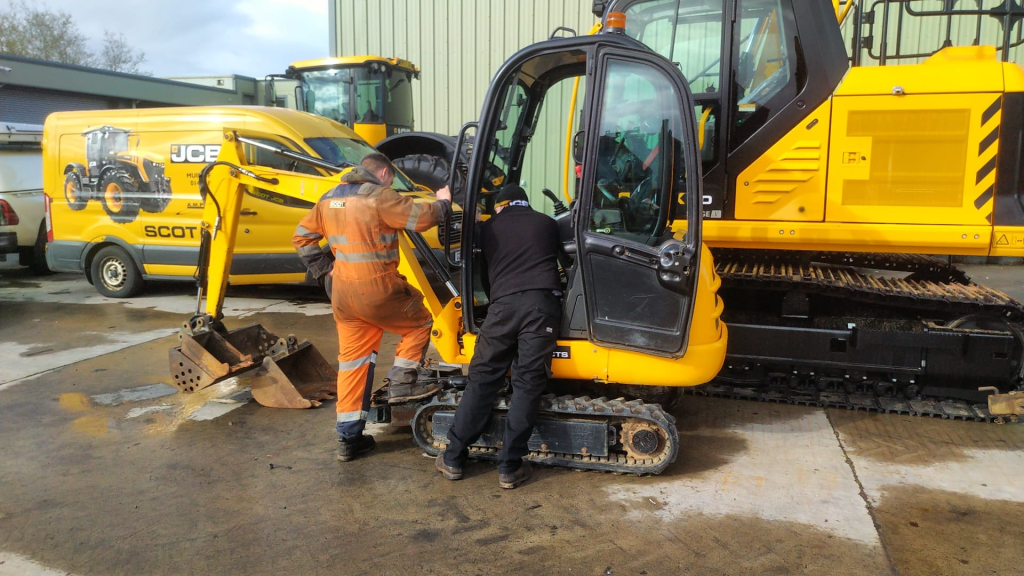
What was not so good, was the “fully serviced” digger appeared as being not so fully serviced. How could I tell with my zero minutes of excavator experience? For example, the hydraulic switches of the boom were not working. Obviously something that can get unnoticed during servicing. But no worries – the mighty on site engineer just hissed “boys” and called in one of his subordinate mechanics.

Engineer and his mechanic

With a universal screw wrench the problem was immediately fixed and quite as immediately broke again. After some retries I was assured if this *ever* broke again, someone would come up to out place to get this sorted. Great! (sneak preview into the future: as soon as we unloaded the digger the problem resurfaced and has not been properly repaired until now)

Excavator loaded

After some loading we were good to go and crawled back to Caithness. But not without paying a quick visit to Clynelish in Brora.

Clynelish in Brora and an Excavator

We enjoyed the view in the lovely bar/café on the first floor and continued our journey all the way to our plot, where we were warmly welcomed.

Welcome to the plot

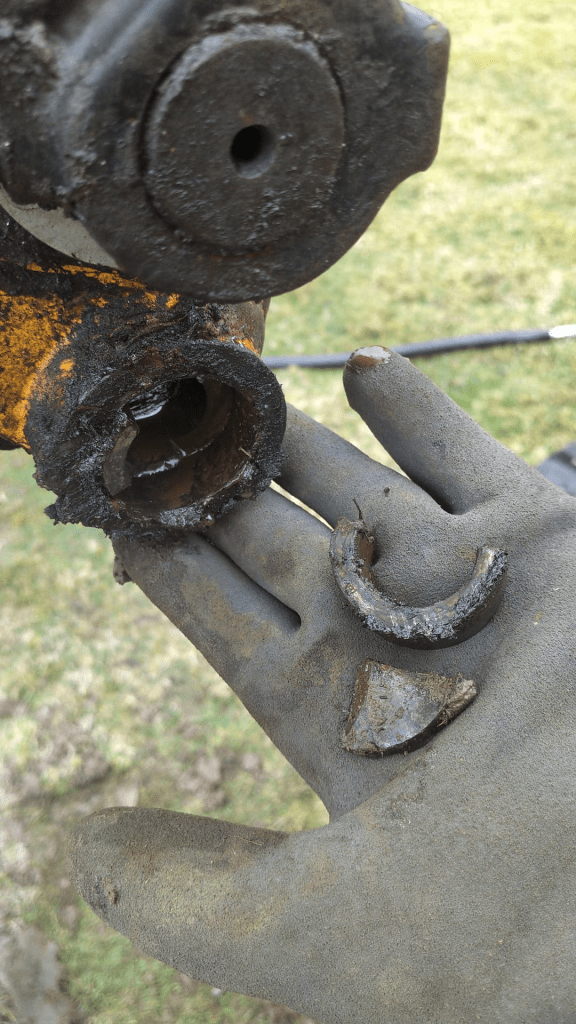
So what was next? After unpacking we not only found out that the boom hydraulic switch was again not working (only moving to the left), but also found the bushings being broken when we took off a bucket. To the defense of the “fully serviced supervisor” this can also easily get unnoticed when you are not changing the buckets before handover.

One time bushing?

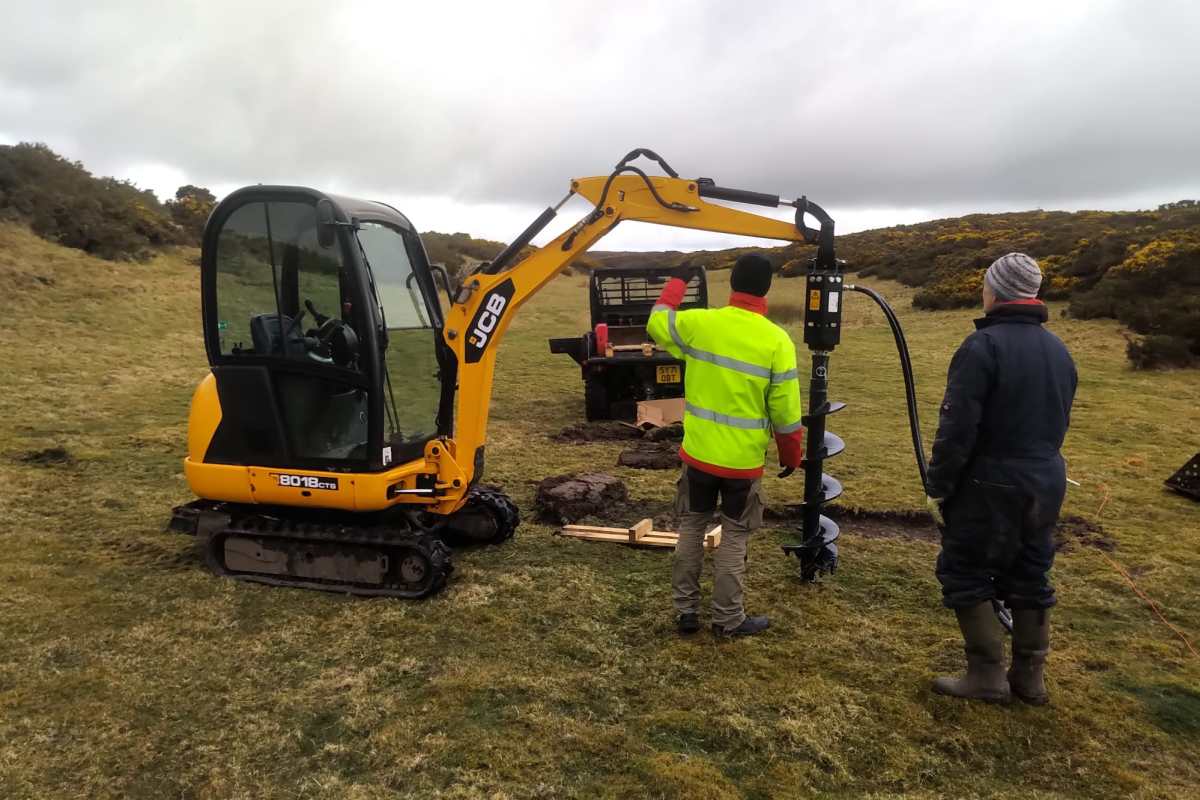
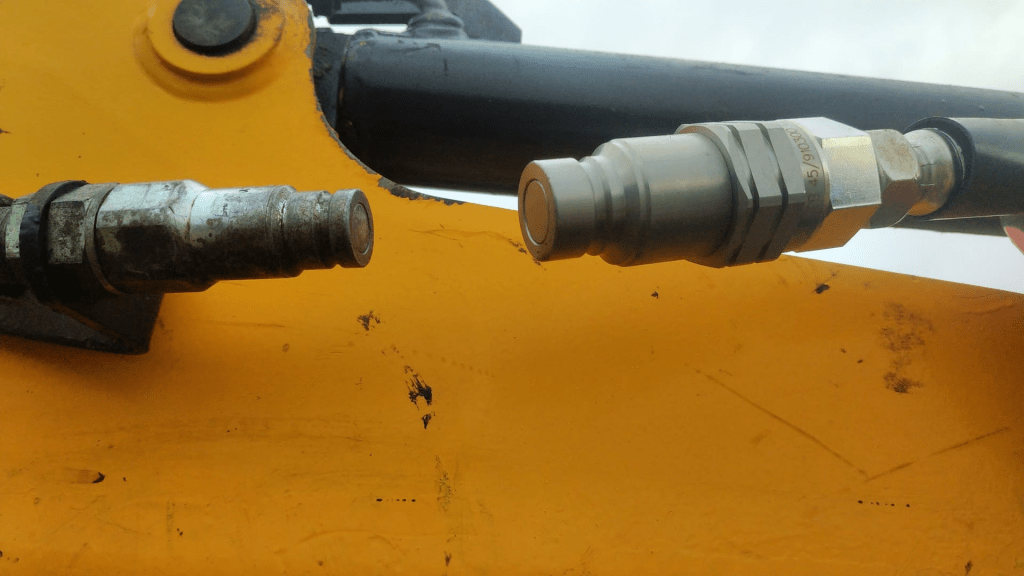
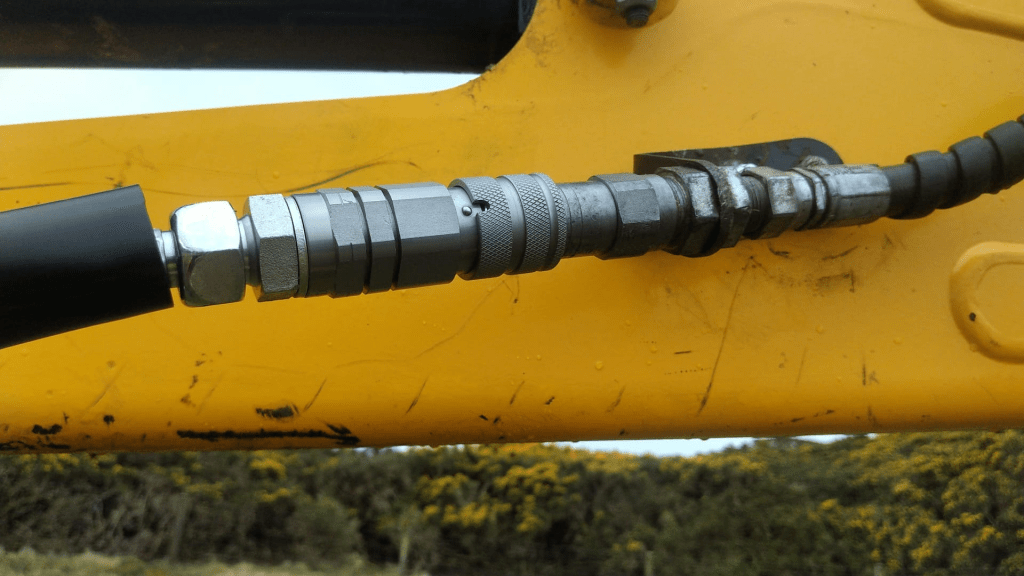
In addition, the as being “new” sold earth drill was apparently not so new, but only a refurbished model (as we could see by some delivery note that someone had forgotten to take away before handing it over to us). But it actually did not matter, as the sockets for the hydraulic were not the same size as the ones on the digger anyway.

Hmm – does it fit?

Trying to find a positive side: the mechanic would not have to come over to just fix a single problem, but a lot of things. After sales servicing to its excellence?

So I found myself in the position to report my digger “DOA” and was quickly assured that someone would come over to help me on that. Being handed over a mobile phone number I left a message with some clear coordinates where the patient would to be found and waited to the next morning (without any real hope, that actually some would show up).

I was wrong. In the moring I got a call and suprisingly two guys showed up and did their work:

  • Bushed repaired CHECK
  • Auxiliary hydraulic valve adjusted CHECKIt was only a temporary fix and the right adapters were missing.
  • Hydraulic pedal fixed CHECKIt fell off after a couple of pushes on the pedal again.
The new adapter – the longer the better

So after the mechanics left, I could at least try with my “new” earth drill. Just to find out, that the hydraulics on the hydraulic hoses of the drill leaked. And I found out, that the hydraulics tank was nearly empty. Also something one normally would not notice when performing some service work before handing it out to a customer.

Side note: in what status would I receive something by that company that was *not new* and *not fully serviced*? This was actually a question I later asked the sales guy. Answer: inconclusive.

But hey, labour seems not be the most expensive part of repair works and therefore I was able to enjoy a vitis of the mechanics on the same day!

To cut a long story short; here is the result as of today:

  • Hydraulics fixed
  • Hydraulic oil refilled (free of charge)
  • Hydraulic pedal still not repaired

And now still waiting for the next visit of the mechanics.

Happy digger operator

And to wrap up the whole story:

JCB Scot was really helping to get this issue fixed; until now this has all been done under “warranty” of a nine-year-old digger.

So would I ever buy a used machine again (me, who has no clue about construction machinery)? Maybe, but probably only “cheaper” and “smaller” machines.

Would I buy from them again? Probably yes, as they still provide a “good” service overall (and they are the nearest seller from our plot).