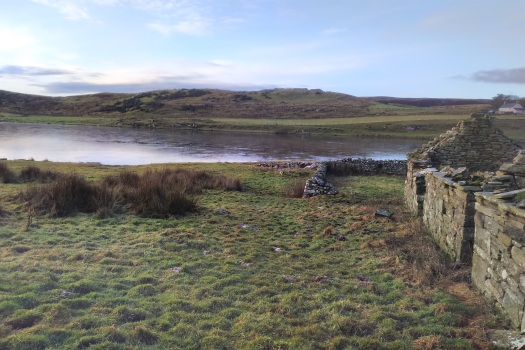
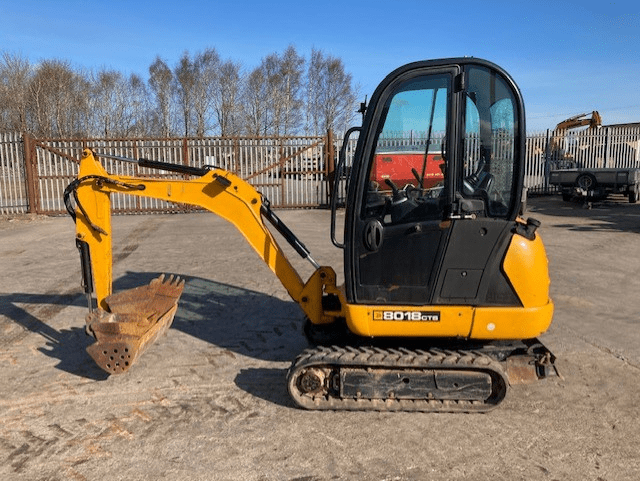
The wait is over. We finally got ourselves a digger. Or: a “mini excavator”, to use the correct term. A used JCB 8018 CTS. Can’t wait to pick it up next week.
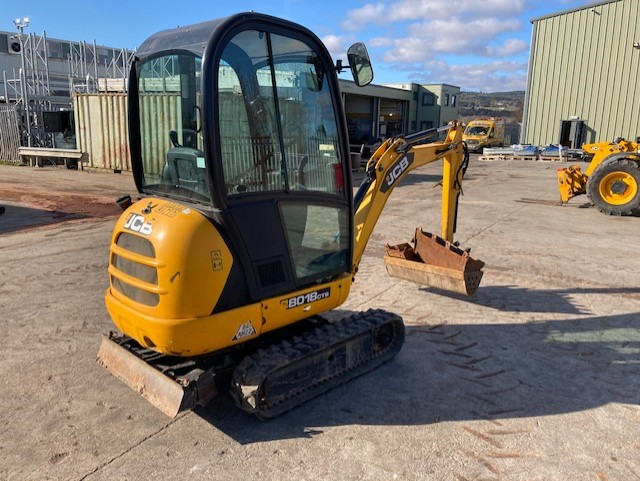
The wait is over. We finally got ourselves a digger. Or: a “mini excavator”, to use the correct term. A used JCB 8018 CTS. Can’t wait to pick it up next week.
Trobolo is not shipping to Switzerland directly, but only available via resellers.
A quick update on my Trobolo(R) shopping experience. Being a good citizen and potential buyer, I gave the company a call to ask, if their numbers on the checkout page were a mistake or indeed intended.
A nice lady called me back and told me, that – despite being able to select Switzerland as the destination country – Trobolo(R) is not shipping to Switzerland at all. And then she added, that this was currently “just not their priority”. Always good to see a prospering company that can freely choose its customers.
And then she added, that there are two resellers in Switzerland that sell this product:
Today, I was looking for a composting toilet for a small shed I am building and came across a promising company called Trobolo. Quite pricy, but hey! we are doing something for our planet right?
After some quick checks and comparisons I came to the conclusion, that IndieBloem(R) should be my next toilet, which would set me back 689 EUR incl VAT (or 520 GBP excl VAT when ordering from the english website).
After selecting an additional liquids container, I went to the checkout page and saw a total price of 718.90 EUR incl VAT (which is a 114.78 EUR by itself):

When I was about to enter my billing and shipping address in Switzerland I was quite surprised to see what happened. The checkout did correctly recalculate and set the VAT to 0% (as this would be a shipping to non-EU country), but the net price of the goods stayed the same (689 EUR for IndoBloem and 29.90 EUR for the container).

This is actually funny, as now the seller (Trobolo) not only adds the complete burden of shipping cost (which is “free” in Germany) on the buyer (me), but also sells its goods for an additional 19% profit (nice margin by the way), as he does not have to deduct VAT upon receiving the payment; plus I have to pay the Swiss VAT/customs of 7.7% upon import of the goods into the country.
Let me think about this … for not too long. Maybe it will not be an IndiBloem after all.
In one of our last posts we wrote about the upcoming, yet to be built, electricity setup in the vNext Car.
And now we changed our plans – slightly. Before deciding definitely for the Pylontech as the battery supplier, we thought we would install and test a comparable setup with both BYD and Pylontech.
Why did we do that? Having a look at the US3000C specs, we see that the recommended (dis)charge current is considerably lower than those from BYD (37A vs 65A). Of course, both batteries supply higher currents than that (74A vs 90A). But the cables sizes of the Pylontech box only supports a maximum of 2*100A, whereas the B-Box supports up to 250A. This maximum recommended current makes a difference when only having 2 batteries at your disposal, as the maximum surge current of the Victron MultiPlus II 48/3000 inverter is 5500W. So with Pylontech I can only support 2* 37A * 48V = 3552W without going over the recommended current and with BYD I can draw 2 * 65A * 48V = 6240W which is over the supported maximum of the inverter. So this is an advantage for BYD. Plus the overall capacity of BYD is higher (and comes at a larger weight).
But of course this has a drawback, as I want to use a DC Circuit Breaker with an integrated isolator, instead of a mains switch and a regular one-time fuse for the batteries. Most of the DC breakers only work up to a 63A and the larger ones are considerably more expensive.
On the other hand, the guarantee and fine-print with BYD declares indicated values are only achieved at a 0.2C rating, meaning that I could only constantly draw a 8000Wh * 0.2C = 1600W anyway, if I wanted to make use of the whole capacity (100% DoD).
Unfortunately I could find no C rating for Pylontech. However, in their warranty, Pylontech writes that the denoted values are only achieved when (dis)charging at 10A per battery (95% DoD). If I calculate this correctly, this would be an equivalent of roughly 2* 10A / (2 * 3374Wh / 51.2V) = 0.15C. In both cases the inverter should only much less than needed to support an induction cooktop and frankly any two devices at a time.
As a side note: Interestingly the B-Box seems to be cheaper per kWh than the Pylontech (as long as you stick with a single battery group).
In either case I will overrun the C rating of both batteries, meaning I will not get the full “official” capacity or life-time out of it. On the other hand, for our car installation this will not make much of a difference, as the Safiery Scotty DC-DC charger will recharge the batteries anytime when needed.
But when designing a complete off-grid system this will make a difference, as there we probably want to achieve a maximum amount of usable capacity and life-time.
But anyway, I will be making two installations and compare them in respect of the ISO25010 main product characteristic categories:
The B-Box has already been ordered. For Pylontech I am still awaiting a confirmation of the quote.
I keep you posted.
Due to the difficulties of getting Pylontech batteries I had to skip the test and go straight for the BYD Battery-Box. See here for how it runs next to our caravan.
But even the delivery time for the BYD was months. So, in the end I decided to build the batteries from EVE LF280K cells myself.
Pylontech Documentation as this does not really seem to be available on their website.
If you read the warranty card carefully, we see that the warranty extension from three to seven years has to be taken with a grain of salt. In addition, the replacement process (even to dead-on-arrive) is not
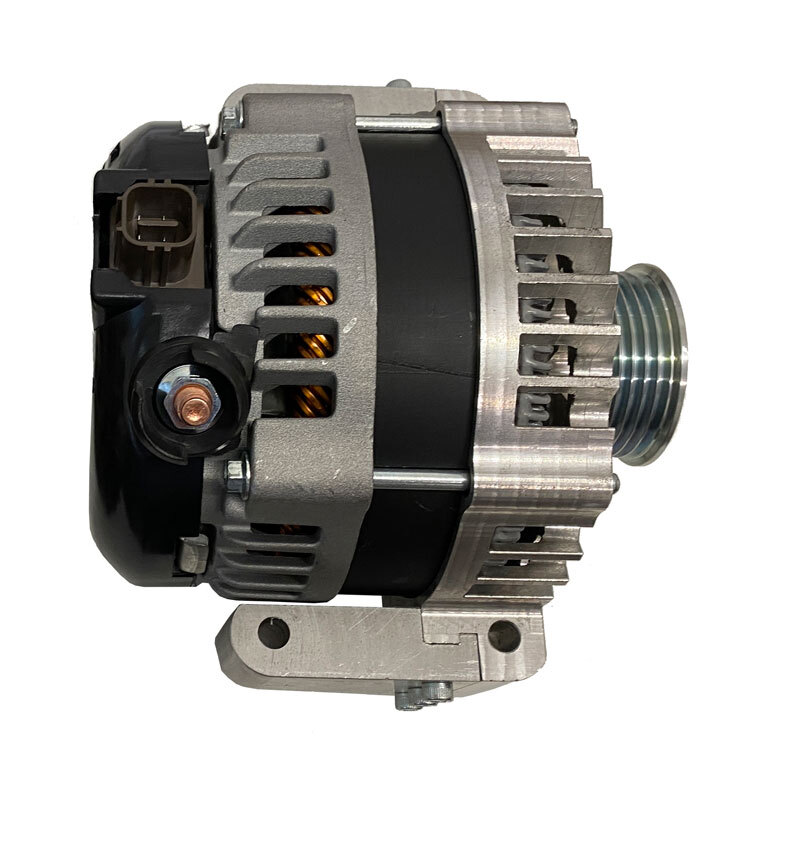
Toyota Hilux 2.4D 2020 with a Safiery 250A Alternator
Our current Hilux is from early 2020 with a 2.4D engine and has a built-in 100A alternator which is frankly quite underpowered to quickly charge our 2 * 12.8V 200Ah Liontron batteries. When I installed 3* Victron Smart Orion-Tr 12-12 30A DC-DC chargers, I could only use 2 of them at a time.
When I talked to the guy who sold us the car, to get an upgrade, I was told, there is no bigger alternator than 100A and no room for a 2nd alternator in the engine compartment. What a pity.
However, when I talked to Bruce from Safiery, he told me my Hilux could run their 250A alternator as well.

As I wanted to swap my batteries and upgrade to a 48V system anyway, I today ordered the alternator and along with it I went for a 3kW Scotty as well.
I am really curious of how this works out.
What does it take to run an off-grid Household on Wind and Solar only
Our plot in Caithness is not really what you would call developed. The next water line is 2 miles away, and the electricity lines just connect our distant neighbours to the grid.
When I made an enquiry with Scottish Power to get me a grid connection to my plot, I was quite surprised, that I would become the partial owner of the company. At least, this is what you could think, when looking at their price tag.
For the ridiculous amount of 35’000,00+ GBP I would get a grid connection to a single place on my plot. Any other point on the plot, stretching a couple of 100m meters, would have to be installed and paid separately.
This and the news of rising energy prices for the next couple of years made me think. There must be something else we could do, like installing a miniature nucelear power plant on my plot, of have perpetuum mobile generating all the power thatI would ever need.
With nuclear energy out of fashion, and expected Planning Permission to be very unlikely, I actually found the perfect couple of “perpetuum mobile”, seeming just perfect for what I would need. Wind + Solar.
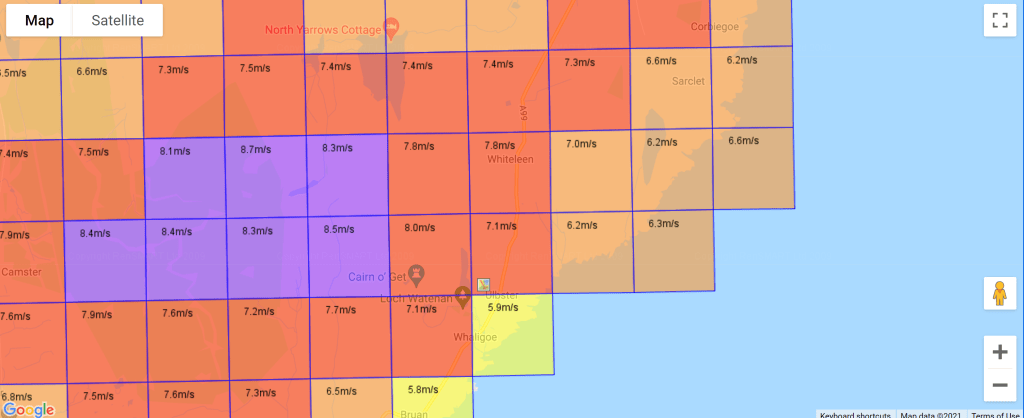
Located at the northern parts of the North Sea, near Wick, wind speed is excellent, as you can see from the map.
Distribution over the year shows, most of the wind is to be expected during autumn, winter and spring.
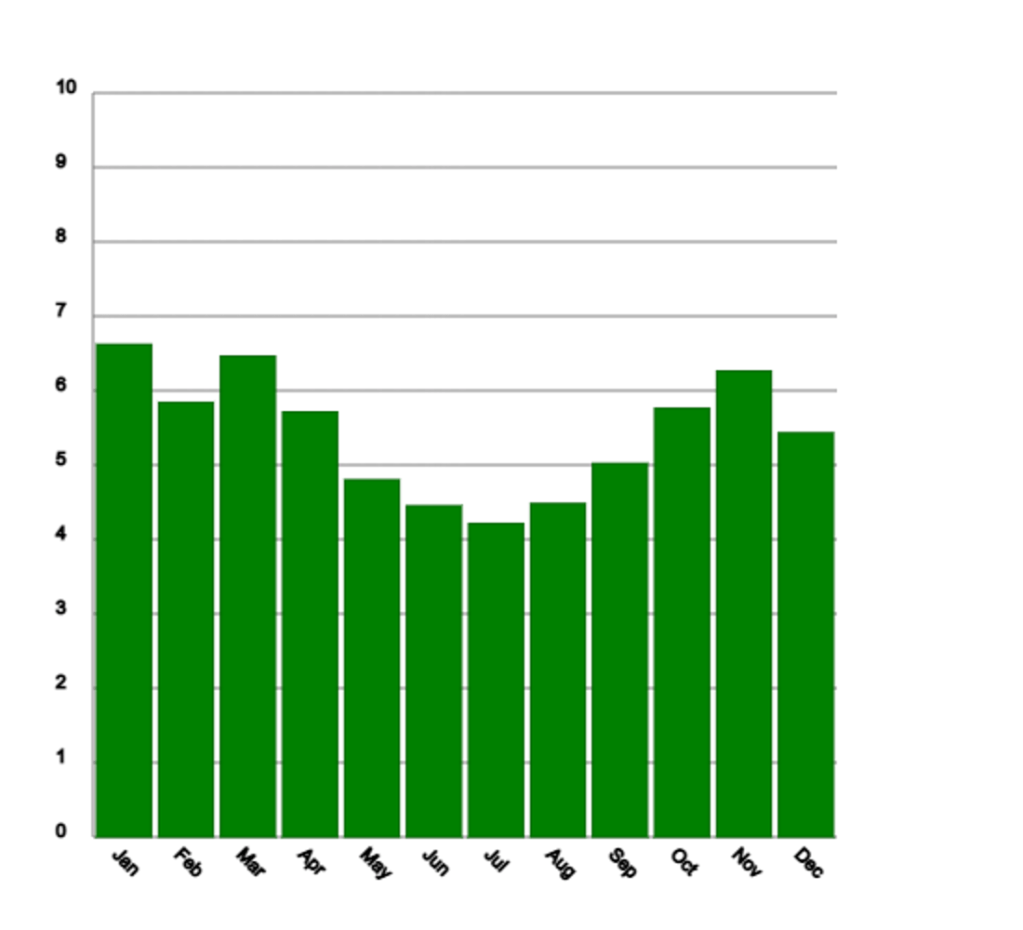
Furthermore, the actual distribution of wind speed reveals, that 60% of all wind speed is in a usage spectrum for wind turbines:

The problem however, in the summer months, there is probably not enough wind to sustain the amount of needed energy production. And the star of our solar system comes into play: solar power.
According to data from the PVGIS-5 database of the European Commission, the expected irradiation of sunlight at our plot roughly looks like this:

In numbers for the last years 2015 and 2016 that gives some really impressive values:
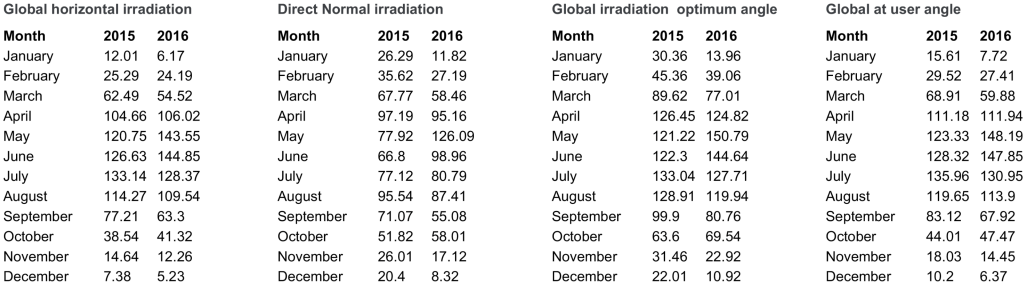
And as we can see from the curve, the sun just starts to shine more when the wind is more asleep.
According to UKPower a medium household in 2019 used 12’000kWh for Gas and 2’900kWh for Electricity, totalling in about 14’900 kWh per year.
This amounts to the following power consumption for a Medium Household:
With some calcuIations from the wind and solar database, I figured out, that with a 5kW turbine and 5m2 of solar panels I could roughly produce this amount of energy over the year:
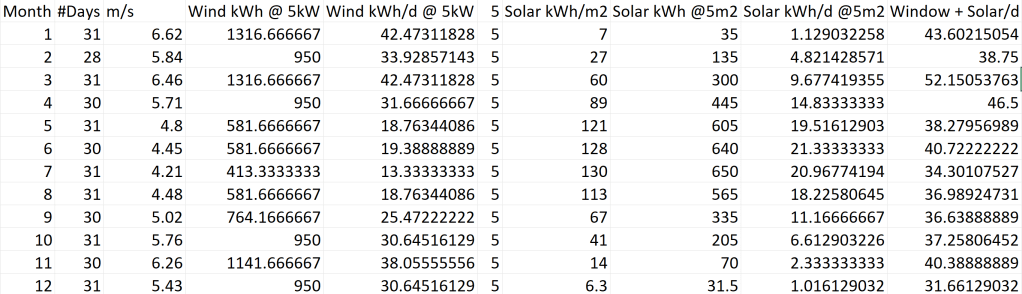
So as we can see, this is just not enough to produce enough energy on your own. But it looks very promising. With more Solar, a larger turbine (or more turbines) or just a backup generator this could easily be addressed.
Regarding backup generator. Of course, energy sources like wind and solar are not stable, so we would have to have some battery storage capacity anyway.
A storage capacity for a single day in 3.2kWh blocks would cost roughly 22’500,00 CHF (list price for a Pylontech US3000). Adding the turbine with 40’000,00 CHF, solar panels 5’000,00 CHF and inverters 20’000,00 CHF you easily end up with a total price of 80’000,00 CHF – 100’000,00 CHF.
Electricity costs of roughly 3’500,00 CHF – 4’000,00 CHF per year will take a 25 years to pay off – if at all. And if the energy prices rise (as heard, by 50%), it would still need a 15+ years to reach a break even.
So what does this mean? There is no perpetuum mobile? And better use the grid and pay as you consume?
Probably not. Betting on higher energy prices, rising inflation, smarter and more efficient technology in the future and outages ocurring more often and often, this could really payoff much earlier than one would think.
Plus, it can be taken as an example, that it might actually be possible to produce your own energy without being dependent on anything else than wind and sun.
48 system in a car and running everything from AC.
We are getting ready for our next car. Or at least start thinking about it. Roughly, we want something like a MB Sprinter (short version, normal roof) and built the interior ourselves. And of course, when doing this, electricity is one part of it.
In this post we give a brief explanation of our requirements, use cases and possible solutions we came up with.
Storage capacity in our existing Toyota is 5’120Wh brutto with two Liontron 12V @200Ah batteries costing around 1’990,00 CHF, which makes 0,77 CHF / Wh. For our next van we would like to increase the storage capacity and the larger inverter, but keep cost down if possible. Currently we use 35mm2 cables to run our 1’200W inverter, so to run a larger inverter we would have to increase cable sizes in our system significantly – or increase voltage size.
After some thinking, we opted for a 48V system (rather unusual for a car) with two Pylontech Us3000 batteries summing up to a net capacity of 6’400Wh. Considering the price for the batteries (arund 1’730,00 CHF each) this would lower the price to 0,54 CHF / Wh. With this capacity we could run an 3000VA / 2400W inverter and cable sizes could then even stay the same.
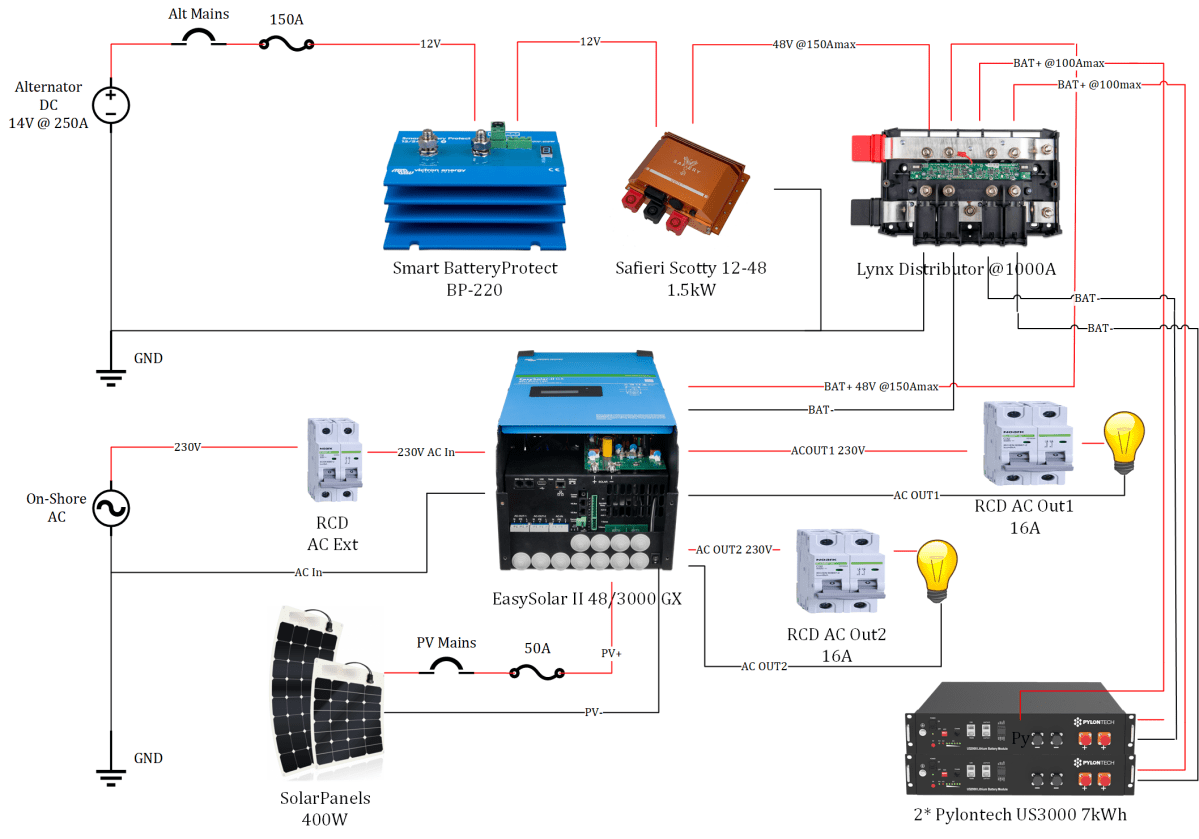
However, the main problem with that setup would be to get 48V from a 12V alternator. But luckily, we are not the first tasked with this problem and Safiery has a solution just for that: Safiery Scotty 12V-48V DC/DC converter at different power levels (1000W, 1500W, 3000W). As the car engine would have a 250A alternator, the setup could really benefit from even the largest model. Ideally the DC/DC converter would be installed in the engine compartment, in order to minimise the relative voltage drop on the way into pssenger area.
As we currently do not have a fixed solar system, this is definitely something on our wishlist. But with that large DC/DC inverter and the fact that we are not staying for days at a single spot without moving the van, the initial cost for 400W solar panels just do not seem to be justified. So, we thought we prepare everything, so we can later still install solar panels without having to redo a lot of installation work. Enter Victron Energy EasySolar-II 48/3000/35-32 MPPT 250/70 GX. Now, how does this roll of the tongue?
But in fact, that system really looks promising: in a H 499mm x W 268mm x D 237mm box at a weight of 26kg, you get
Now this is rather impressive if you consider the price span of 2’248,00 CHF – 2’469,00 CHF.
Considering, both the Scotty and the US3000 also have a CAN bus interface, this really make a neat paclage, as all devices are able to talk to each other. More bang for the buck.
At least in theory. As I have not built it yet. But I think, this is a good starting point. I will contact the vendors to get a response if my setup is supported and if there are any reference installations on it.
Now you might wonder, how I would charge my other 12V devices, as I do not have a single 12V output in the setup. And yes, I thought about this too, and came to the conclusion: I do not need 12V output. Or sort of.
Compressor, winch etc I will power from the alternator directly. All the rest I will power via AC, such as the fridge, mobile, USB, notebook. This of course, comes with a penalty, as I have to convert the energy twice. But this also saves me an additional device and a lot of cabling and extra fuse boxes (and this is all saved space).
Now about the weight:
The van (2-seater) has a total loading capacity of 1080kg, so I think this is a justifiable weight for a pretty massive power system.
For connection of these systems, I opted for a bus bar with integrated fuses, the Victron Energy Lynx Distributor, though a back-to-back-cabling with extra fuse boxes would also have worked.
In case, the interaction with Safiery, Victron and Pylontech via CAN bus does not work out as expected, I would insert a Smart BatteryProtect BP-220 in front of the Scotty, so I can switch the converter on and off depending on the ATD and ATC signal in the EasySolar via a relay.
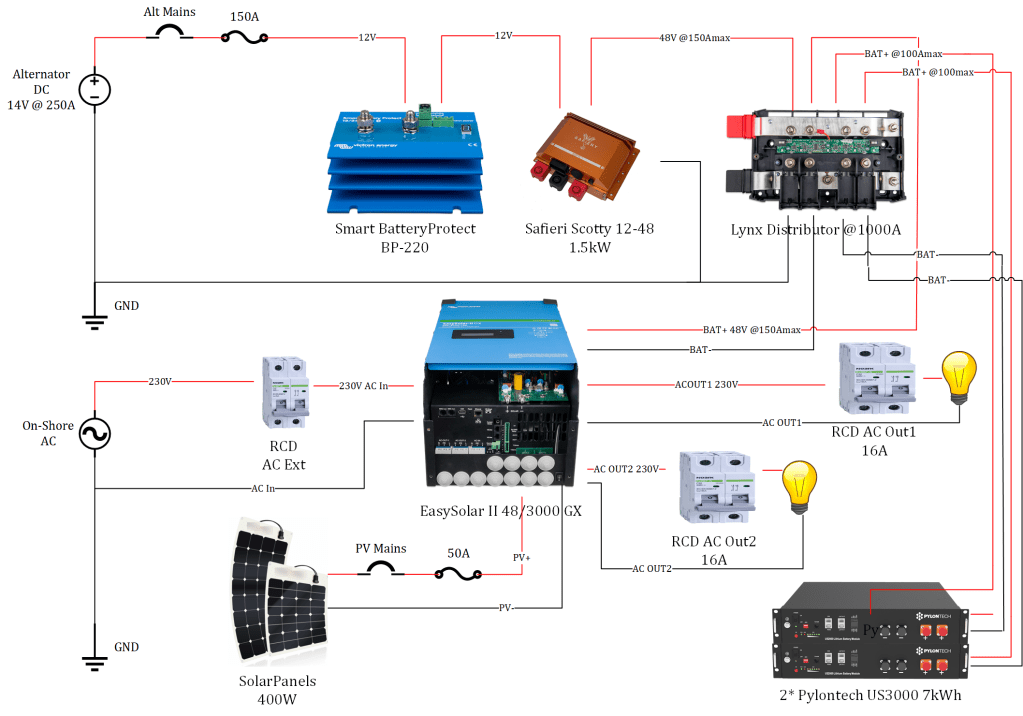
So these are my plans for the next van. I am curious, what response I get from the vendors and how it all works out.
In case you have questions or recommendations for improvement, I am more than happy to hear from you.
Velcro + Android Tablet = cheap SatNav
Back, when we bought our Toyota Hilux we basically got the cheapest variant we could get; meaning, that we would not have seat heating or SatNav system. Instead we got a built-in no-extras “entertainment system” with a CD player. I added some links, in case you are generation x-why-z-what-do-i-know and were obliged to pass on this pre-historic equipment.
But that now has changed! (And no, we did not upgrade to DVD.)
When sorting through some boxes, I discovered an old Android tablet (a Huawei MediaPad T3 7″, if I am not mistaken; with street prices around 70 CHF) that still seemed to work. When I checked, that it could still run Google Maps and connect to my Victron Chargers and LionTron batteries, I thought I give it try.
With some Velcro I quickly sticked the tablet on the screen of the “entertainment system” and the CD slot. And I must say, it looks exactly as it was built for being in that very place.
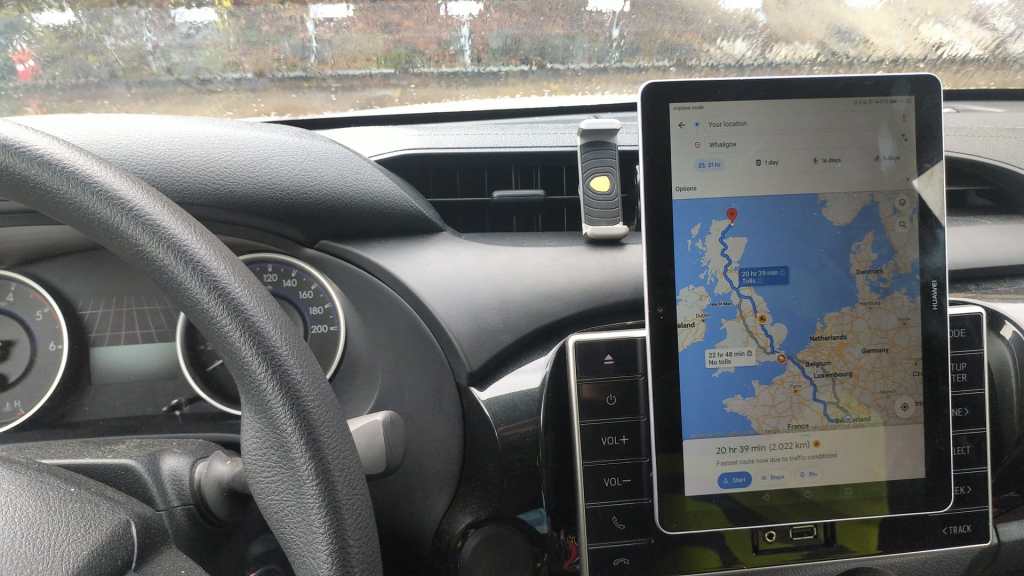
Finally, I could make use of the 3.5,mm TRS input and the USB charger on the front. However, the charger does not provide enough power to charge the device. It just prevents it from discharging. So maybe, I still have to use the charger at the 12V cigarette output.
On the other hand, my onboard monitoring capability greatly improved, as now all my apps are much better readable due to the larger screen.
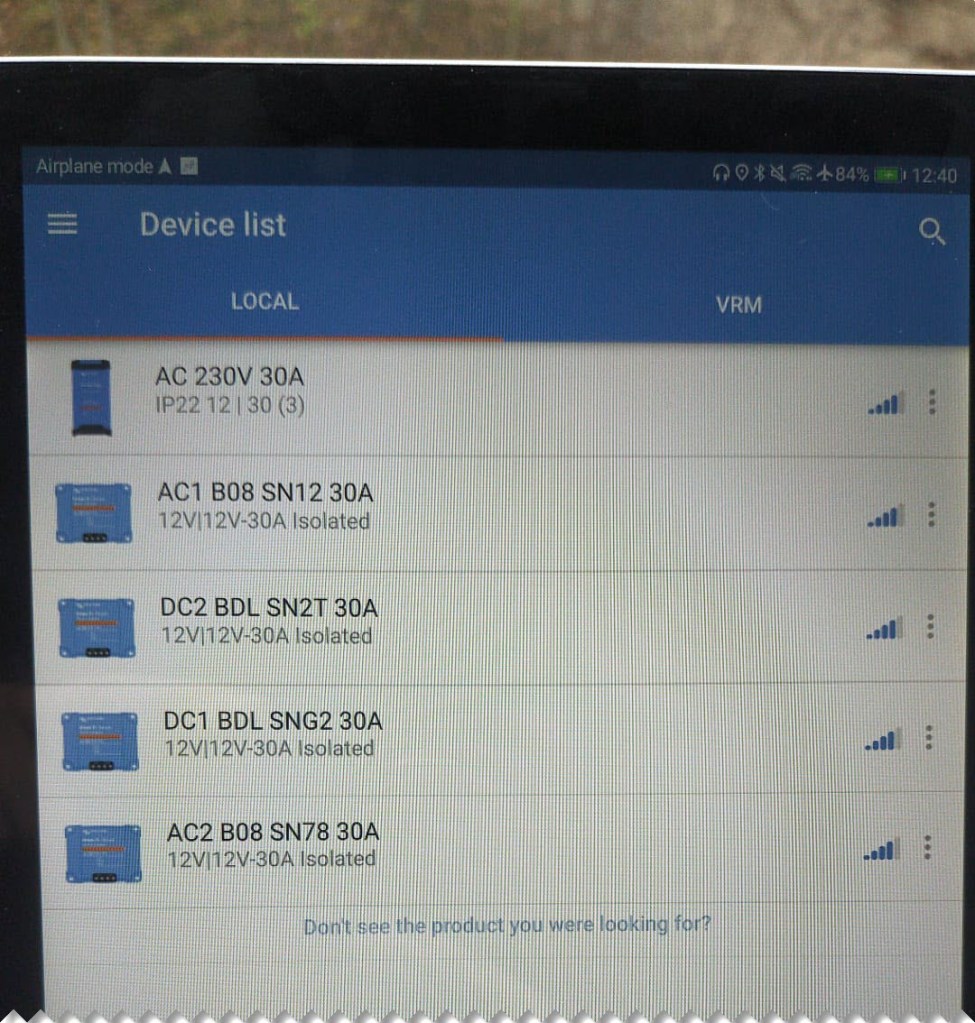
And now the cables:

But to all this good news there is one caveat: now, I do not have a CD player any more.
Scotland has done everything to make up for our last trip. The weather has been really nice, warm and sunny and Caithness has turned out to be a much more welcoming place than one could think. The countryside is breathtaking and the heavily peated river reminds me of why Scottish Whisky is the best.


Our neighbours have kindly taken us under their wings and are making sure we don’t miss out on the sites, one has to visit up here. Having travelled a lot, they are giving back some of the kindness they experienced themselves while abroad. We could not have had better luck.
To round up a beautyful day, I was able to attend a choir rehearsal in St. John’s Church in Wick. It was balm for the soul to be singing in this wonderful old church with sweet and kind people who made me feel, like I belonged.

But the most heartwarming moment was not even the music but really the teatime with some members of the choir afterwards. It was so refreshing to be part of that group of smart and witty women. Thank you for letting me be part of that!
So we made it up to Caithness. The road was good. We were once more surprised at how serious the Britts are about those traffic cones. They not only mark the way with them, they litteraly build walls with those things…
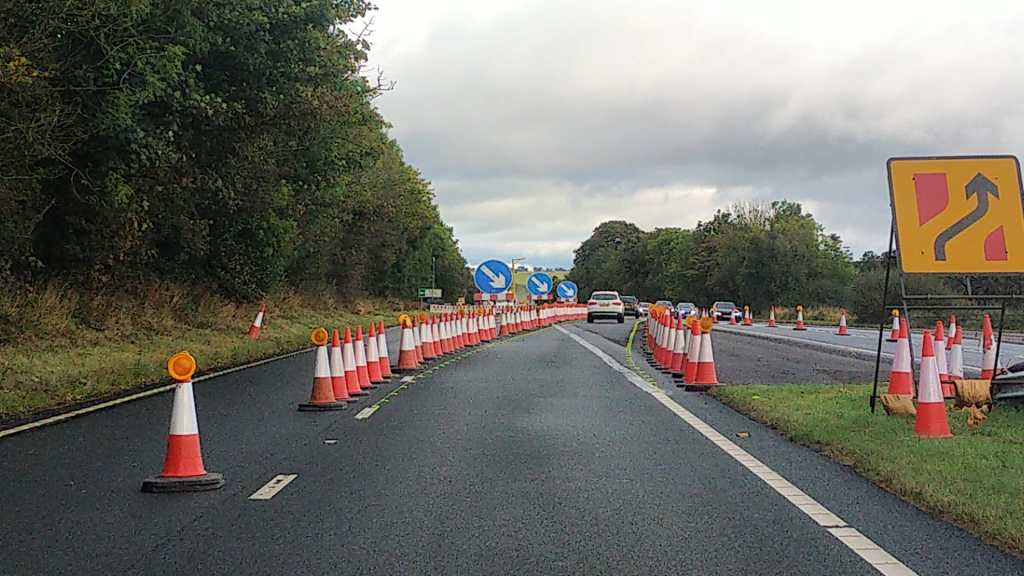
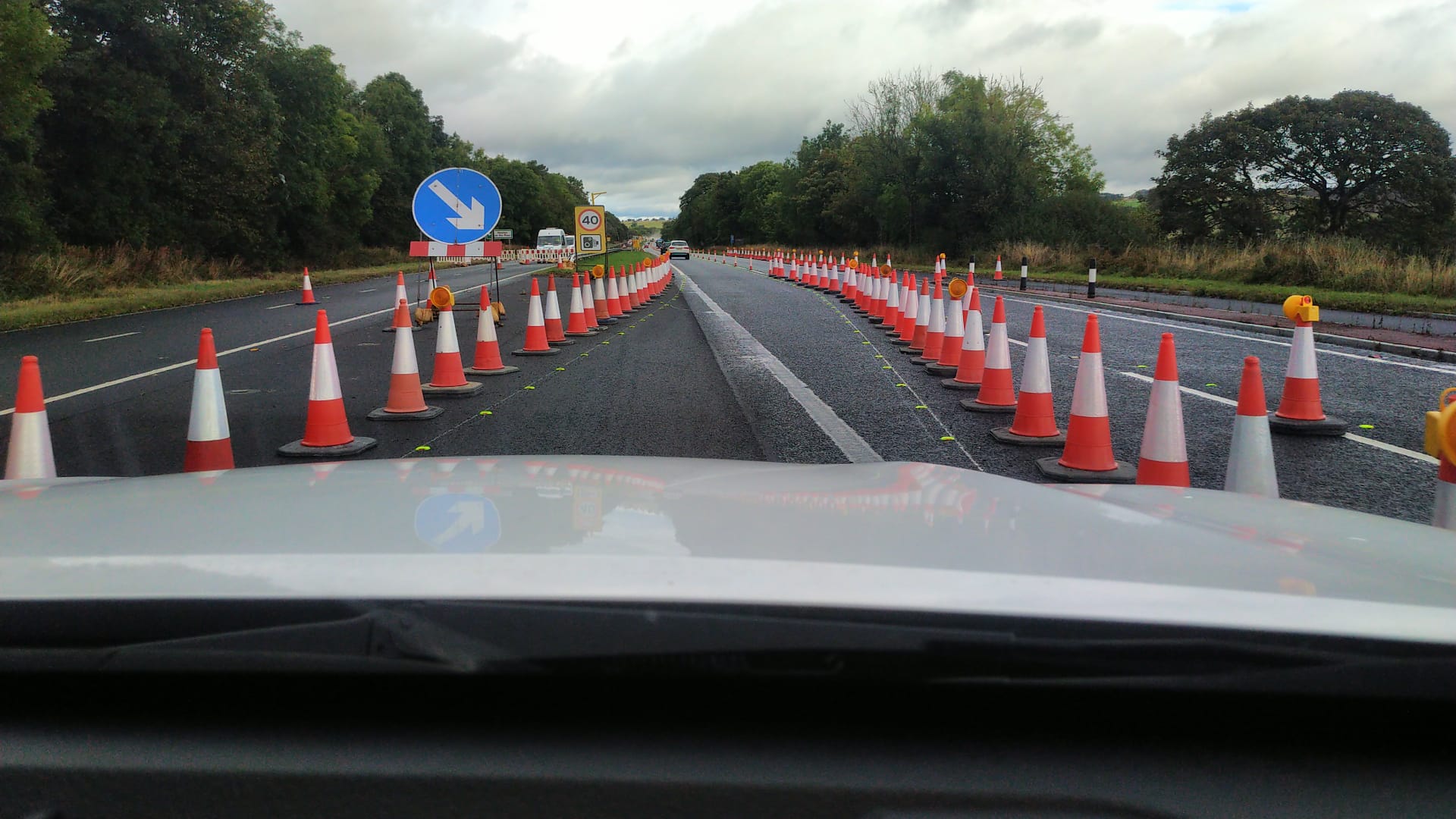
Before arriving in the UK, we have been worried about the fuel shortage, we read about in the news. This is why we decided to first leave the bigger cities behind us, before trying to find diesel. Turns out, there was no problem really. The very first gas station we tried, had fuel and not even a line of waiting cars. So we took that for a favorable sign and continued our journey north.

Loch Watenan welcomed us with some rain but also with the most heartwarming hello from our neightbours.
Having learned from our last trip, we did NOT try to drive on our plot by night without knowing the state of the ground. This is why we stayed over the night on the parking space south of the lake.
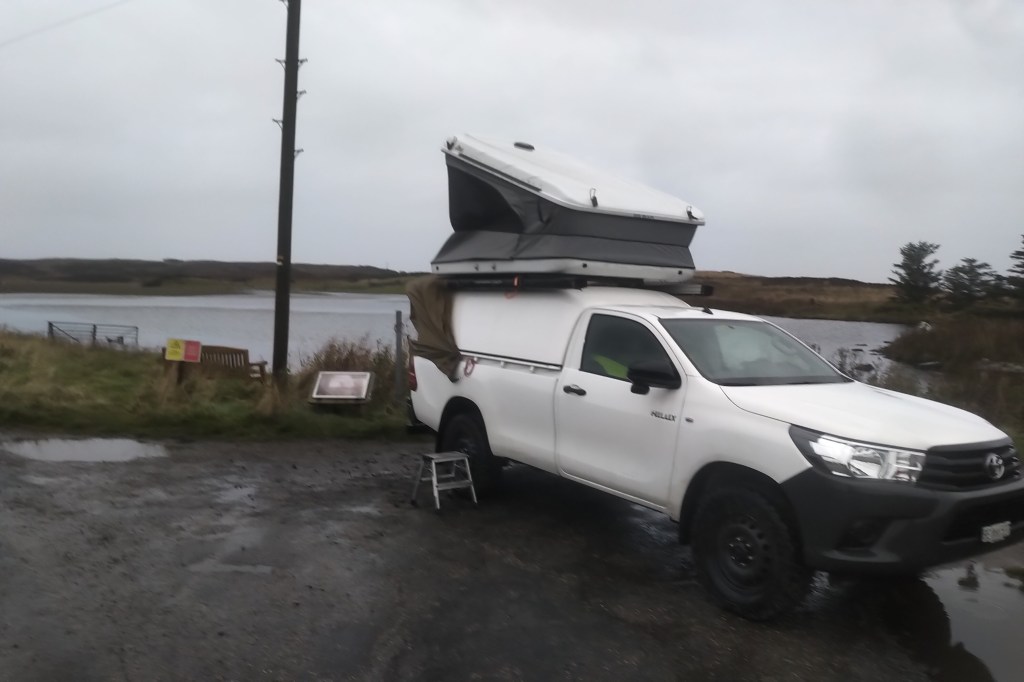
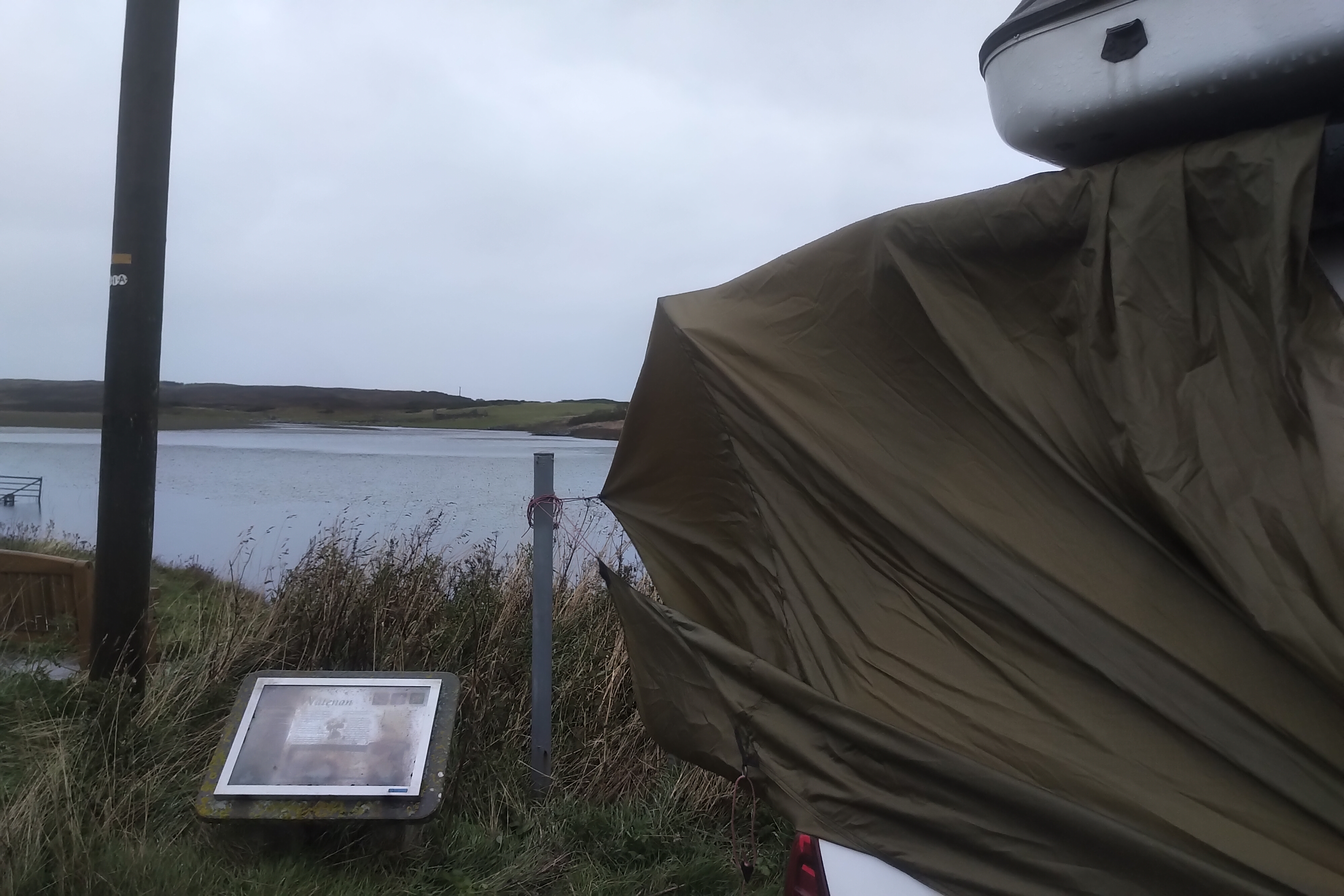
The night was calm and clear, allowing us to see an amazing starry sky.

(OK, you might need some imagination for that one…)
And right now, the day is breaking in a breathtaking manner on Loch Watenan…





 Our Journey to Scotland