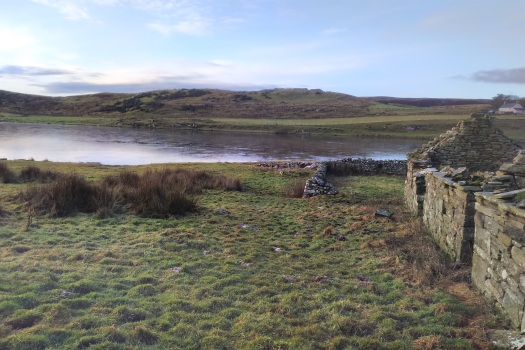
Converting a workshop into a flat

Now, that we just finished our plumbing course, it is time to apply our freshly acquired skills.

A prowd owner of a Certificate of Unit Credit towards Level 2 Diploma in Plumbing Studies

What better opportunity could there be than to convert an old workshop into a modern flat? During the next weeks we will document our plans and progress towards that conversion.

These are the things that need to be done:

  1. Add an interiour wall to separate bath room from kitchen
  2. Add an interiour wall to separate bed room form entrée
  3. Paint walls and ceiling
  4. Lay laminate flooring
  5. Rewire electricity, add energy meter and distribution board
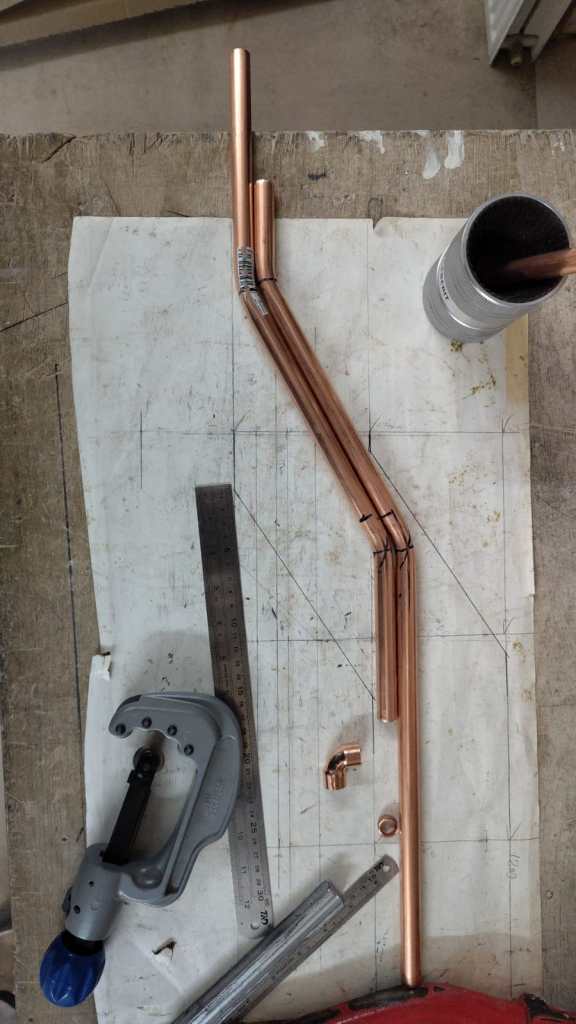
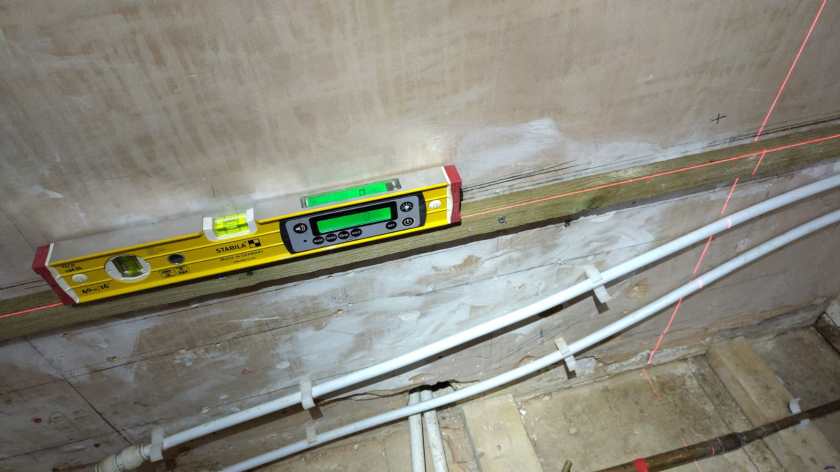
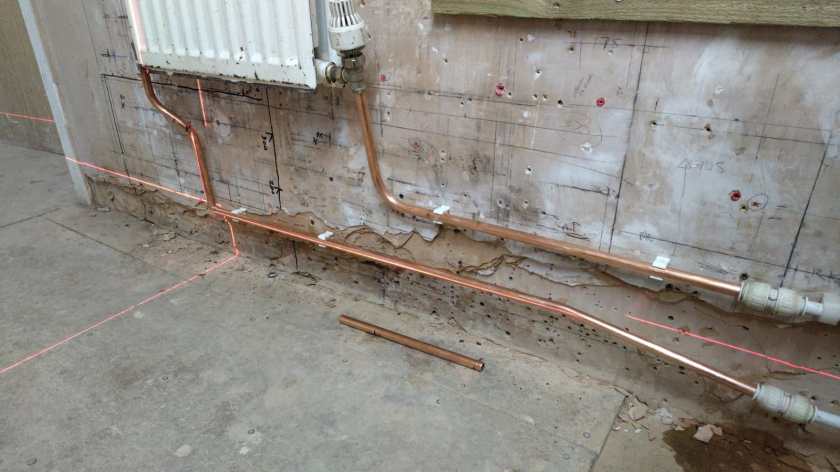
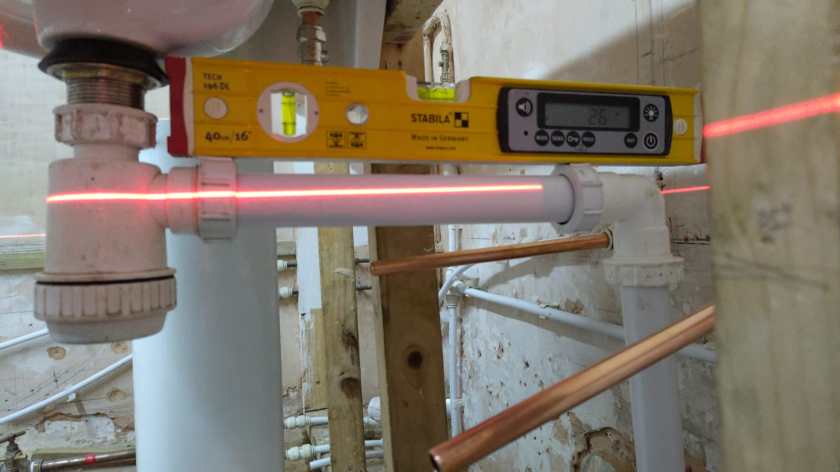
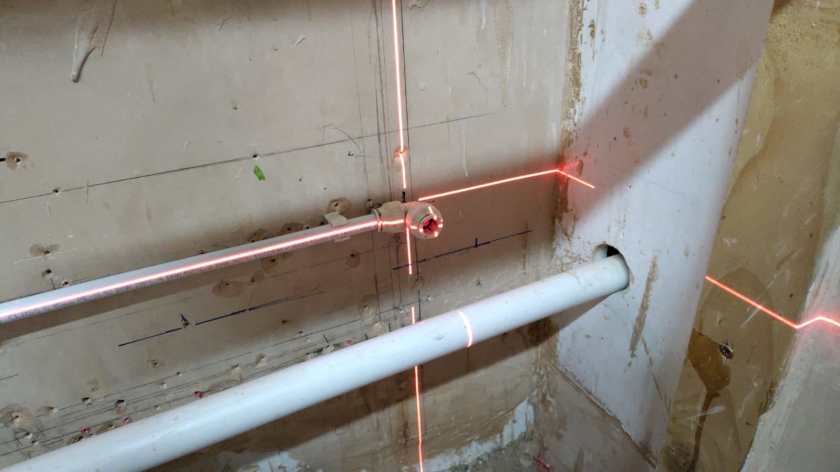
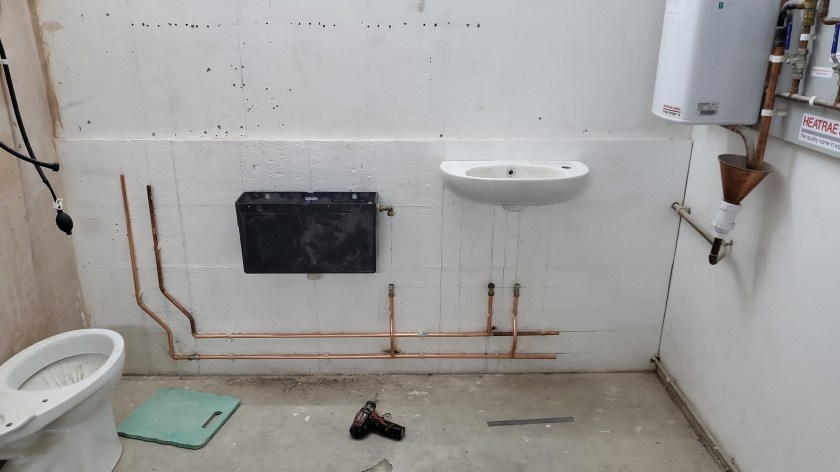
  6. -and of course now to the plumbing- Install pipe work for water in bath room and kitchen
  7. Move soil stack up to first floor
  8. Install shower, toilet, basin and washing machine
  9. Install kitchen sink and dish washer
  10. decommission existing connections
  11. … and clean up and make space first

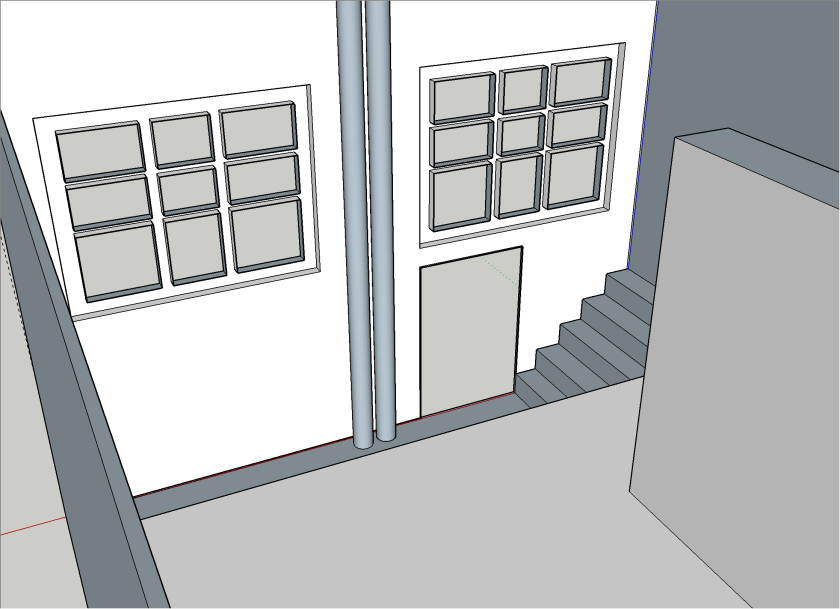
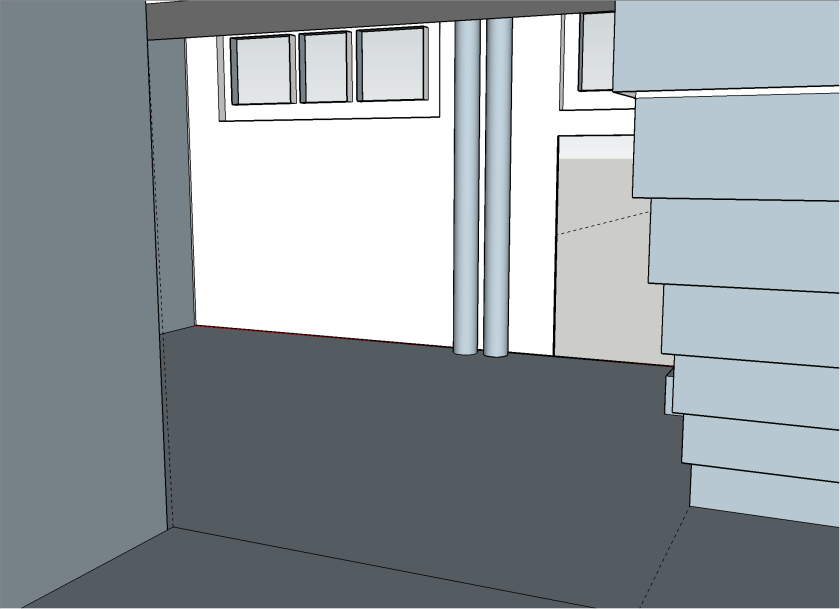
We first started with a basic room layout which I did in Sketchup Make 2017, the last *free* version of Sketchup by Google (now owned by Trimble). Though Trimble does not support or offer that version, thanks to the Internet Archive Wayback Machine the version can still be downloaded.

Note: the “PRO Trial” will revert to the free version aftert 30 days.

My last Sketchup experience dates back to 2015 when I modelled the packaging for the beer bottles of our then breweey, so the model I came up with now (not completed) is not really stable not particularily beautiful. But you will get an idea.
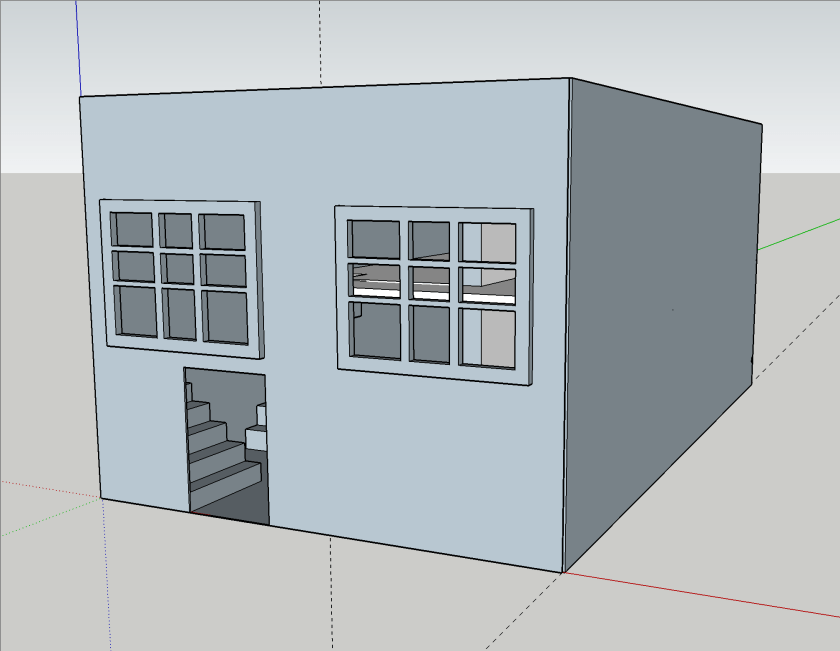
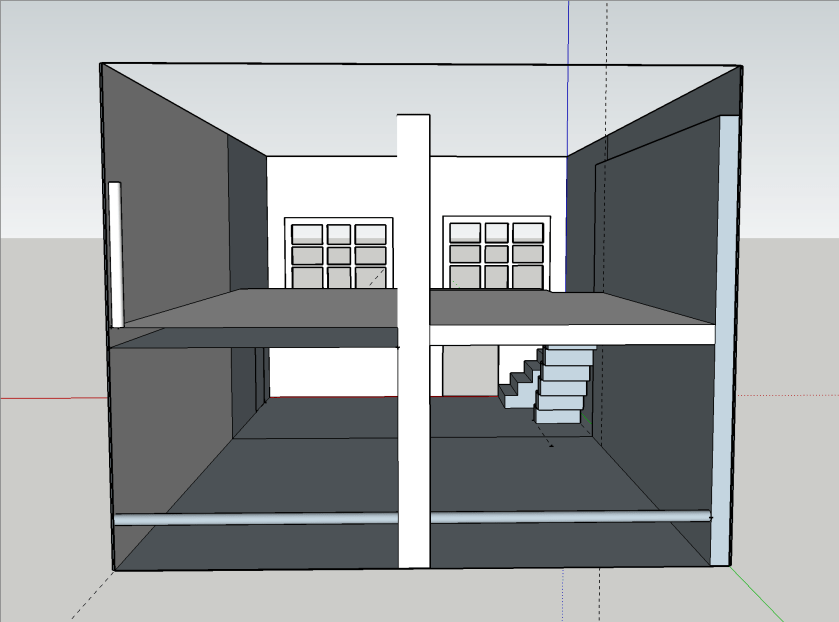
As the walls of the building are made of ferroconcrete and we are not fans of flush mounting we decided to put all the pipework and cabling on the walls and not hide them in conduits.

For the pipework we decided to use Geberit Mapress 15mm stainless steel pipes. There we go for the slightly cheaper 1.4521 variant (and not 1.4401) which is also approved for drinking water:
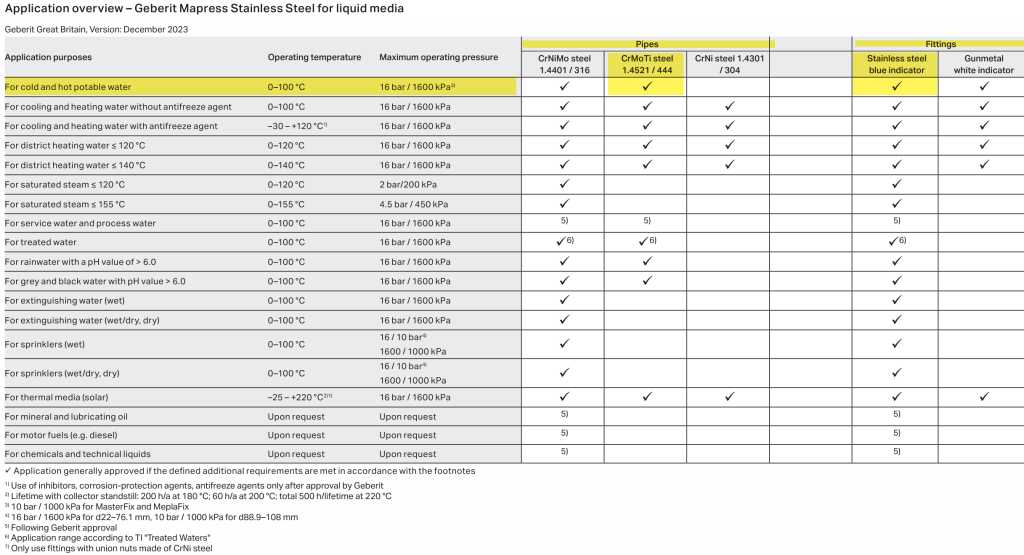
Application overview – Geberit Mapress Stainless Steel for liquid media, taken from https://cdn.data.geberit.com/overviews/GB-en/DAS_157952.pdf

For the electrical installation we have to install a distribution board with a separate energy meter. For this, we chose Hager and wanted to try out the quickconnect system, where everything is just plugged into place instead of being screwed down.

With the Hager Ready app (on Windows) it was suprisingly easy to configure and validate the layout (though the “wizard” was not working in my favour and always picked the “wrong” products which is why I added the components manually):
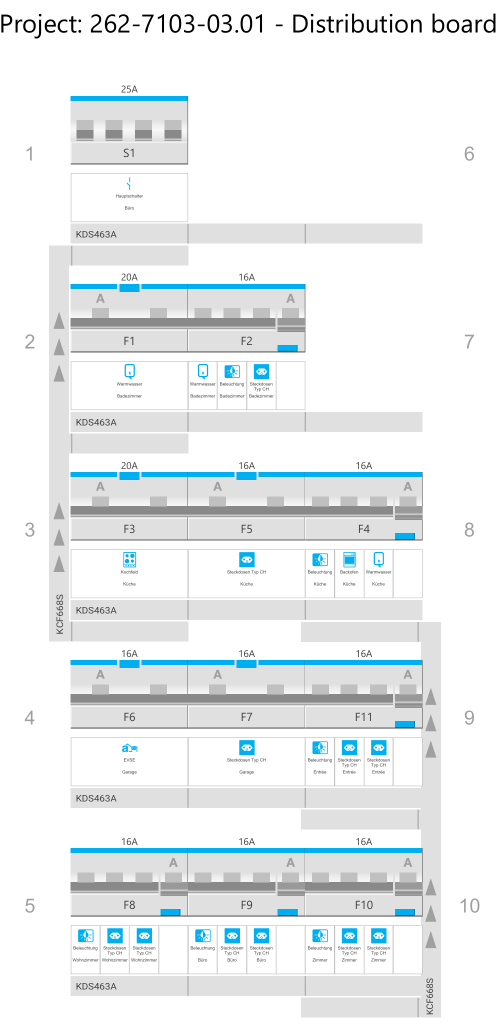
Distribution board with components

It even generated a 3D view of the selected enclosure:
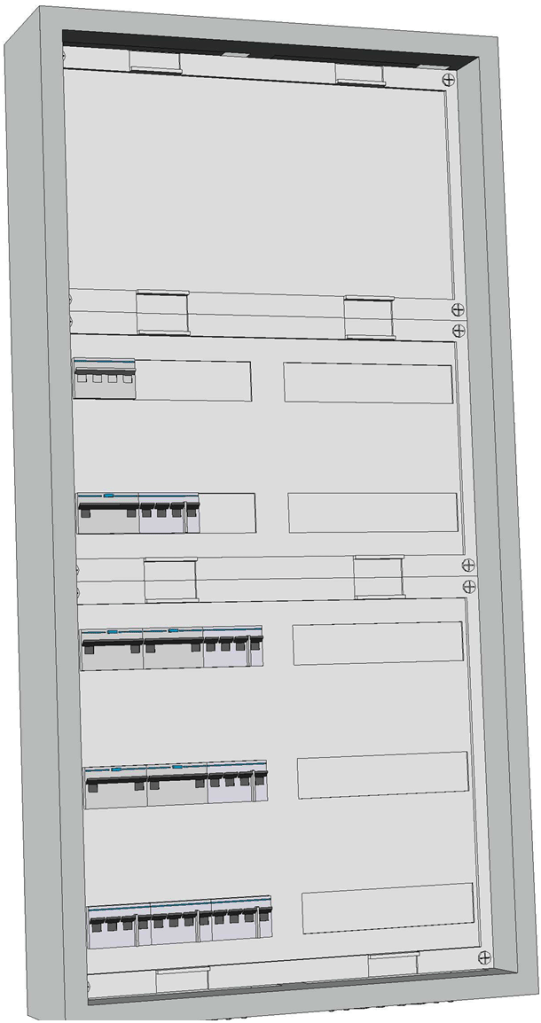
3D view of enclosure

For the connection of the actual wires from the rooms to the 11 RCBOs I chose to go via 2003 WAGO DIN rail terminal blocks (on row 1 of the board). So with quickconnect in place and these terminal blocks, I only have to run 56 2.5mm2 wires (plus one 16mm2 PE) for the whole distribution board!

To make calculation of the required cable lengths a little bit easier I threw the numbers into this spread sheet:
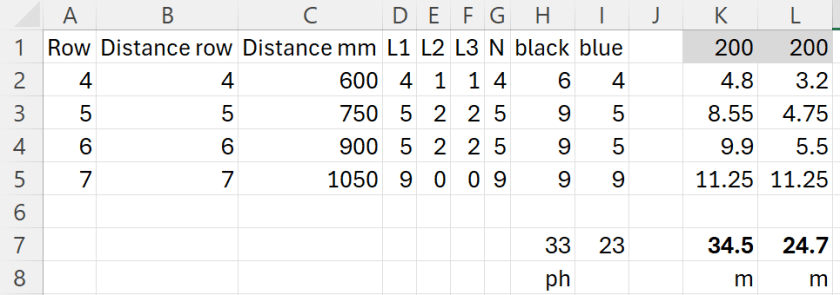
Required cable length for a 2×7 distribution board

For 33 phases and 23 neutrals RCBOs I would need nearly 60m of wire! This is because I really cannot use bus bars for neutral. For a comparison: If I had got a 2×6 distribution board I would have used nearly 10m less for the internal cabling (but unfortunately, there was none available):
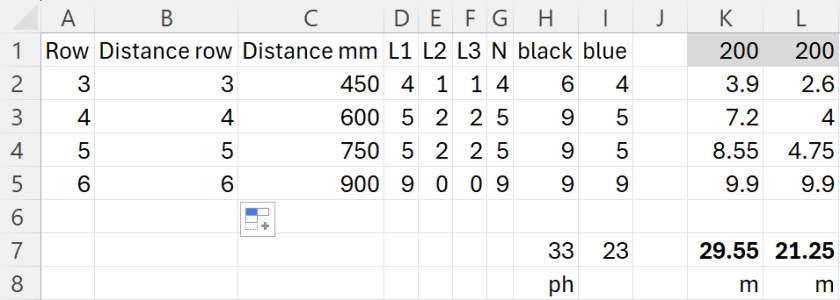
Required cable length for a 2×6 distribution board

I ordered most of the electrical stuff today and will have an update on it when the material arrives.

And this is it for today.

“Go with the flow” as the Plumber would say

As we are now increasingly looking into water treatment and the water supply in our shed, we decided that it wouldn’t hurt to know a little more about what we are actually doing here.
That’s why we enrolled on a 6 week Level 2 Diploma in Plumbing Studies (6035-02) course at City & Guilds. Contrary to expectations, the course was extremely helpful, instructive and, above all, great fun. We owe a lot of the fun to our instructor Iain, who was always able to pass on the tips with a lot of humour but also a lot of experience.

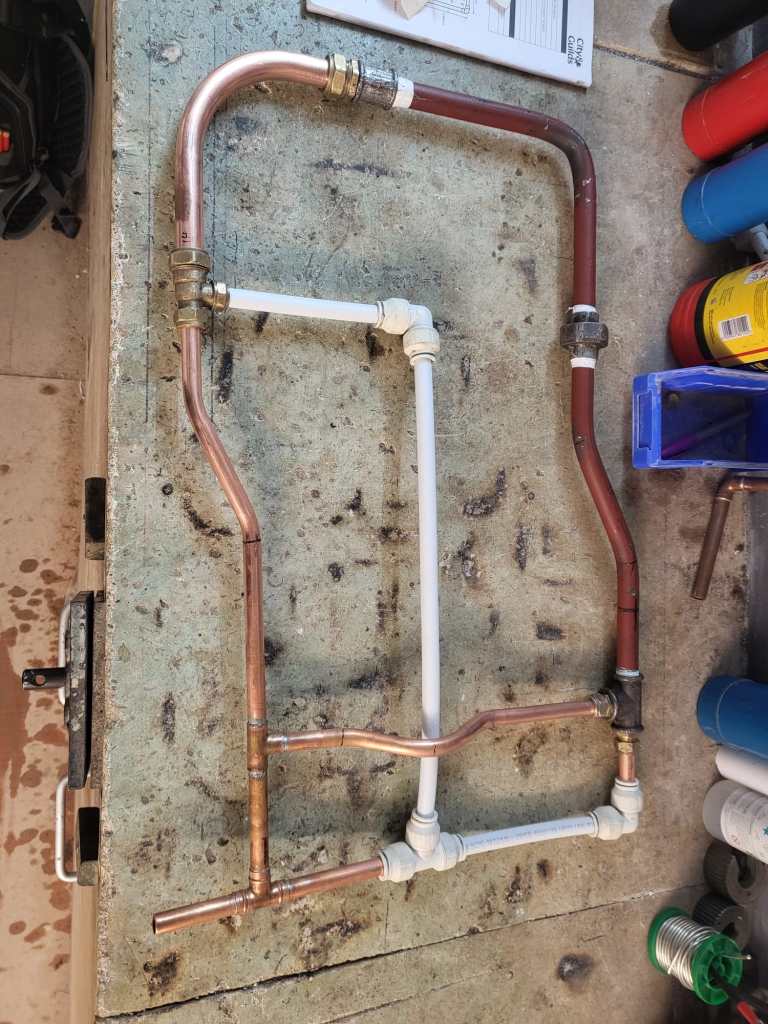
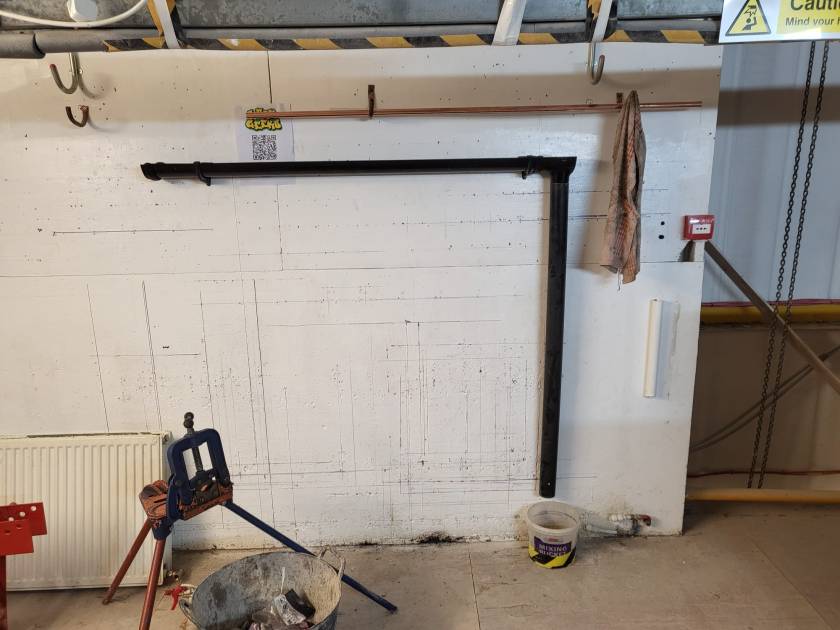
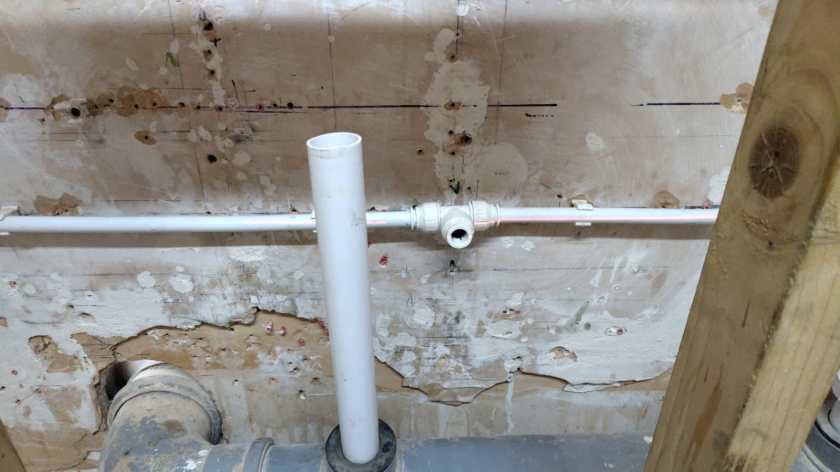
We learnt how to bend and solder copper and even threaded the dreaded LCS pipes, how to lay plastic pipes neatly, and how to make sure that everything is tight and does not leak.

Ensuring a leak-free sanitary experience
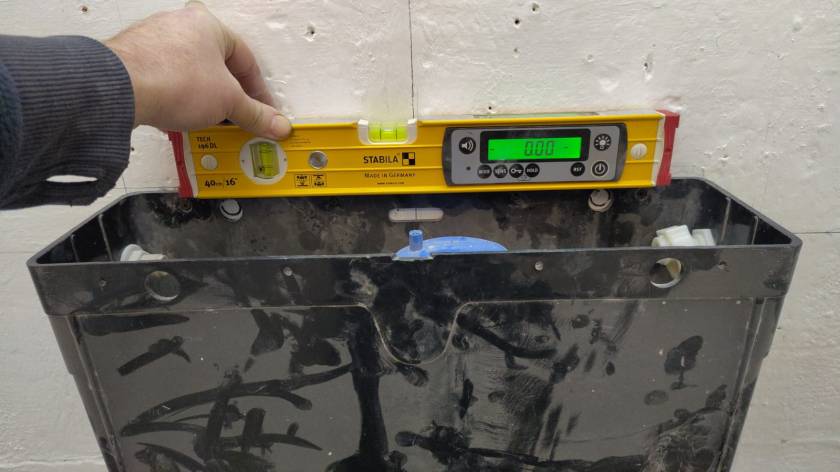
Of course, not only when it comes to plumbing, only perfect is just good enough …
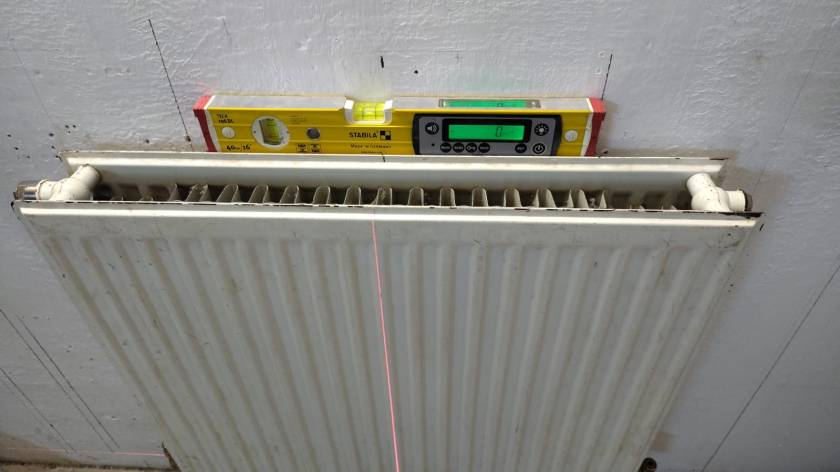
… especially with the help of pro tools.
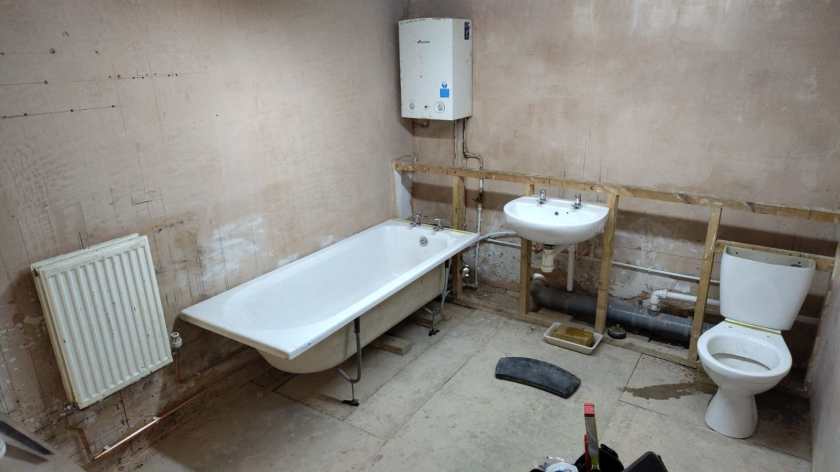
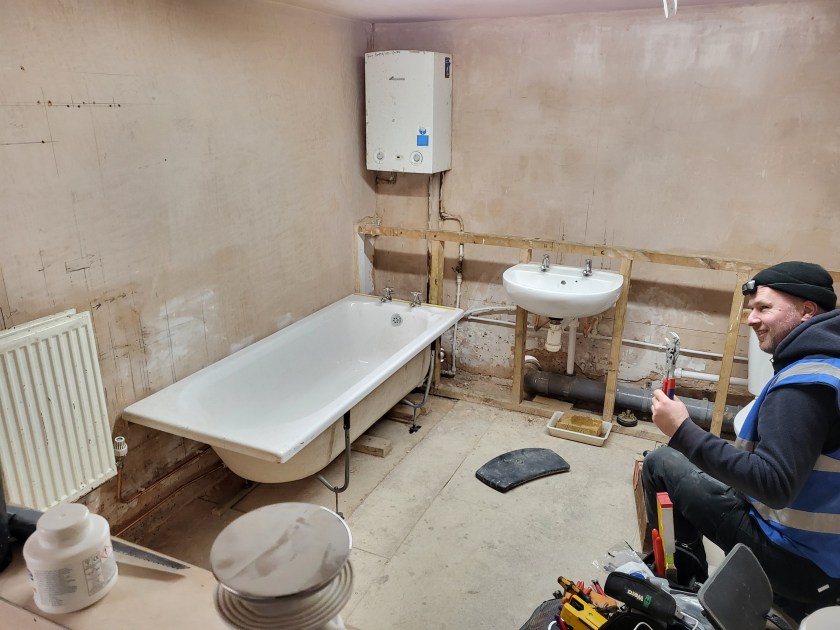
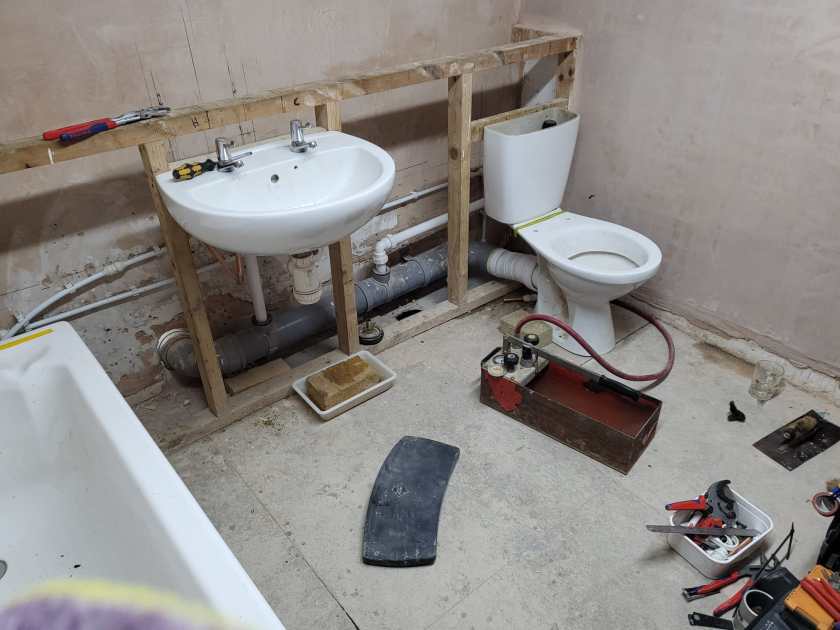
Installed bath room

So, now we are even more ready and “beyond being prepared” than ever and neither radiators, showers, bathtubs, toilets nor washhand basins or kitchen sinks will put us off any longer… (not that they ever had)

Water Filter Build

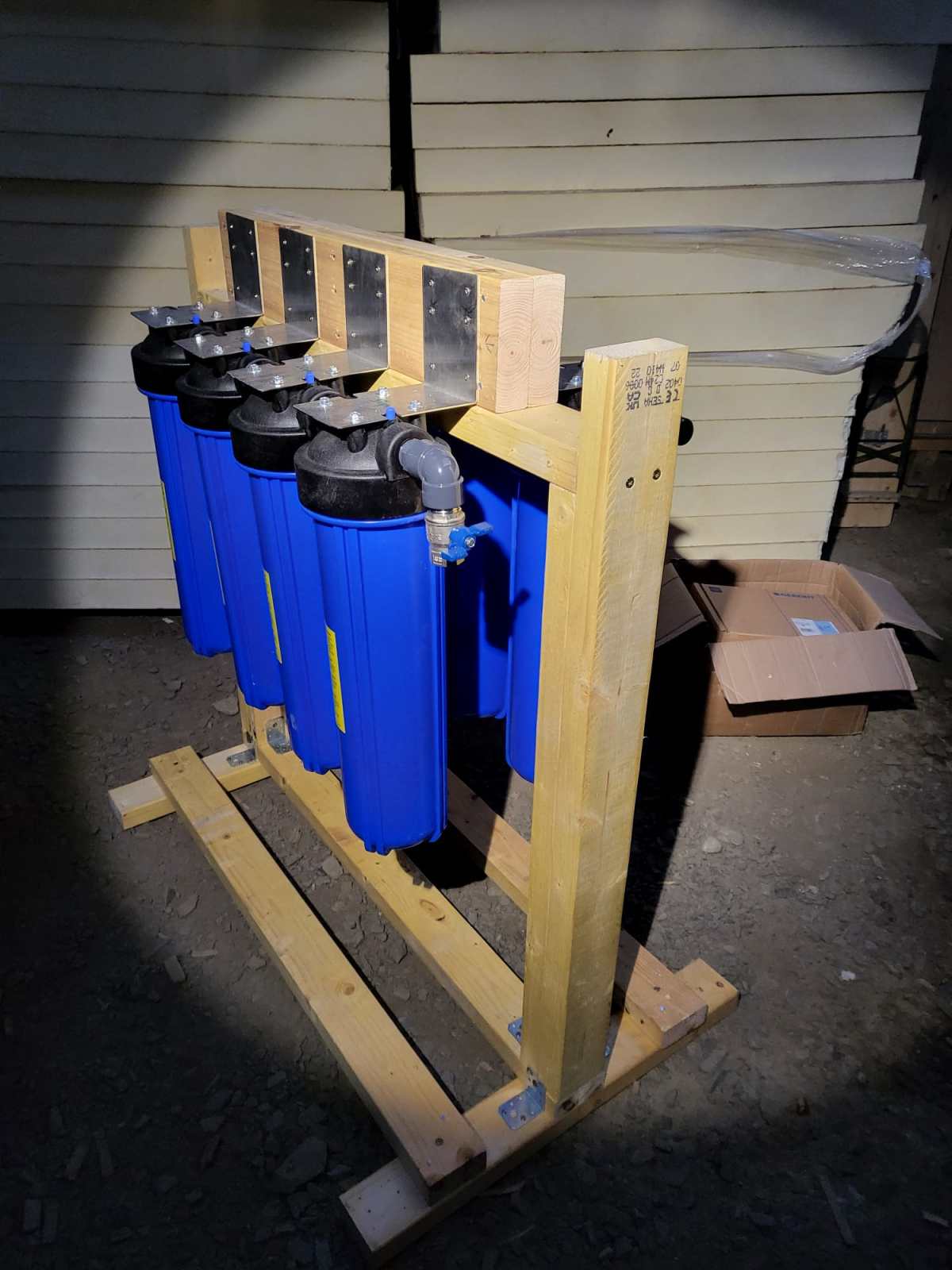
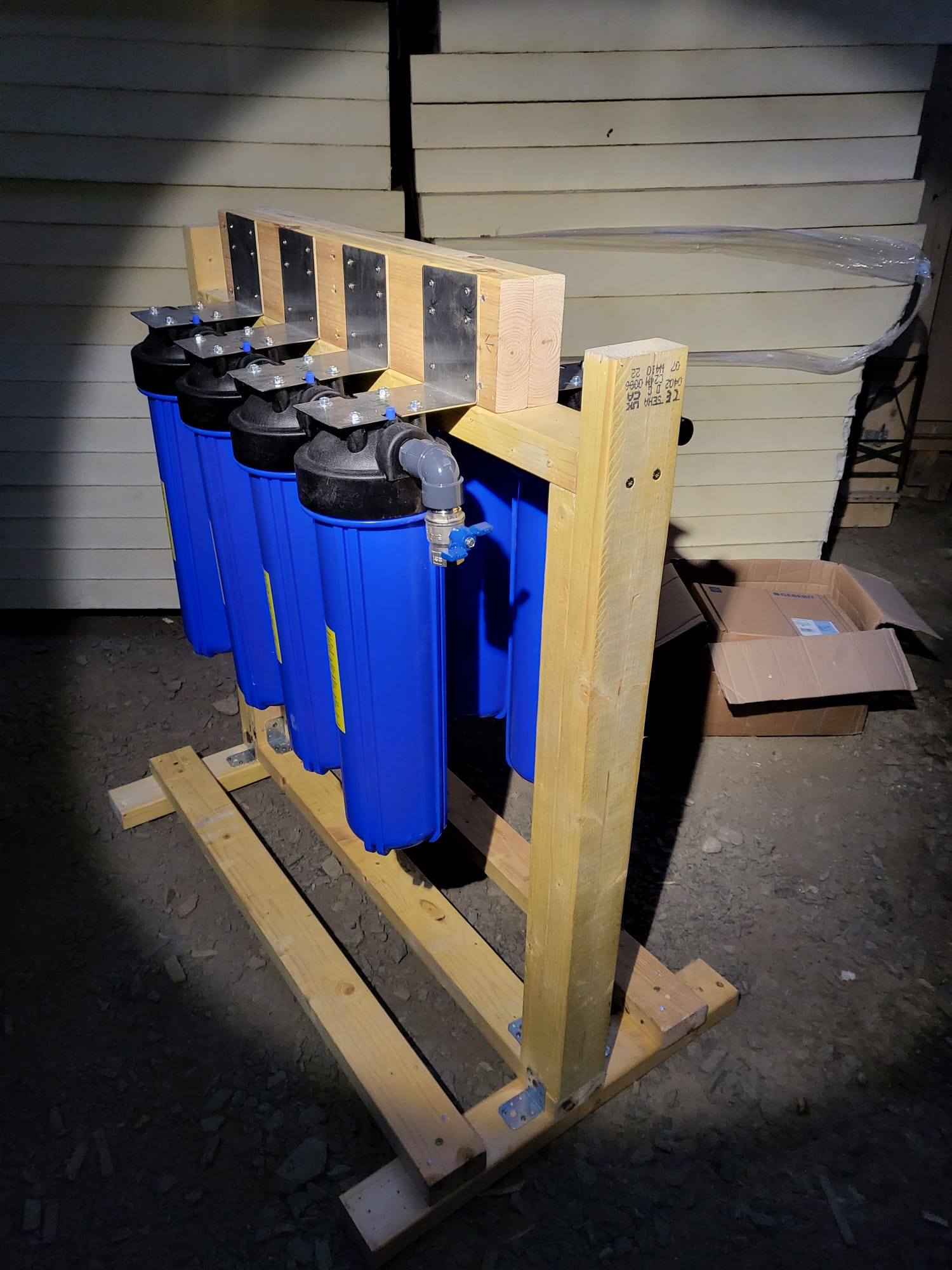
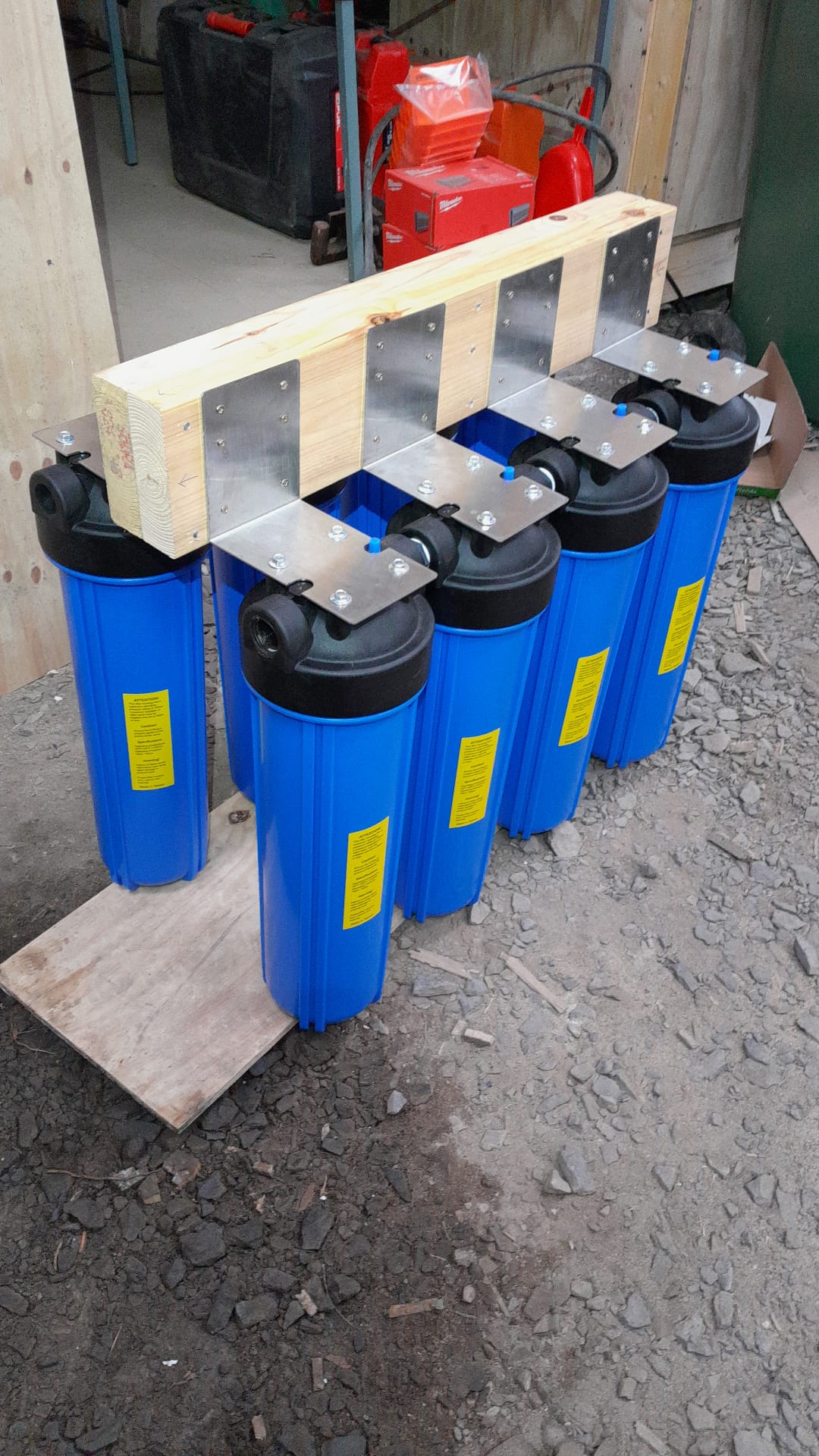
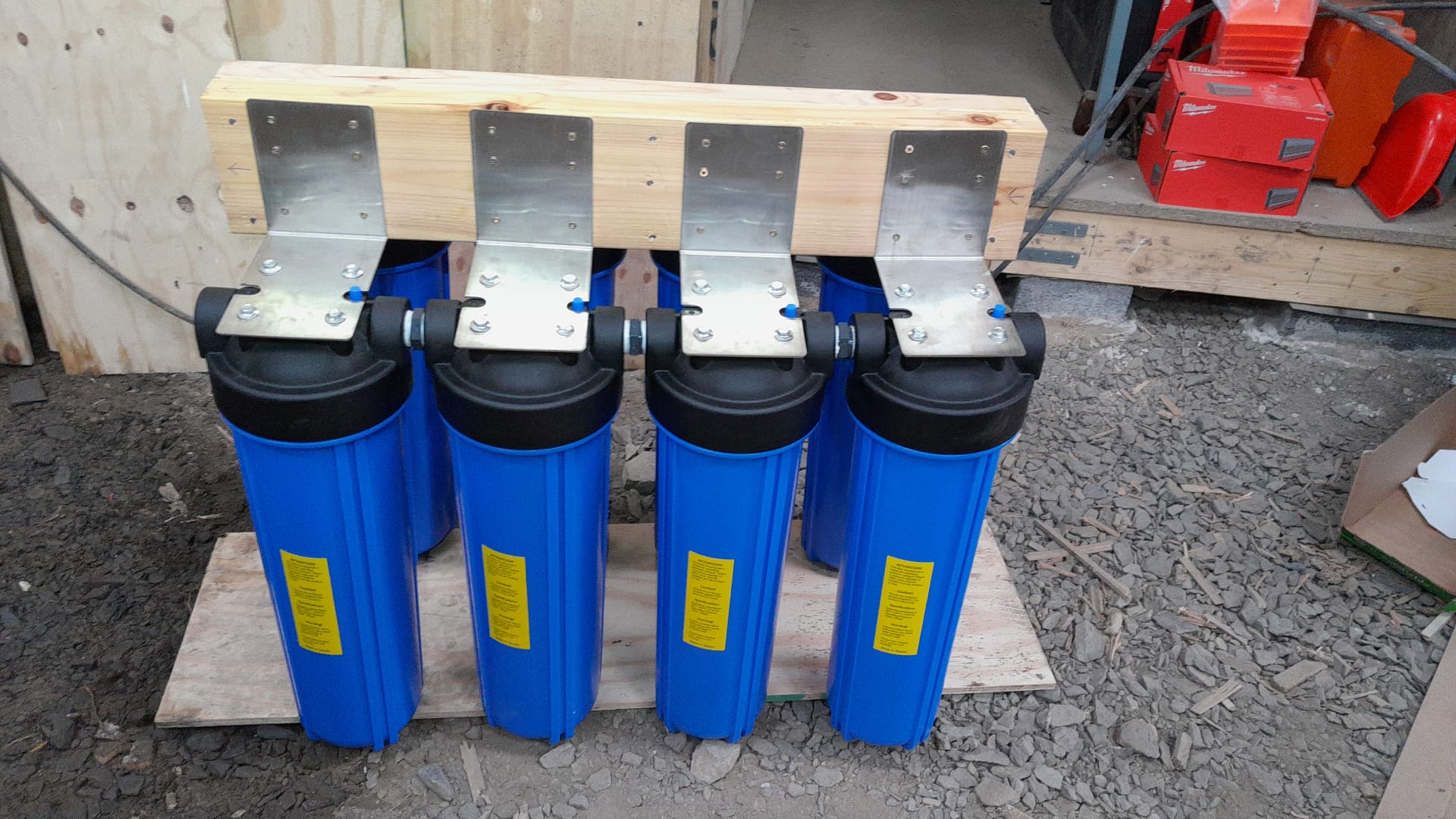
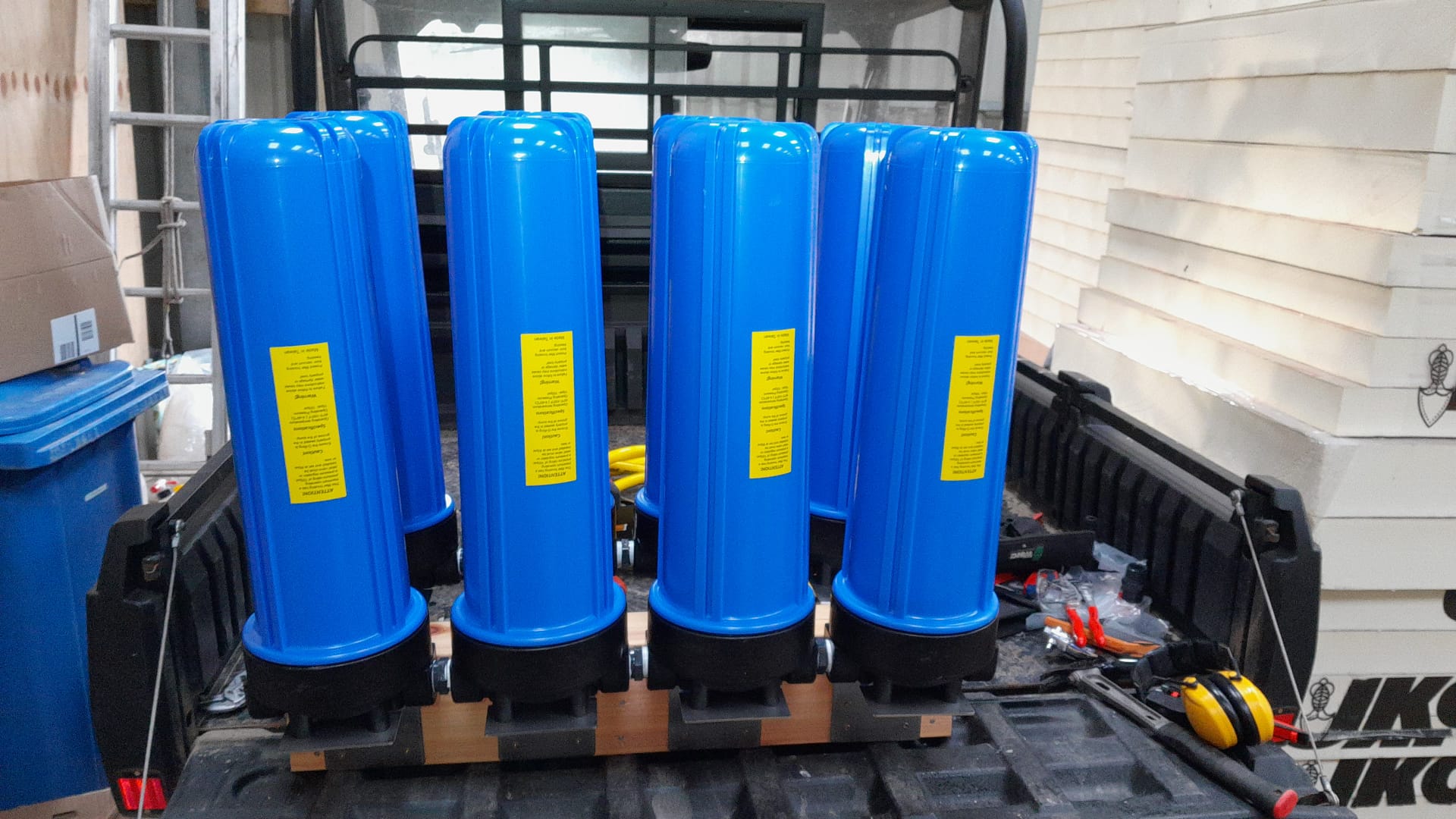
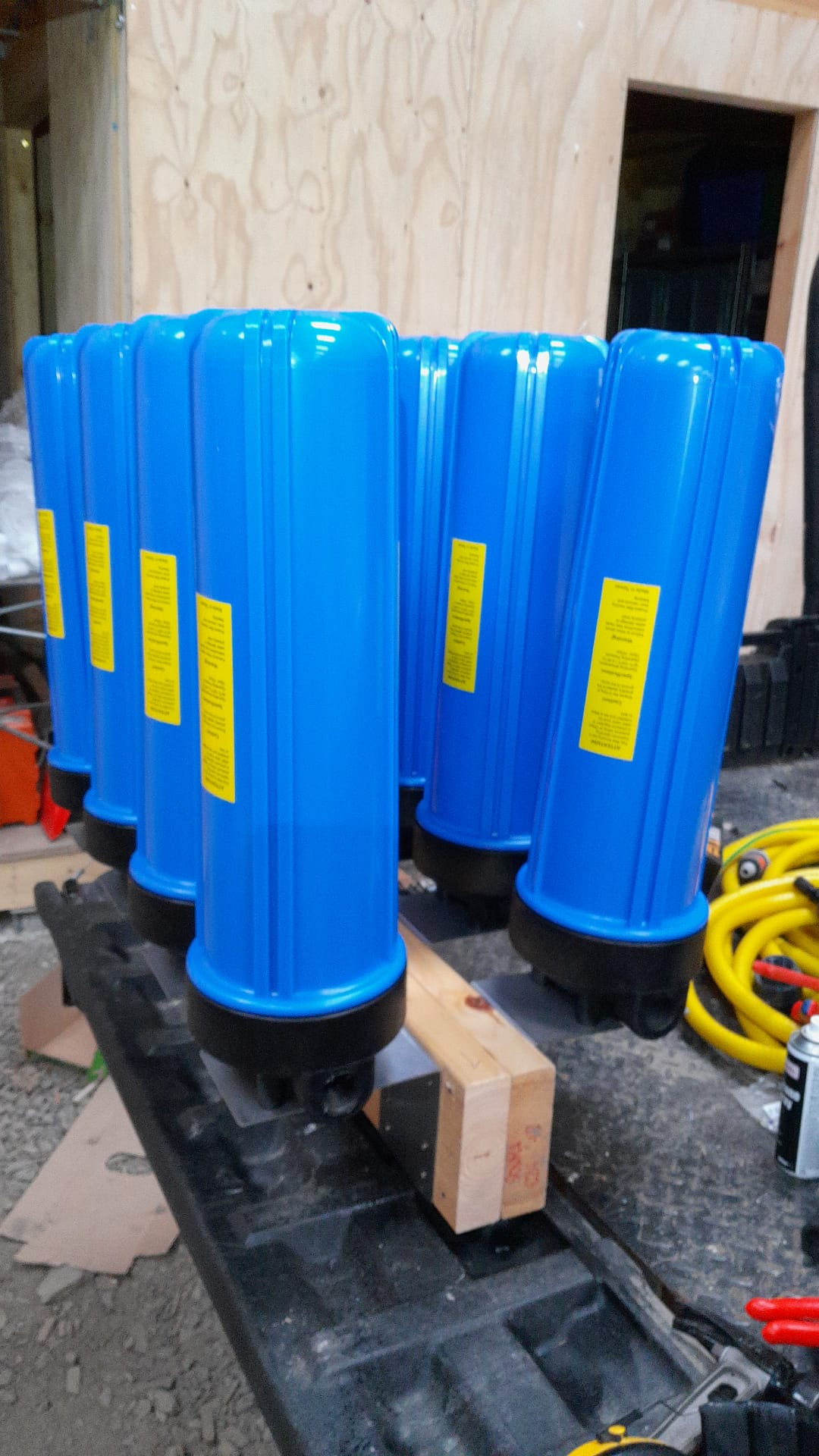
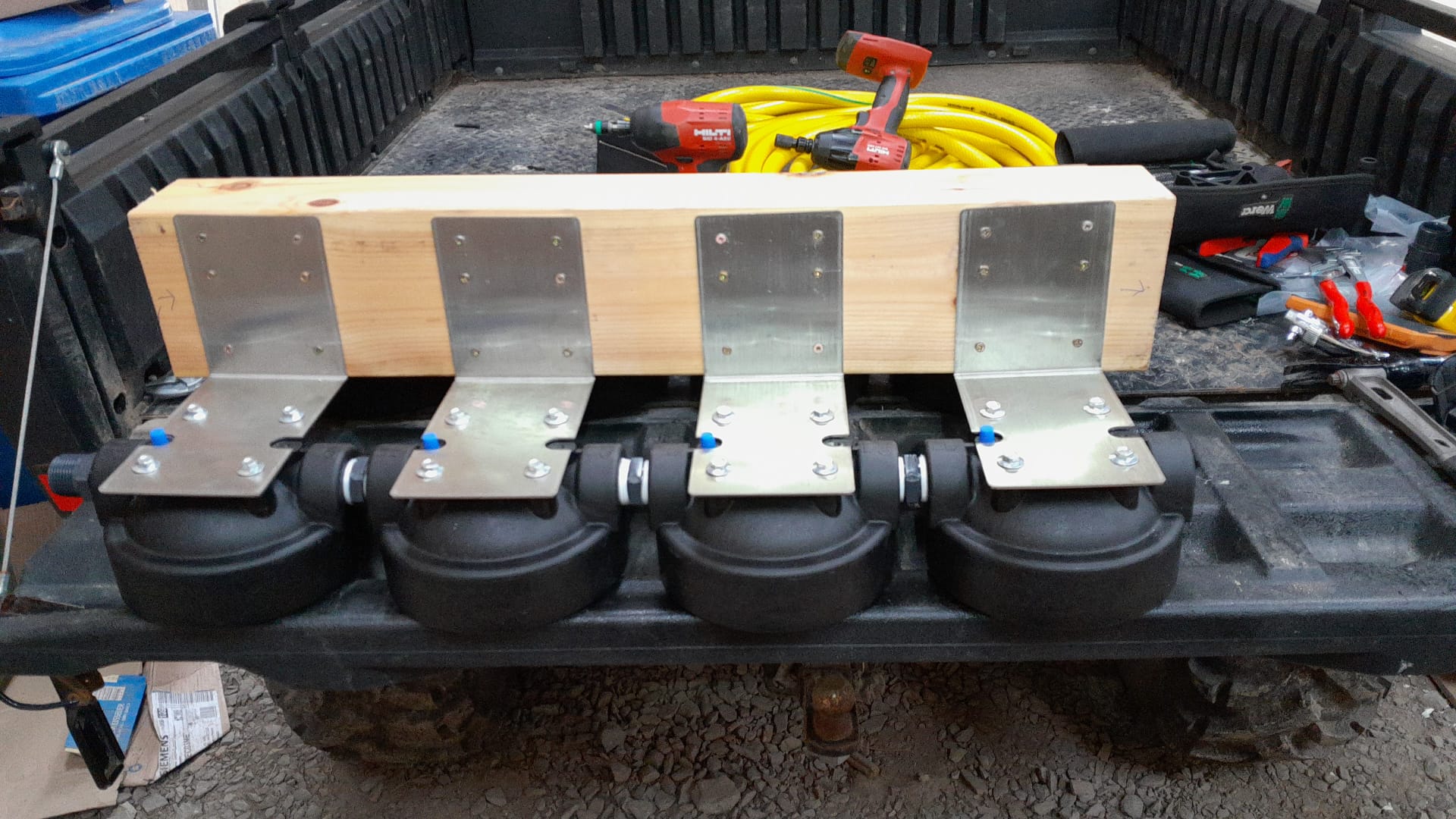
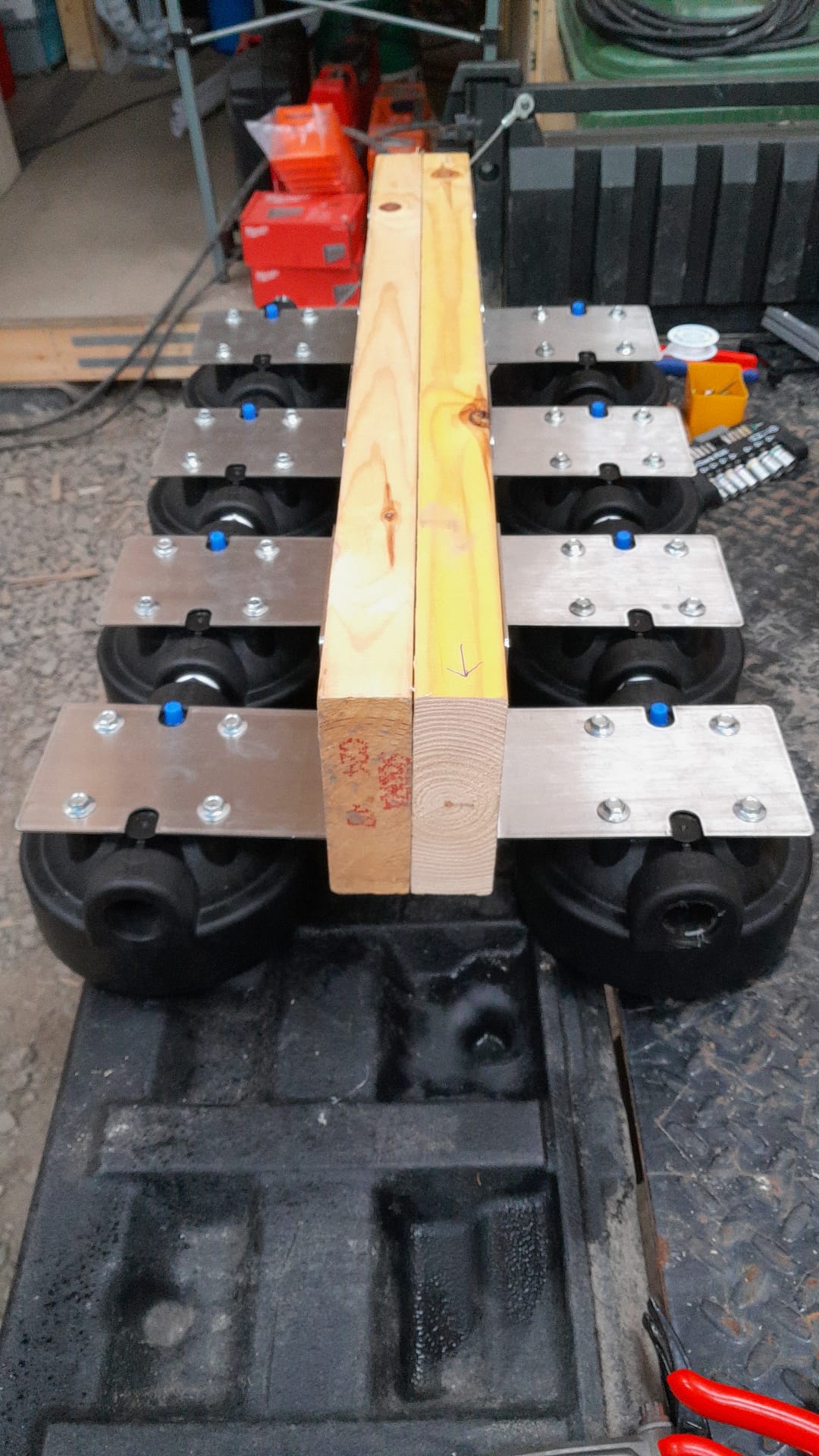
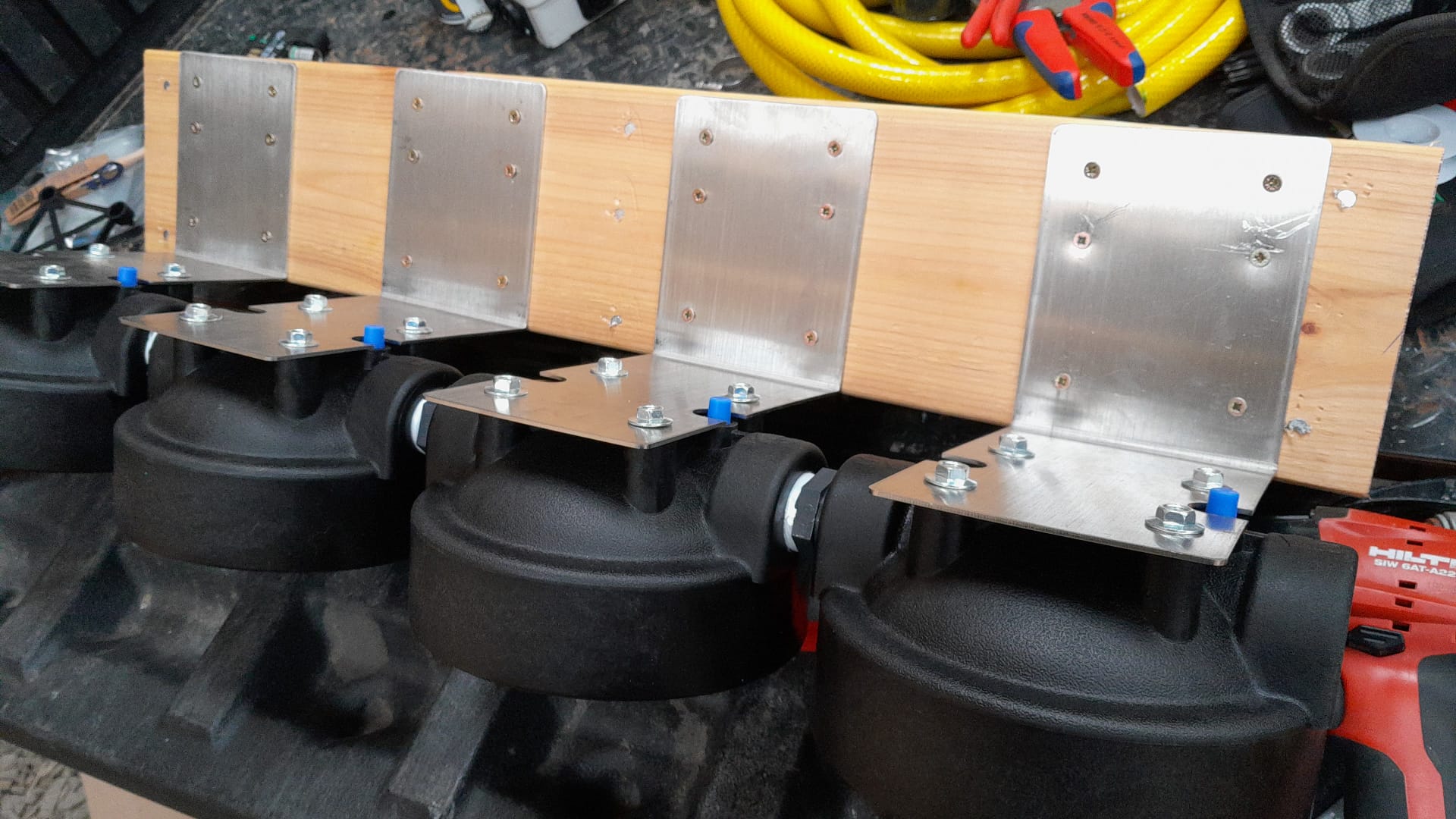
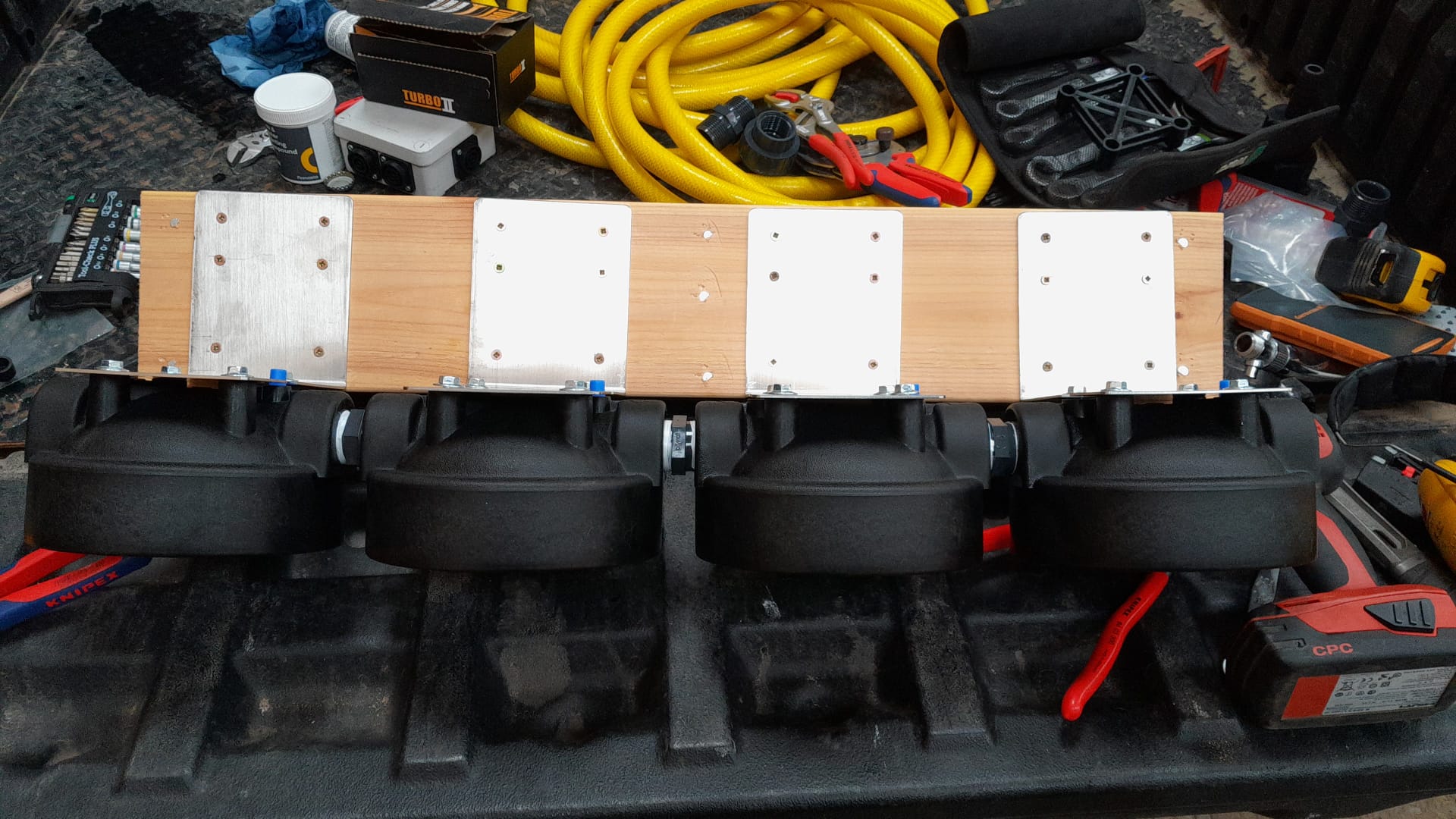
Here is the state of our current water filter build and installation:

With these 2 strings of 4 serial 20″ Pentek Big Blue compatible water housings we can filter in 4 steps from 50um, 20um and 5um down to 1um before it gets processed via the Wedeco Aquada UV lamp. However, we use Purefer Filter Housing from Global Water Solutions.

By running 2 strings in parallel we reduce the pressure drop stemming from the sediment filters and allow for maintenance and changing the filters without interruption of the water service to the barn.

The whole installation is just under 1200mm * 800mm (length, width) and fits on a standard EUR-pallet (EPAL).

Next step is to install the pipe works running from the “mains” connection (rainwater from both 6’000l tanks) to the filter housings and from the UV lamp to the DAB EsyBox Mini 3.

Another milestone: Dishwasher

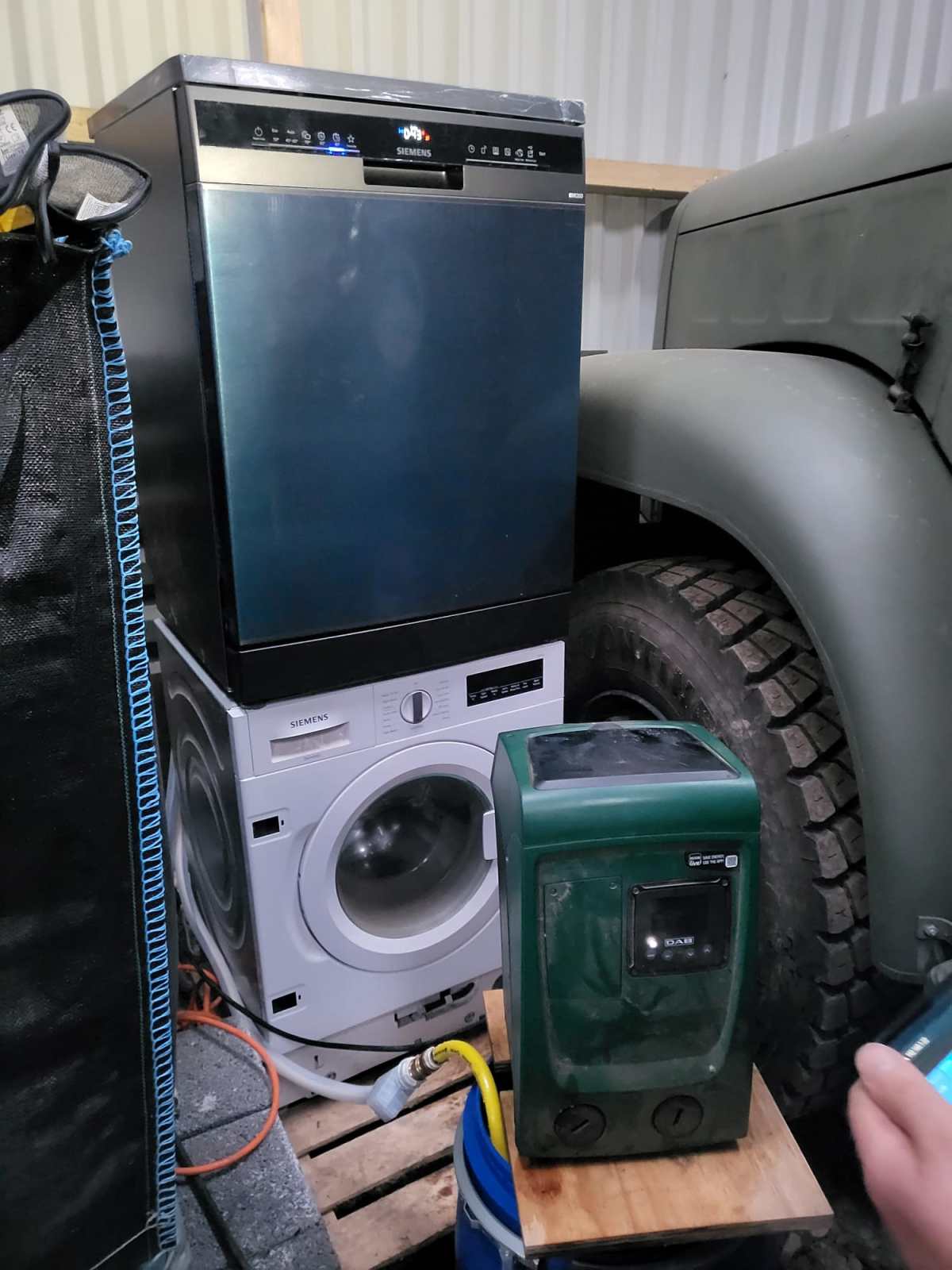
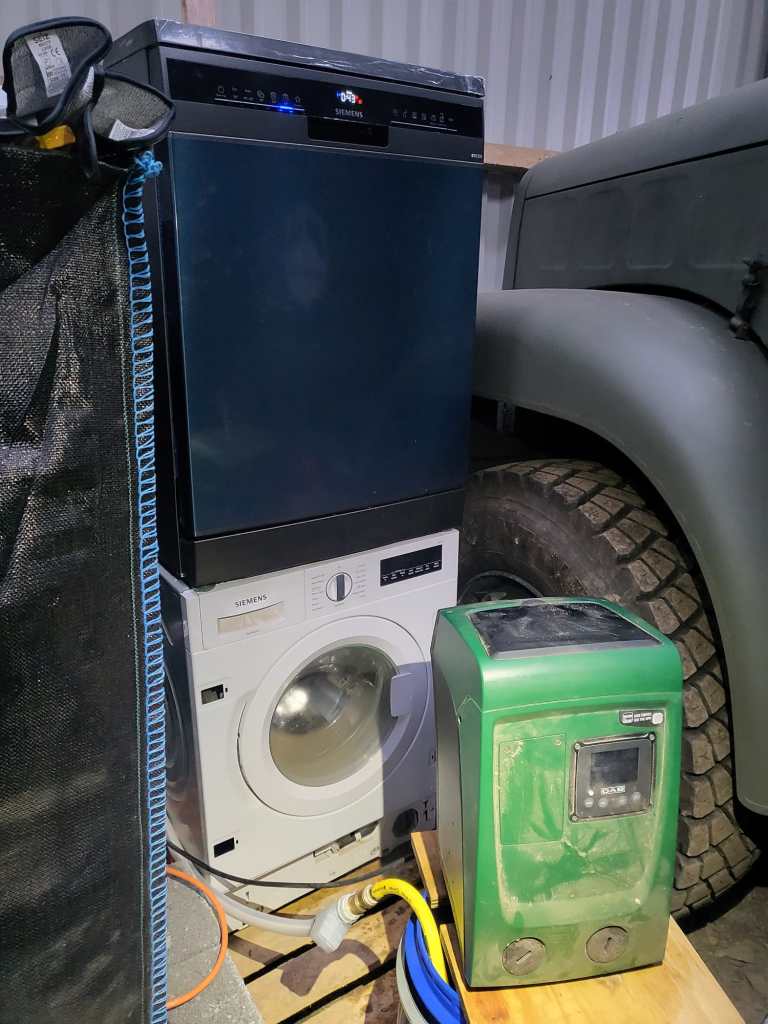
We definitely moved beyond Maslow’s pyramid and introduced a dishwasher to our ever growing list of utilities – which by the way fits nicely next to our Saurer 2DM … It is a Siemens iQ300 SN23EC03ME which is also driven by our DAB Esybox Mini 3.

What we found out so far:

  • Water consumption is much higher than advertised even when using the 45°C/45min programme.
  • Power consumption seems slightly higher than advertised as well with a peak consumption of around 2200W.

But all in all, we still save time, water *and* power compared to washing up by hand. And this holds true even for much less energy efficient dishwashers with an energy star rating of D or worse.

So, next time I buy a dishwasher I think twice if I spend a 100 quid extra on a more power efficient device – especially, when using solar for most of the year …

Dishwsher Siemens iQ300 SN23EC03ME on top of a washing machine driven by a DAB Esybox Mini 3

Quick review of our 12V USB-C mobile shower

Last December we wrote about our plans for a mobile shower. And today, I describe show how it actually works.

We currently use the shower, Brunner Aquafresh 2.0, in our Caravan instead of the built-in shower with the boiler to reduce the risk of legionellae and to conserve power.

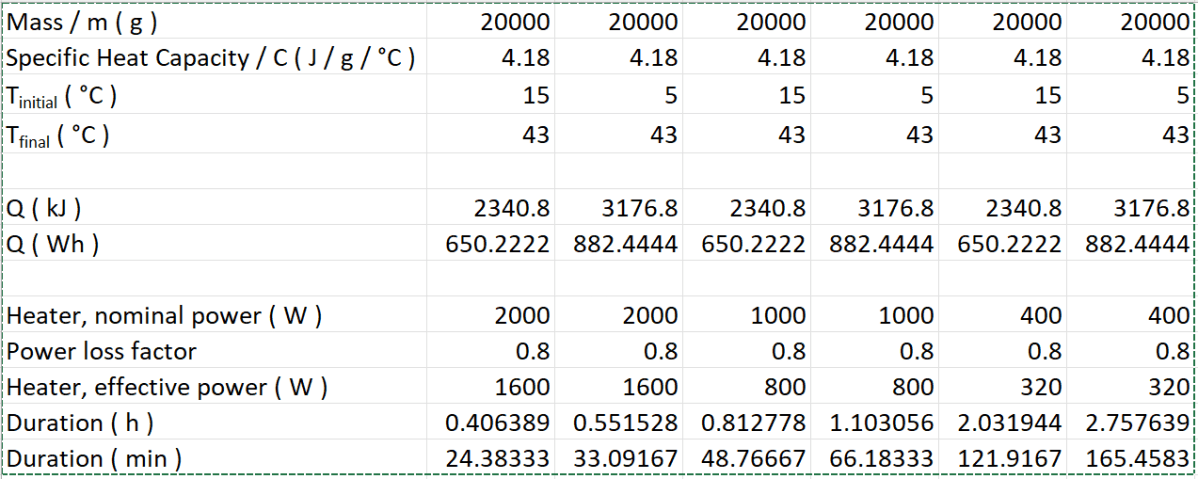
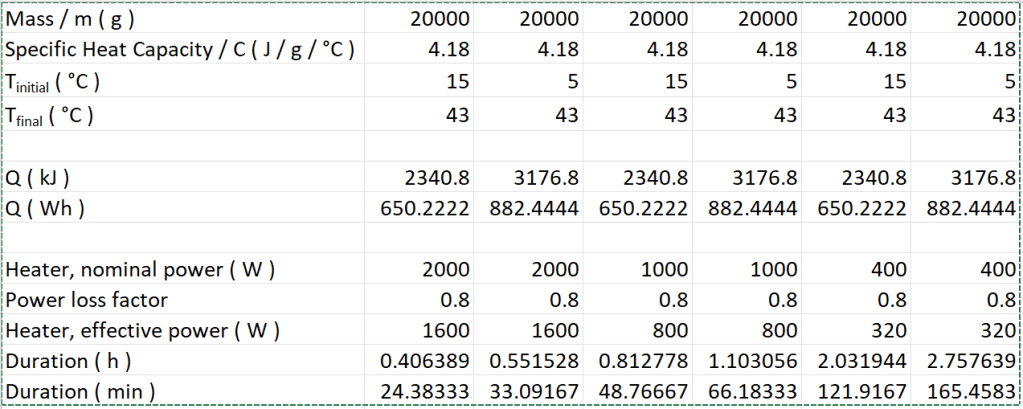
We heat the water with a 2000W immersion heater which takes around 25min to heat the water to 43°C from 15°C (see the post linked above for more details on time and power requirements). And make sure to stir the water after heating before use.

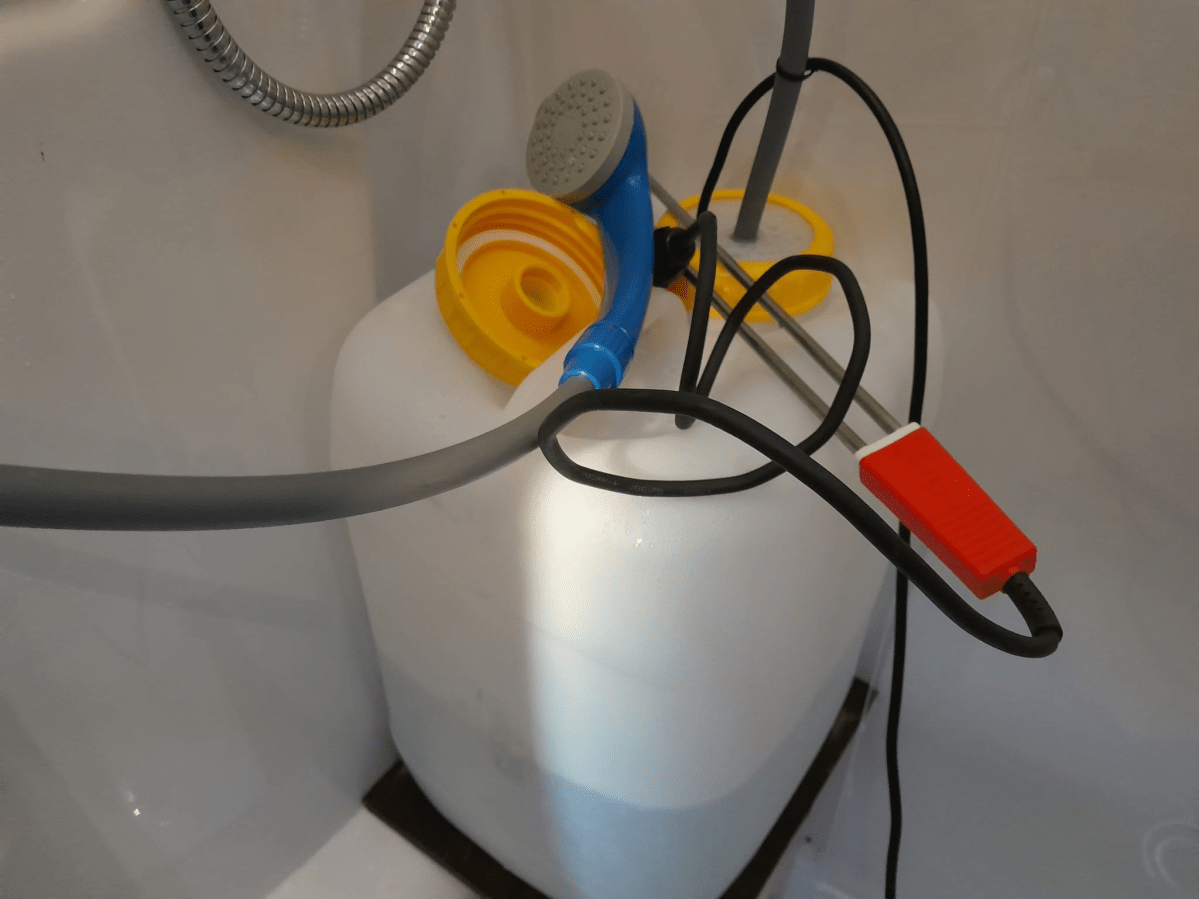
The water is kept in a DIN96 20l wide-neck container from Comet with a special dust 2-hole cap to fit the hose and the elecitricity cable into it. The pump itself has a standard 12V car/cigarette plug that connects to a USB-C trigger board that takes it power from a USB-C power bank with Power Distribution (PD) 2.0.

Everything is kept within a 30mm PIR tube and glued together with hot glue. This does not look to nice but it works. To further “water proof” the device I keep it in a plastic zip-lock bag with the opeining upside down. See below for an even easier option for this.

The on/off-switch on the shower itself is not waterproof – but until never got too much water to produce a short.

To actually get the hose and the electricity cable through the plastic cap of the container I cut away the switch (as it could not be opened) and connected a new one (from Steffen, bought at Landi for 1,50 CHF).

The power bank must be able to deliver 3A @ 12V (the pump has a nominal power consumption of 35W). Water pressure is ok, but not great. Two people can consecutively shower from a 20l container (without washing long hair, of course).

Video: Quick review of our 12V USB-C mobile shower

We also use it in our cars as a mobile shower. On the road we only have a 1000W immersion heater, so heating up the water takes twice as long. But in the summer the initial temperature is much higher so it slightly compensates the total time needed.

UPDATE: instead of going through the hassle to build a USB-C to 12V converter yourself, you can also buy this item from Aliexpress. It is a sealed USB-C to 12V converter. It is much smaller than the tube-based device and costs only around 5CHF, but has no fuse.

Note, that there is a version with and without converter. I went for the version with the converter and with a cable length of 300mm.

USB C PD Type C Male to 12V Car Cigarette Lighter Socket, image from aliexpress.com

Getting a Washing Machine from John Lewis & Partners

So, this will be another rant about online retailers and their delivery strategies in the Highlands.

A couple of days ago, I ordered _the_ missing piece for our barn: a washing machine. Having had good experience with Siemens, I went for a similar model that I already have in Switzerland, the Siemens iQ700 WI14W502GB. I wish I had that iQ. chapeau to Siemens product management and markting.

As I found it relatively hard to find Siemens retailers in the UK for that model, I ended up with John Lewis & Partners. Never heard of them before, but as it seemed they were an official Siemens reseller.

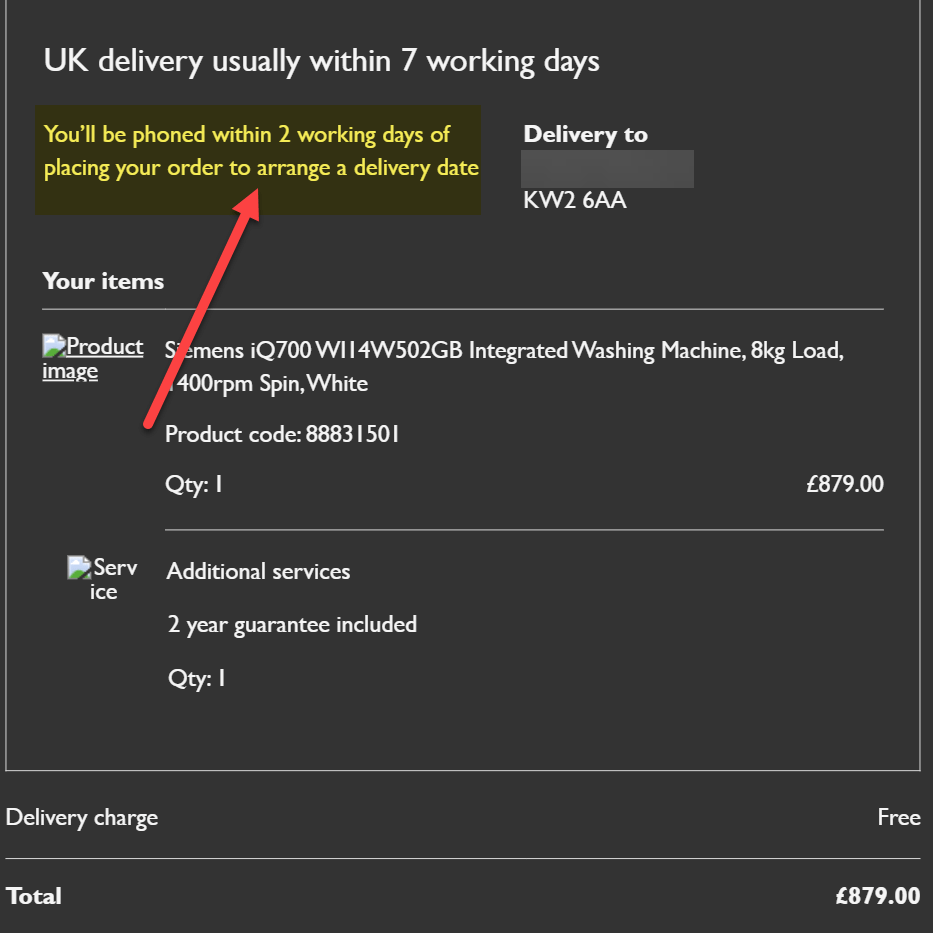
During order and checkout, I was told that the item would be delivered _usually_ withing 7 working days. Of course, the word “ususally” usually leaves room for variance and interpretation. And I got a “free delivery” and assurance they would call me within 2 working days after the order to arrange a delivery date. No “usually” there.

Order confirmation email from John Lewis & Partners

So, what happened next? I never got the promised call, but after a couple of days, actually after 7 working days, I received another mail telling me the item had been dispatched. So, no arrangement of a delivery date.

Item dispatch notice after 7 working days

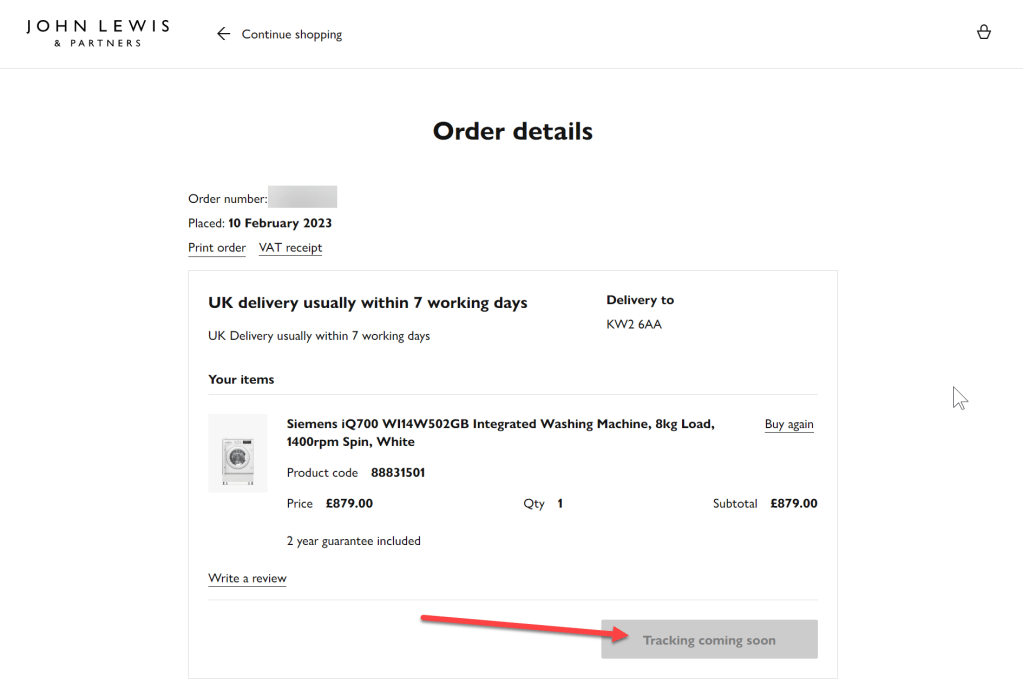
So, I waited another 24 hours as noted in the email to get the tracking link, so I could see in advance when the item was supposed to arrive. No luck that. Every day I checked the link, it only said “Tracking coming soon”.

John Lewis order details and no tracking link

Surprisingly, today I got a phone call from a delivery guy, telling me he was about to deliver an appliance. Unfortunately, I just left the property for some other tasks.

Now, less than 2h later and 10 working days after my order, my neighbour received the washing machine for me – with the tracking information still “coming soon” and me having to move the machine later on to my plot.

I would have thought that online retailers in 2023 could do better. – Hmm wait, I actually know online retailers that do better (for years).

Any “Customer Happiness Engineers” at John Lewis & Partners reading this?

And this is the end of today’s story about the delivery of a washing machine in the Highlands.

Our plans for a mobile hot water shower

While we were building our washroom on the plot, we were thinking of having a hot water shower in there as well. But instead of having a boiler and keeping the water hot for an extended unused time, we were thinking of sth different:

A manual boiler and a 12V camping shower.

The ingredients

How it works

  1. Fill the canister with water (20l max).
  2. Place the thermometer into the canister.
  3. Place the heater into the canister and hook it to the opening of the canister. Make sure the metal of the heater does not touch the plastic or the thermometer.
  4. Power on the heater (either from your battery or your inverter) and wait until the water gets to the destination temperature. For the actual duration see “The maths” section below.
  5. Remove the heater.
  6. Insert the immersion pump of the shower into the canister.
  7. Connect the power bank to the USB-C trigger board via the USB-C cable.
  8. Have the trigger board output voltage to be set to 12V permanently or set it manually to 12V.
  9. Connect the power calbes of the shower to the trigger board.
  10. Have a shower.

The maths

In case you are wondering, how it would take to heat up the water, here is my calculation (with the formula taken from various sources on the internet).

Q = m * C * delta(T)

So in case we want to heat 20l to 43°C from an initial temperature of 15°C with a 2000W immersion heater, we might need to wait for approx. 25min. If we did same but with an initial water temperature, it took us roughly 33min.

With a 1000W immersion heater, the numbers would change to 49min and 66min. And with a 400W we would have to wait 122min or 166min.

The amount of power needed is also shown on the above table. As you can see, it uses between 650Wh and 885Wh. So be careful when using a 12V immersion heater with your 90Ah car battery – don’t …

Conclusion

It quickly becomes obvious that a heater with only 400W will take too long to heat the water. At least I would put it over night into the motorhome, caravan, trailer or wahtever place so it can “pre-warm” a little bit. This might save you between 45min – 60min.

With 20l of water the shower experience will be limited to under 6min on “full throttle”. But with careful “breaks”, I still think the amount of water is sufficient for a full shower (not including washing long hair, of course). And if this does not provide sufficient water, there is always the option to add another 20l.

And: we will post a video with visual evidence as soon as it gets warmer …

Our water tanks arrived

Two weeks ago our water tanks arrived. But due to heavy winds, it was only possible to collect them last weekend.

The tanks are manufactured by Enduramaxx, but I actually ordered the tanks from JDP in Inverness, as it was cheaper to buy from them.

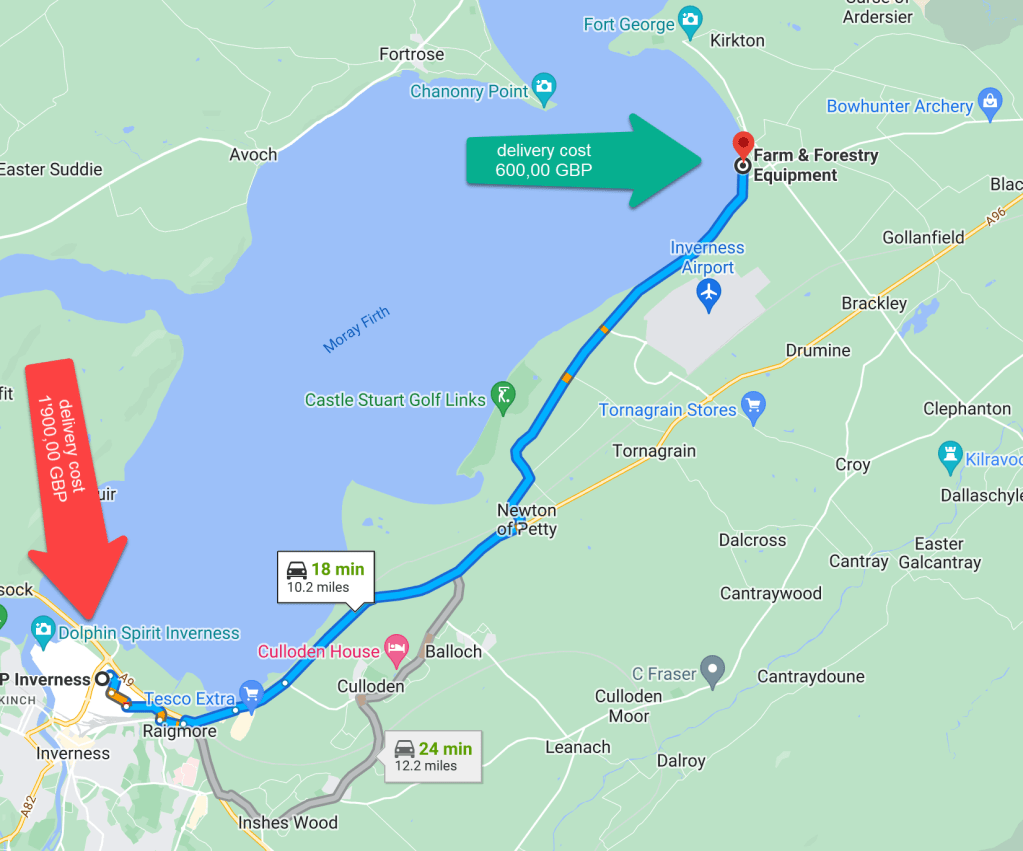
And then there were the transport cost … According to Enduramaxx or JDP, delivery cost to Whaligoe would be have been between 1’800 GBP and 1’900 GBP. Hmm, that is actually more than the price for the tanks!

Though JDP on their web site offered free delivery, there is a fine print on their web site (“Remote Areas”), stating that specific post codes seem to be exempt from it. When I suggested to them to pick up the tanks directly from their branch in Inverness (and thus saving me the delivery cost), they told me that I could certainly do that but the delivery fee would also apply. As it seems their branch in Inverness (post code starting with IV1, in the center of the city) is also considered a “Remote” or “Restricted” area.

But then funnily, Farm & Forestry in Ardersier (being 10 miles away from the JDP Inverness branch) was not considered a restricted area and could get delivered without paying a fantasy price.

A distance of 10 miles makes a difference of 1’300 GBP in delivery cost (source Google Maps)

The next interesting thing was the price of the water tank itself. The price quoted by the JDP main office was cheaper than the price of the Inverness branch – though both would buy the tank from Enduramaxx directly.

Anyway, after some weeks now the both tanks arrived. And I got 2 times the 6’000l version (instead of a 5’600l version that I originally wanted to buy).

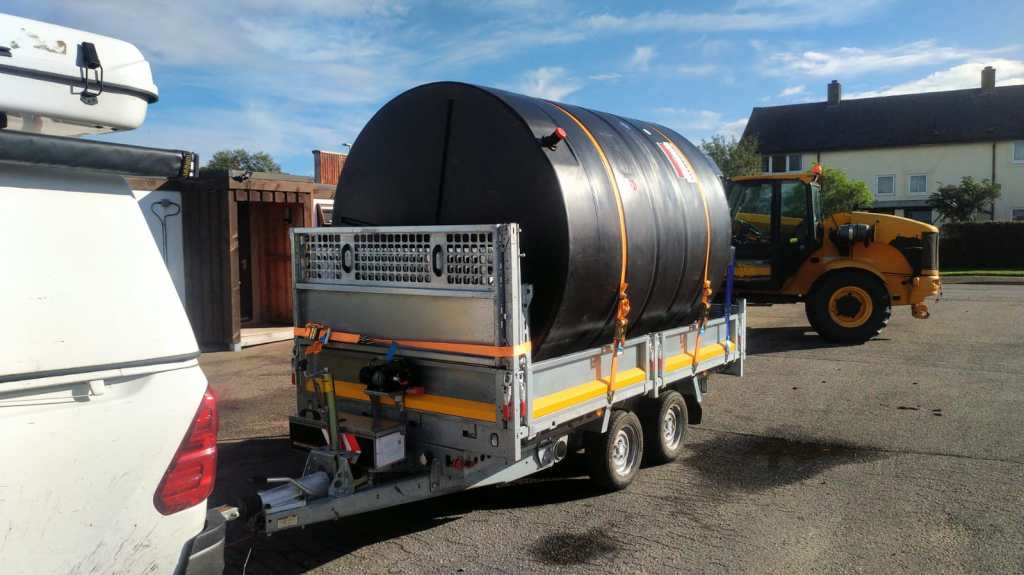
And on Saturday, I went to Inverness to load one of the tanks on my trailer. Once again, the trailer proofed its purpose. After unmounting the high side walls we could drop the tank carefully on the trailer bed.

And as soon as we have the roof on the barn, we can start collecting rain water …

Tank loaded and secured with 2 orange and 2 blue ratchet straps
Tank safely arrived in Whaligoe with 3 orange and 2 blue ratchet straps
On the way to the plot
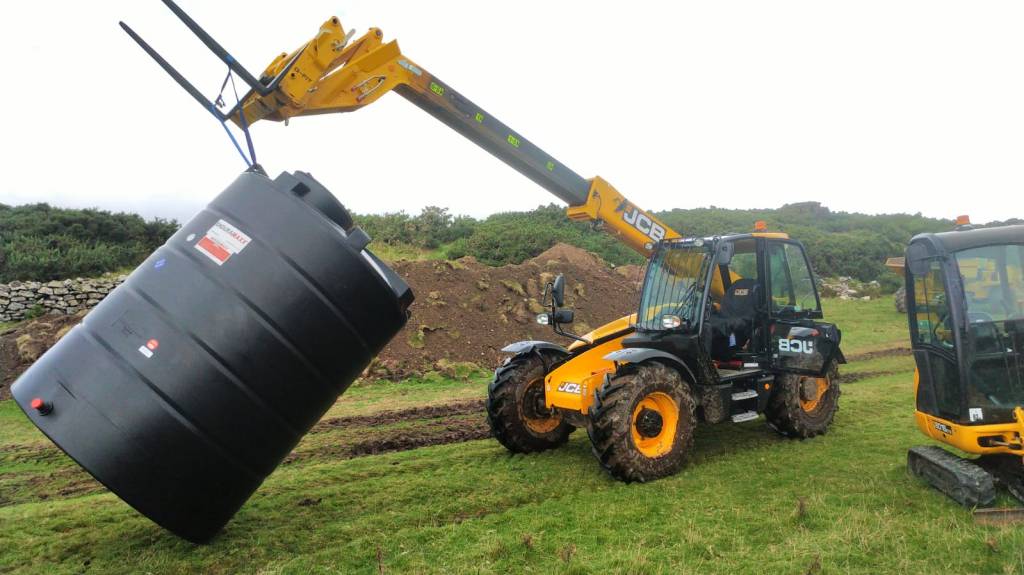
Unloading with the TeleHandler

ps – yes I had to stop on my way home a couple of times as the road surface and the resulting bouncing of the trailer was not helping at all to hold the tank in place …

Heating water with an immersion heater and thermos flask

Today I will task about how we heat water in our Toyota or caravan with a relatively low power consumption.

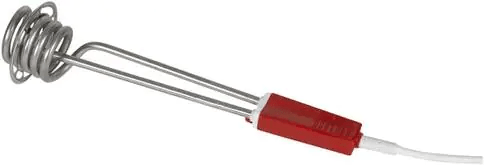
For this, we use an immersion heater that has a nominal power consumption of 1000W. The water is inside a one liter steel thermos flask. Be careful of course not to fill it up too much to prevent the boiling water of sparkling out of the flask.

Prosper Tauchsieder Real (image from galaxus.ch)

The water here has an initial temperature of 20°C (68F) and takes around 5 to 5 1/2 min to boil.

We successfully used the heater with different inverters. It also worked well on a relatively small model, like the Votronic 1200W and the 12V 200A Liontron battery without any issues.

There are even immersion heater models with lower power consumptions – often with a “portable” denomination. But of course it will then take accordingly longer to boil the water. But it might make sense if you have a smaller battery system or inverter. And there are DC models as well, that can be attached directly to a battery without an inverter at all.

But the main point for us was that this immersion heater just fits perfectly into the flask (after we removed the metal ring you can see on the picture). So after boiling, we can leave the water inside the flask without the need for an additional pot, and without having it to pour from one pot to the flask either.

The heater has a small plastic hook that it holds it in place. So it does not touch the bottom or any side of the flask.

After use the device is certainly hot, but it cools down quite quickly. If you use the water and empty the flask right away and do not have a proper surface on where to cool it, you can stick it back into the flask for cooling off.

And when not in use, the water heater takes nearly no space at all, or at least much less space than a normal electric water heater.

Two years ago, this water heater cost us roughly around 25 CHF. This is (today) around 25 EUR or 22 GBP. We got it from Galaxus, a swiss online shop. But we have no affiliation with it at all.

This model is called “Prosper Tauchsieder Real“, whatever this means. But as I said, there are plenty of different models out there.

Don’t forget to unplug the heater after use as it doesn’t have a sensor to detect when the water is boiling. The description however says, it has a dry detection feature. But I really never tried that out.

So this is it for today.
Sizing Water Consumption and Storage Tanks

With the nearest water connection more than 500m away and crossing a main road plus multiple neighbours’ grounds, we decided to go for a rainwater collection and filtration solution.

So be prepared for a lot of numbers in this post.

In order to size such a system, I first tried to find out the demand of (drinking) water we would have on our plot.

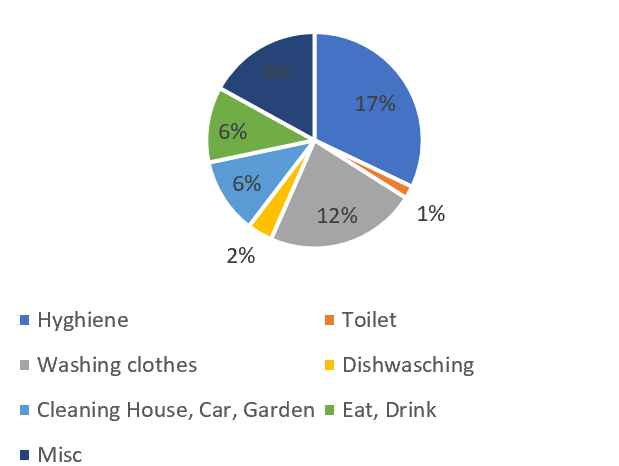
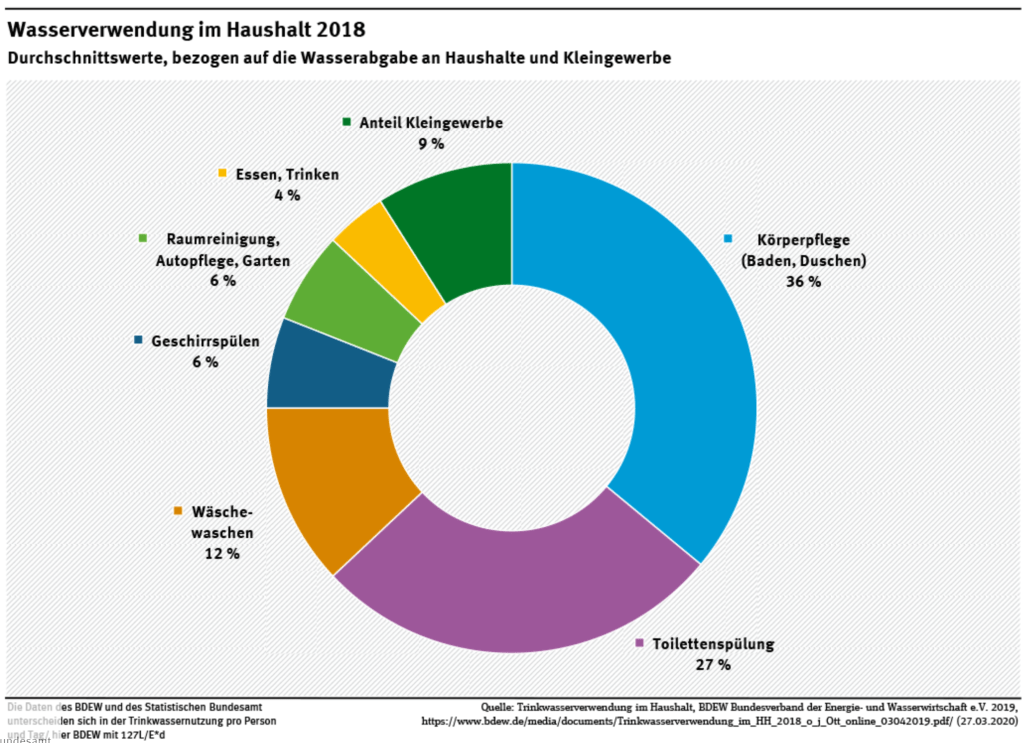
According to a publication of the german Umweltbundesamt every person in Germany used 123l of drinking water per day.
This breaks down to the following parts as seen in the following picture:

Source: BDEW 2019

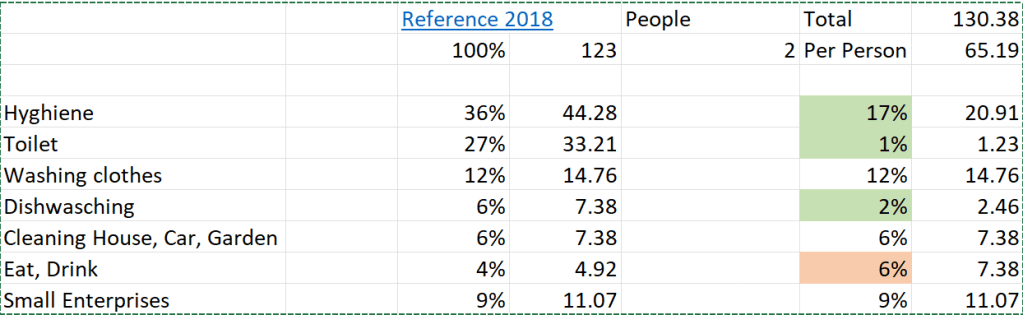
I adjusted the numbers slightly to what I would expect in our environment (for example, as we are using a composting toilet we need nearly no water for the toilet, but I left in the 9% for small enterprises). Percentages in green are estimated less than the provided statistics and percentages in red estimated higher than the statistics:

Summary of water consumption

This gives us a distribution like this:

Estimated Water Consumption Distribution (65l)

I then calculated the demand for 2 people of several periods of time:

Demand and Supply

So I came to the conclusion that our 2 people household would roughly need 50’000l of drinking water per year and that with a standard 1000l IBC we could last approximately 7 days (which I the amount of water we can easily carry in one go with the TeleHandler).

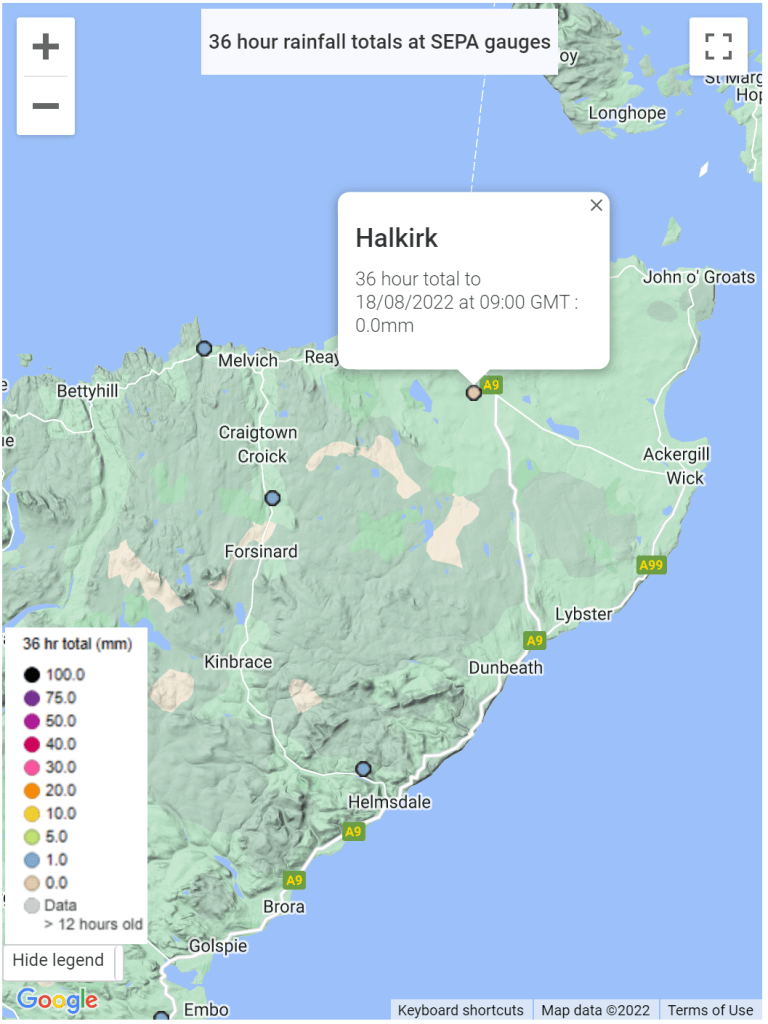
I then went on to the SEPA web site to find information about rainfall data in the area where we are. Unfortunately, the nearest data points on their map are either Halkirk near Thurso or Kilphedir near Helmsdale.

Image from: SEPA Rainfall data for Scotland

Among the various statistics they provide they list the actual rainfall in mm/cm2 for the last 12 months:

SEPA web site Rainfall data for Scotland

I projected the numbers from this chart to the size of the roof of our barn (roughly 310m2) that would act as our water collection surface:

Estimated rainfall

So even during the last driest months in the last year (June: 8’520l and March: 6’240l), we expect still be more than enough rain (> 4’000l) to supply us with water.

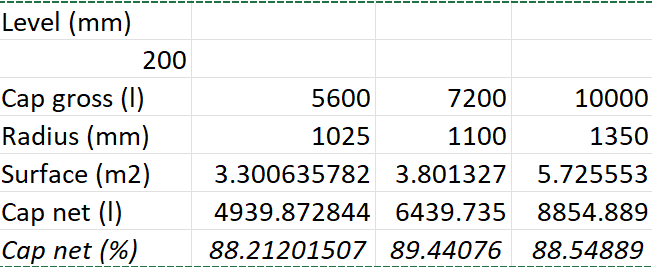
And now to the sizing: As I do not want to empty the tanks completely (there is always some sediment or dirt at the bottom of the tank), I want to be able to leave approx 20cm water level in the tanks.

I looked at the dimensions of water tanks from different suppliers and found these dimensions for the sizes of 5’600l, 7’200l, 10’000l:

Tank sizes and net capacity

So even with a 5’600l tank I could “survive” for a whole month and still had left 20% for increased demand while always leaving 20cm of the water in the tank. And with a lifting capacity of at least 1’250kg we can still move around such a tank if required.

So my sizing conclusion would be to get two of these 5’600l tanks (so one tank could always go into maintenance or act as a backup) and and have two 1’000l IBC tanks for emergency water transport.

Depending on the water tanks and its certification this would cost approx 2’500,00 GBP (without delivery fees or hoses and the like).

Did I miss or forget something? What do you think?

ps – below you find the podcast version of this blog post: