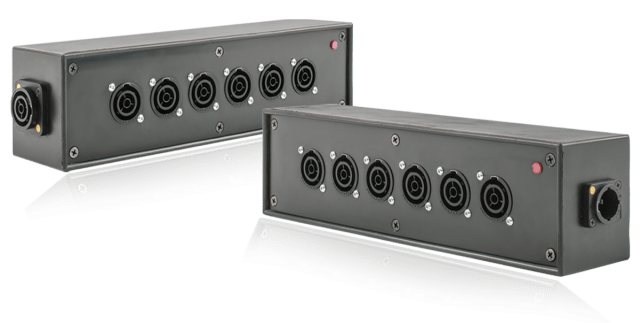
Recently, when I converted most of my electrical sockets and connectors to Neutrik powerCON True1 TOP, I was looking for a Neutrik power distribution. After some failed tests to build a box myself from an junction box, I found a product called Mini Brick from an italian company called Valentini which was sold via Distribution Zone in the UK for a retail price of 145 GBP (174 GBP incl VAT).
The box is essentially a 6-way (and not 7-way as shown above) power distribution rated up to 3500W (nearly 16A @ 230V) and has a red status light to indicate if it has power.
Build quality is very good (metal or hard plastic case, rubber coated); and the price is also understandable, as the chassis connectors alone would cost around 60 GBP. However, I was not totally happy with it due to is relatively massive form factor: L80mm x W75mm x H300 mm plus connectors.
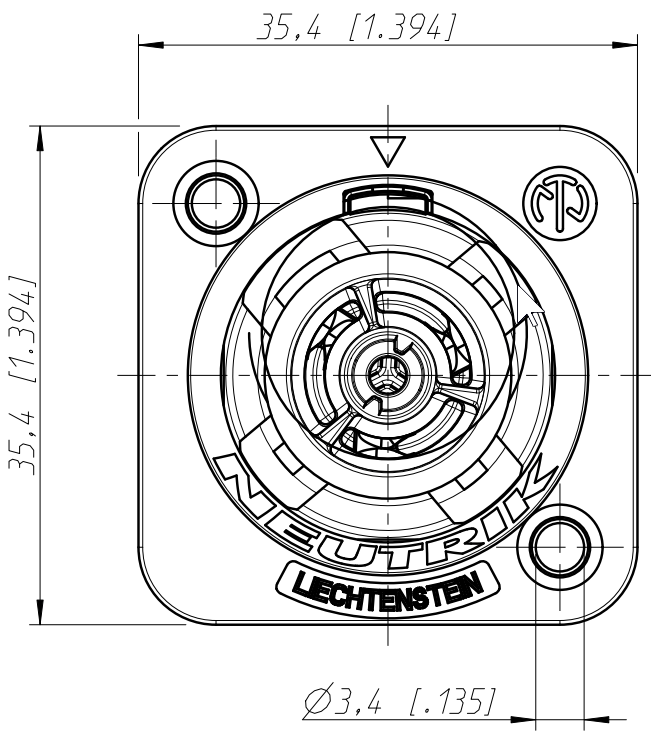
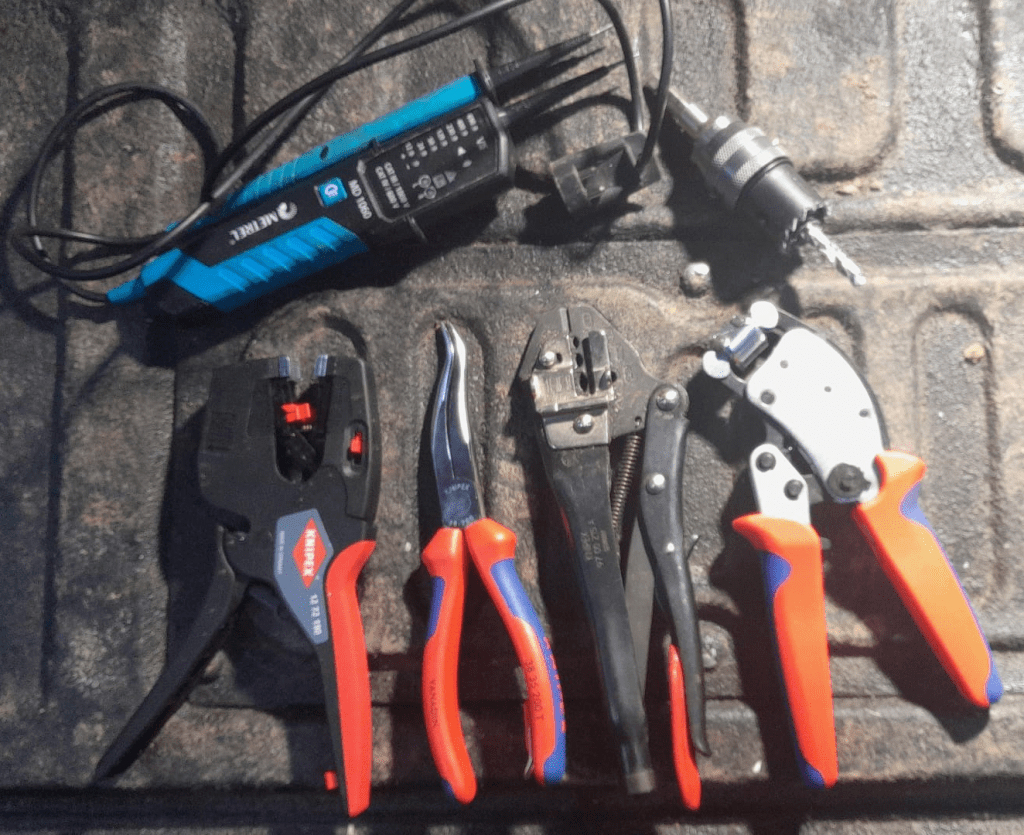
To cut the holes for the chassis connectors into the case, I used a Hilti 30mm hole saw with my Wabeco drill stand. Drilling the duplex chassis connector obviously needed 2 holes and a cutting away some excess plastic (later on I found out that a 25mm diameter is better suited for the smaller part of the duplex connector):
Opening for the Neutrik NAC3PX-TOP duplex chassis connector
Note: one might be even able to use 29mm and 24mm holes, see the detailed drawing – maybe I try this next time.
To mount the chassis connectors onto the box, I used M3 screws and hex nuts (I could not find TX versions) which I drill with a 3mm Hilti HSS-Cobalt drill (yes, overkill – but the only drill I had at hand). Unfortunately, the screws were a slightly too short, so it was a little bit of fiddling to get the hex nuts onto to the screws.
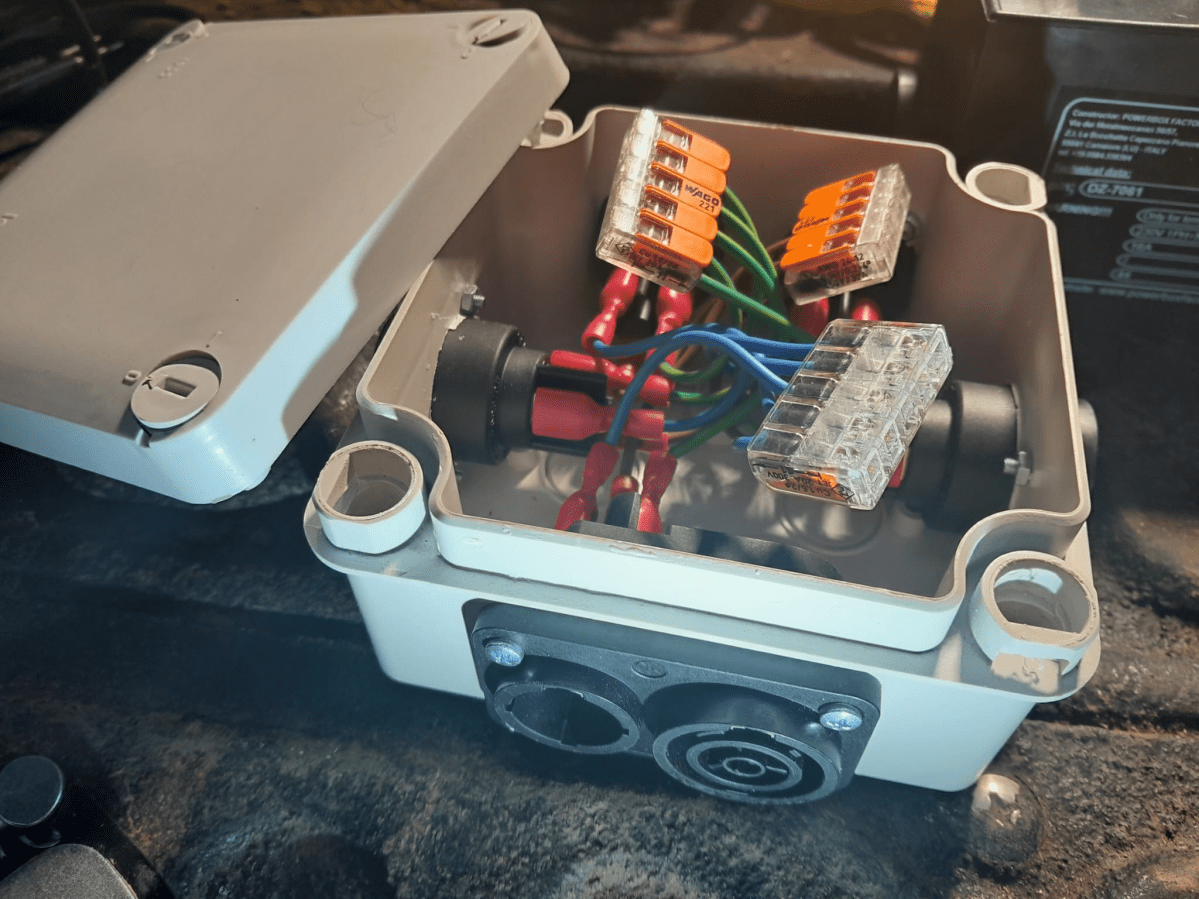
After all the Neutrik connectors were installed, I wired them to a 5-way Wago 221 COMPACT series splicing connector (221-415) with fully insulated blade receptable connectors (1.5mm2, 0.8mm, 6.35mm) to the socket and with 1.5mm2 ferrules to the clamp.
After assembly I did a final connectivity test to ensure all wires (L, N, PE) were correctly connected. As the duplex connector has a different wiring layout, it is easy to mix things up (PE is in the middle and not at the side).
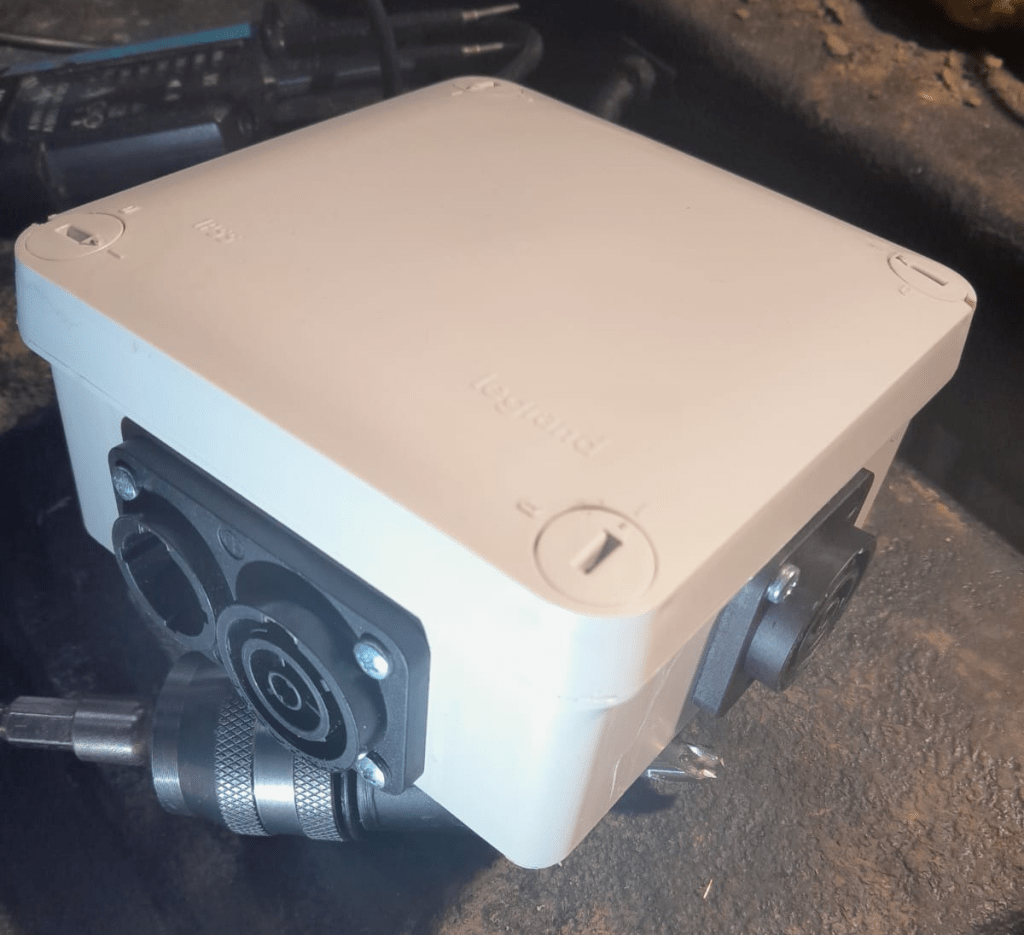
5-way Neutrik powerCON True1 TOP distribution in a LeGrand Plexo junction box
The end result is not as sturdy as the Mini Brick, but much lighter and smaller. And if I ignore the amount of labour I put into the build, this box is certainly much cheaper.
Video: 5-way Neutrik powerCON True1 TOP distribution box made from LeGrand Plexo
And as usual: electrical installations can be dangerous – only have them performed by qualified personnel.
I am not the first and probably not the last, either. With leisure batteries becoming larger and larger, fuel becoming more and more expensive and the EV charging network better and better, I thought it was time to rethink charging leisure batteries in campervans, mobile homes and the like.
As I restrict the charging of my EVE 280Ah cells to 125A, the maximum power to charge with is either 8* 3.2V * 125A = 3200W for a 8s 24V battery or 16* 3.2V * 125A = 6400W for a 16s 48V battery. But as of now, I only plan for 24V batteries in our vehicles. This means, that even with the lowest single phase Type 2 charger in a EV charging station we get more power (16A * 230V = 3680W) than the battery can be charged with.
and a single phase Type 2 socket to a Swiss T23 socket, which they call a “bike adapter” – this comes in handy at charging stations with a 3-phase Type 2 cable.
As a 24/3000 MultiPlus-II (or EasySolar-II) does only support charging of up to 70A (resulting in a nominal charging power of 24V * 70A = 1680W), we would still be 55A “short” of the desired maximum charge current of 125A. With the EasySolar-II GX or the MultiPlus-II GX there is no 24/5000 version and the MultiPlus-II 24/5000 uses considerably more power (18W vs 13W) and is way heavier (30kg vs 26kg [including MPPT charger] vs 20kg). In addition the inverter would be massively oversized as the maximum expected inverter power would be limited to 8* 3.65V * 125A = 3200W (^=4000VA), anyway.
So, I came to the conclusion the least expensive and space/cost-efficient solution would come in the form of a Victron Skylla-TG 24/50A Charger:
So, with the combined power of the EasySolar-II and the Skylla-TG (70A + 50A = 120A), I can now theoretically charge at 8 * 3.2V * 120A = 3072W – near the maximum supported power. As the charge current will probably reduce at around 80% SOC, my 24V battery can be charged from 40% to 80% within one hour – at a price of less than 30p per Kilowatt (or 90p the hour)!
Here a comparison with some smaller generators:
a Honda EU10i will deliver 900W with 0.538l (around 1671W/l or 0.598l per 1000W)
a Honda EU22i will deliver 1800W with 1.075l (around 1675W/l or 0.597l per 1000W)
a Honda EU32i will deliver 2600W with 1.394l (around 1865W/l or 0.536l per 1000W)
If one liter of E7 costs roughly 1.50 GBP, the price per 1000W is between 0.80 GBP and 0.90 GBP.
Comparison of different charging options
And with a standard vehicle alternator of 100A the maximum charge current for a battery would not exceed 60A. So, a realistic amount of power to charge the battery with a running engine is around 12V * 60A = 720W. If we expect the vehicle to use 2l per hour running idle, the price for 1000W would sum up to over 4.17 GBP – not cheap.
Only the Honda EU32i comes near to the maximum charging power of 3200W/h. But the initial cost for the inverter and the price per 1000W is far beyond the cost of an additional AC charger, a Type 2 adapter and the energy cost at the EV charging station. And ideally, the energy from the EV charging station is “greener” than the energy from the vehicle or stand-alone generator.
Note: I did not write about solar panels at all. The reason for this is our special “use case” where we are mainly in northern europe where during autumn and winter there are very little hours of sunlight – at a time when we need energy the most. Plus, only two of our vehicles have actually space on the roof for solar panels.
This is my current take on charging larger leisure batteries. What is your opinion on this?
On our seemingly never-ending quest to the perfect “mobile home” and its electrical setup.
Once, someone told me the perfect vehicle for a mobile home would be a tri-fold:
a 20m truck when stationary;
a Unimog when off-road;
and a Porsche when on roads.
As it seems hard to get hands on such a vehicle we have tried different combinations over the years – with a few “failed” attempts such as our VW California T6 or the Hymer B-MC I WhiteLine.
So, recently we took a different tac and went for a trailer. A “König KHC303630” to be precise; which is a 2m high, 2m wide, 3.66m long sandwich cabin on a twin-axle trailer (with an overall length of under 5m). The idea was to have something more comfortable and spacious than our Hilux with the roof-top tent. If you want to get an impression of how this looks have a look at one of thesevideos.
Before we actually made the decision to purchase the trailer, we went to Trochtelfingen to see for ourselves. It was then when we decided to have the main battery system voltage different from the 12V standard.
Originally, I thought to have a 16s 48V system with Eve 3.2V 280Ah cells. However, the resulting weight would be over 80kg – without BMS, case or inverter. So, I thought about installing an 8s 24V system with a resulting nominal power of 7168W. And it seemed that such a system would still satisfy our requirements.
The mximum single load would be 2000W for a duration of up to 35min.
The sum of all 12V loads would not exceed 360W.
The total load would not exceed 2300W.
The Eve cells support 0.5C, meaning I could constantly draw up to 2800W (at 2.5V) and 4088W (at 3.65V) at 140A. However, as my largest DC MCB is only rated for 125A I could only use between 2500W and 2650W. But that would be still more than sufficient. And the Victron EasySolar-II GX 24/3000/70-32, the inverter which I had in mind for this installation, supports sustained loads only up to 2400W anyway.
So first determine, how many 24V connections do we need?
For the 12V system, I expect to use a 12 port Plus/Minus distribution:
Refridgerator
Bed
5* lights
12V socket for shower
4* 12V sockets
To convert the battery voltage to 12V, I opted for a Victron isolated Orion-Tr 24/12-30 converter. The whole 24V/12V converter will be able to be by-passed and directly connected to the 12V of the trailer, as well.
For minimum chargin on the road, I plan for a Victron Buck-Boost DC-DC Converter 50A. But as this would take more than 6 hours of driving to fully charge, the idea is to mainly charge via AC. However, the EasySolar can only charge with up to 70A. And in order to get closer to the maximum of 125A, I would add a Skylla-24/50 TG . Why I chose the Skylla-TG over the Skylla-I? I only need it for sporadic AC charging and the TG model is lighter and cheaper.
So, with the EasySolar and the Skylla the total amount of charge current adds up to 70A + 50A = 120A, which totals in a theoretic 3072W (just over 13A at 230V). So, any standard 16A cable would do to charge the battery.
So, this will be another rant about online retailers and their delivery strategies in the Highlands.
A couple of days ago, I ordered _the_ missing piece for our barn: a washing machine. Having had good experience with Siemens, I went for a similar model that I already have in Switzerland, the Siemens iQ700 WI14W502GB. I wish I had that iQ. chapeau to Siemens product management and markting.
As I found it relatively hard to find Siemens retailers in the UK for that model, I ended up with John Lewis & Partners. Never heard of them before, but as it seemed they were an official Siemens reseller.
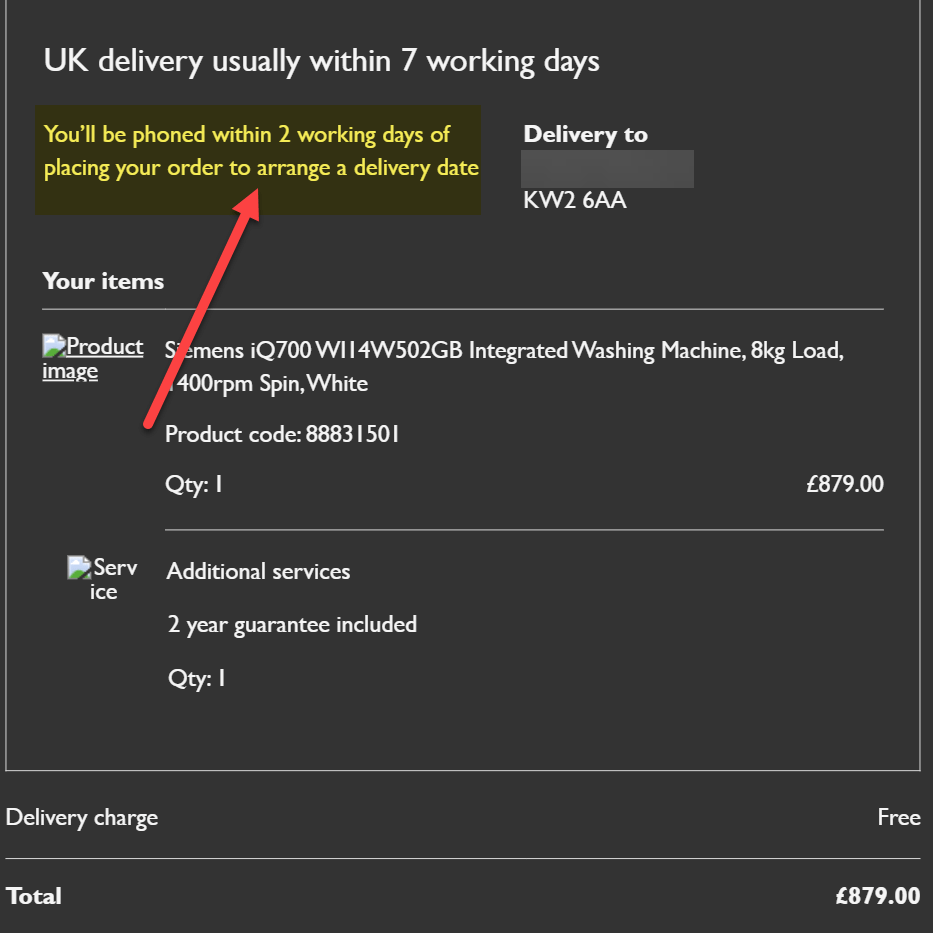
During order and checkout, I was told that the item would be delivered _usually_ withing 7 working days. Of course, the word “ususally” usually leaves room for variance and interpretation. And I got a “free delivery” and assurance they would call me within 2 working days after the order to arrange a delivery date. No “usually” there.
Order confirmation email from John Lewis & Partners
So, what happened next? I never got the promised call, but after a couple of days, actually after 7 working days, I received another mail telling me the item had been dispatched. So, no arrangement of a delivery date.
Item dispatch notice after 7 working days
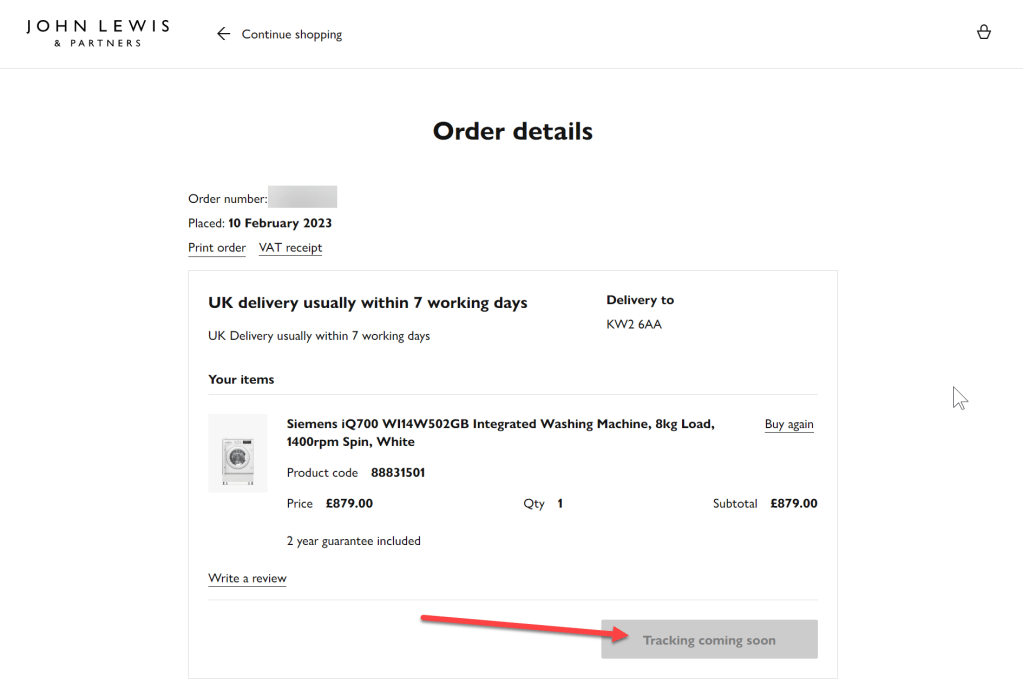
So, I waited another 24 hours as noted in the email to get the tracking link, so I could see in advance when the item was supposed to arrive. No luck that. Every day I checked the link, it only said “Tracking coming soon”.
John Lewis order details and no tracking link
Surprisingly, today I got a phone call from a delivery guy, telling me he was about to deliver an appliance. Unfortunately, I just left the property for some other tasks.
Now, less than 2h later and 10 working days after my order, my neighbour received the washing machine for me – with the tracking information still “coming soon” and me having to move the machine later on to my plot.
I would have thought that online retailers in 2023 could do better. – Hmm wait, I actually know online retailers that do better (for years).
Any “Customer Happiness Engineers” at John Lewis & Partners reading this?
And this is the end of today’s story about the delivery of a washing machine in the Highlands.
With the next Toyota Hiace and the Saurer 2DM around the corner waiting to be converted, I thought it was time for consolidating our vehicular electrical installations.
But before going into details, some history first: In 2019, we started on the VW Calkifornia T6 with a Super B Epsilon 12V90Ah LiFePO4 battery as a simple drop-in replacement and added a Votronic SMI 1200 ST inverter to it. And this was probably where I made my first two mistakes. At that time, I decided for Votronic and against Victron Energy. And I did not pay attention to the non-existing programmability and extensibility features of the Votronic inverter.
Once with a vendor stick with that vendor? There a pros and cons to it as we will later see.
When we later prepared our Hilux for our first longer trip to Loch Watenan, I opted for a Liontron 12V200Ah battery again (for the reason Liontron being way cheaper than Super B). And for the inverter/charger, I went for Votronic again (SMI 1200 and the same DC-DC charger 1212-45) .
But when I tried to get the DC-DC charger working, I realised that the D+ signal was not available on the Hilux. All in all, I did not get it to work in any configuration and looked for alternatives – which came in the form of the Victron Orion-Tr Smart DC-DC Charger family. And when I had to add an AC charger (where in the Hymer I could use the existing AC charger) to load the Liontron battery “on-shore”, I chose the Victron Blue Smart IP22 Charger.
So, at that time there was some kind of tie between Victron and Votronic. And the setup was getting more complicated and more complicated. And I am not only talking about the diminishing space in the trunk of the Hilux.
If I had known about the Victron MultiPlus series at that time I could have saved me a lot of headaches and complications.
It was shortly after our first and very successful trip to Loch Watenan, when we got rid of the Hymer and I added the battery from it as a second battery to the Hilux. And I got 2 more Victron DC-DC chargers. But I sticked to my Votronic inverter. And this is how the final layout looked like:
Toyota Hilux setup with 2 Liontron 12V 200Ah batteries, 4 DC-DC 30A chargers
This all worked well end of 2021 when one of the Liontron batteries did not want to charge properly anymore. The combined cell voltage stayed low at 13.1V with no single cell near at 3.5V and the internal BMS still reported 100% SOC.
So it was time for a change. And while doing that eliminting some design shortcomings of the current installation:
Invertert has a power maximum of 1200W.
AC charging is limited 30A.
Both 200Ah batteries are operating separated with one of them feeding the inverter and the other feeding the 12V DC sources.
Each pair of DC-DC chargers is bound to a single battery.
The alternator cannot feed all 4 DC-DC but only 3 chargers at the same time.
Have both batteries run in parallel to feed the inverter and the DC sources at the same time and thus reducing the maximum current at 1300W to 65A (when both batteries are dropping down to the minimu of 4* 2.5V = 10V) or considerably lower when running at 14V (45A) .
But the “best” of it, I then got rid of all the Votronic devices and can integrate and configure more easily with Victron. And I can do the same in the Saurer and HiAce.
I hope I can start with the conversion mid of March and will post updates on the way.
So, what do you think? (And no, I have no affiliation with Victron at all.)
The Caravan we got last year did not come with an inverter, so getting coffee in the morning or running a microwave was only possible when our main generator was running. And the installed battery for 12V support had a rather small capacity. This was clear to us from the beginning, as we eventually wanted to connect the Caravan to our EVE 280Ah cells.
But since we got our Starlink internet and our router did not seem to run easily on DC power, we needed -in addition to the temporary morning AC coffee spike – a more permanent AC solution.
Of course, first I updated the firmware of the inverter and configured it work with the battery:
Setting the AC input to 16A
Setting the battery type to LiFePO4
Setting the charge current to 70A (which is over the recommend amount of 50A, but see below for details)
As I did not want to connect a Cerbo GX to the system, I just used the VictronConnect App. Maybe I add a VE.Bus Smart dongle later on, or I connect some GX nevertheless. Who knows … Until now, it needs a wired connection to the inverter to see its status.
After powering on the generator, I confirmed everything was roughly working as expected. During the first run, the SOC was shown as 100% though the BMS of the battery internal saw it differently. In addition, the reported Amps and temperature were seen differently, as well. So, even that I set the inverter over the recommended maximum of 50A for the battery, the actual charge power was never much higher than the actual maximum).
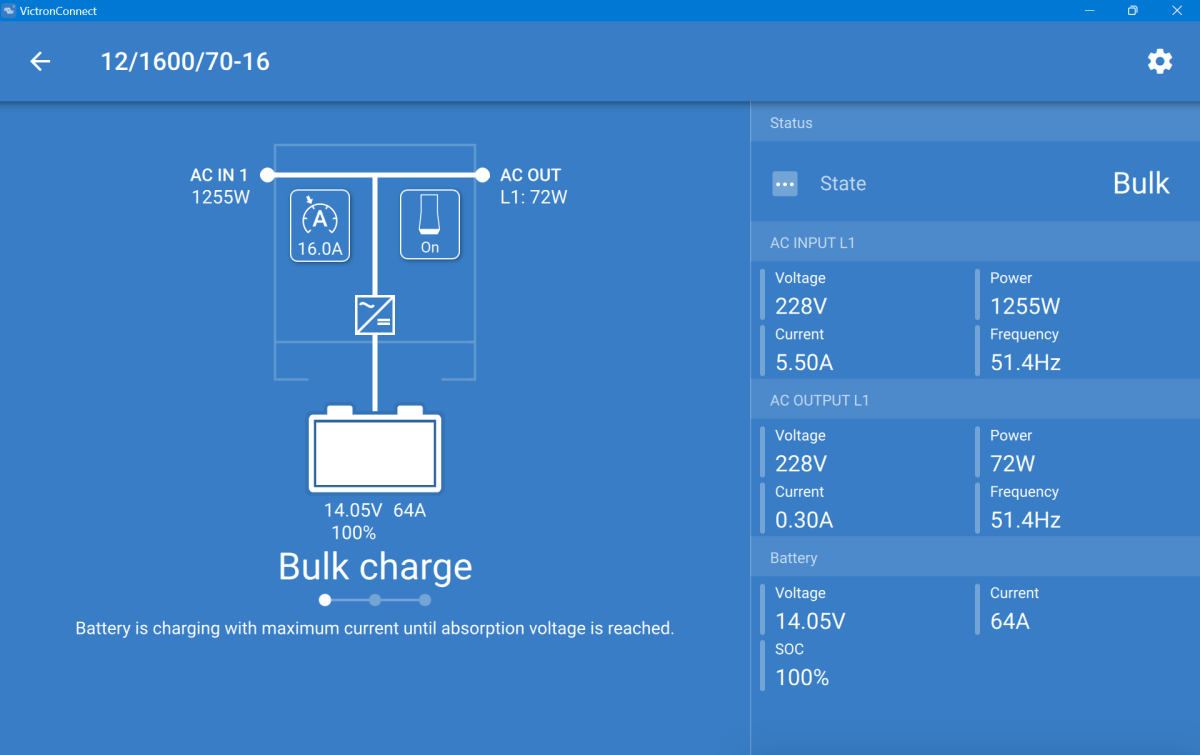
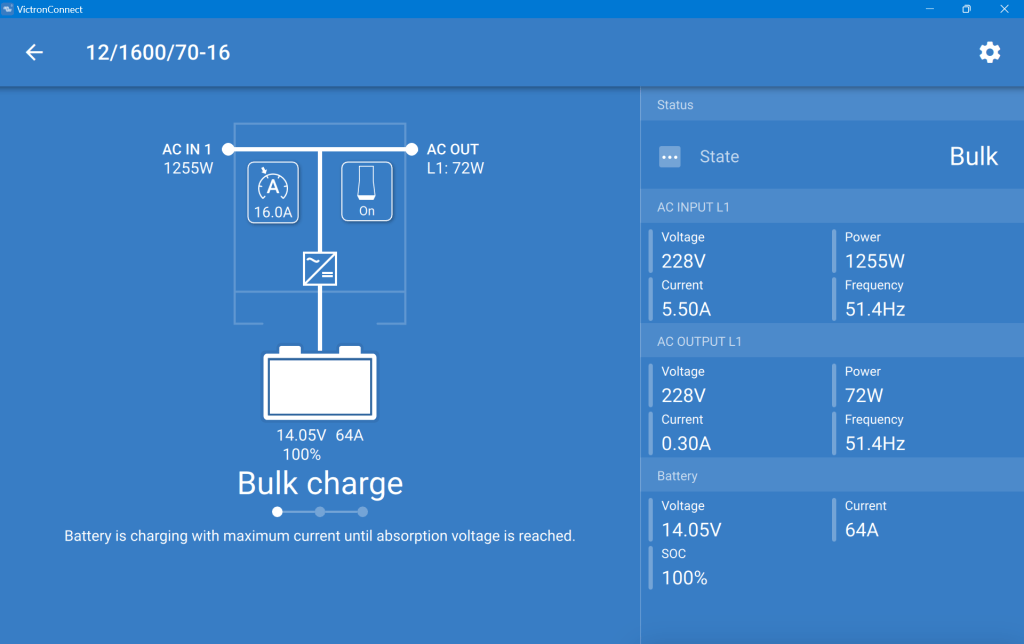
This is what the inverter saw (100% SOC, 14.05V DC cell voltage, charging at 64A):
MultiPlus charging the Liontron battery via the generator
And this is, what the Liontron BMS reported (76% SOC, 13.8V DC cell voltage, charging at 55.5A):
The SOC as seen by the Liontron battery BMS
In the end, the BMS stopped charging when it thought its batteries were full. And the inverter did not complain. However, I noticed that the cells were really not in balance (with a delta of 200mV between the lowest and highest voltage).
Discharging was ok, as well. However, I soon realised that the 100A discharge current could not be achived in my setup. The inverter tried to draw power and the BMS cut off with a “Discharge over-current” (OCD). SO, still no coffee via our Nespresso machine (and no microwave either, for that matter).
So, what is the take away of all this?
It works and now, I can run the Internet all day.
All in all, it is a relatively simple and quick setup.
The Liontron battery does somehow not live up to its specs (and yes, I know the battery could be a size bigger for what I want to achieve; but I did not want to buy an additional battery for this temporary solution).
It is way cheaper and more flexible than to buy this “off the shelf”.
Maybe, I add a Victron SmartShunt to get a more accurate SOC reporting (as I do not see any other way to integrate the BMS with the inverter).
Charging of the battery is quite fast when running the generator.
So, a few already know … In the last couple of days, I finally decided for a “universal” adapter standard to get rid of my UK, Swiss and European plugs and sockets. I looked at different adapters and the winner is:
The connector is a successor to the tried and tested “PowerCon” – but with some advantages:
It supports “hot-plugging” (connecting and disconnecting under load)
It is IP65 rated.
They come in a “L”-version for cables with a larger diameter. But even the normal sized connectors still fit a 3-core 2.5mm2 H07RN-F cable.
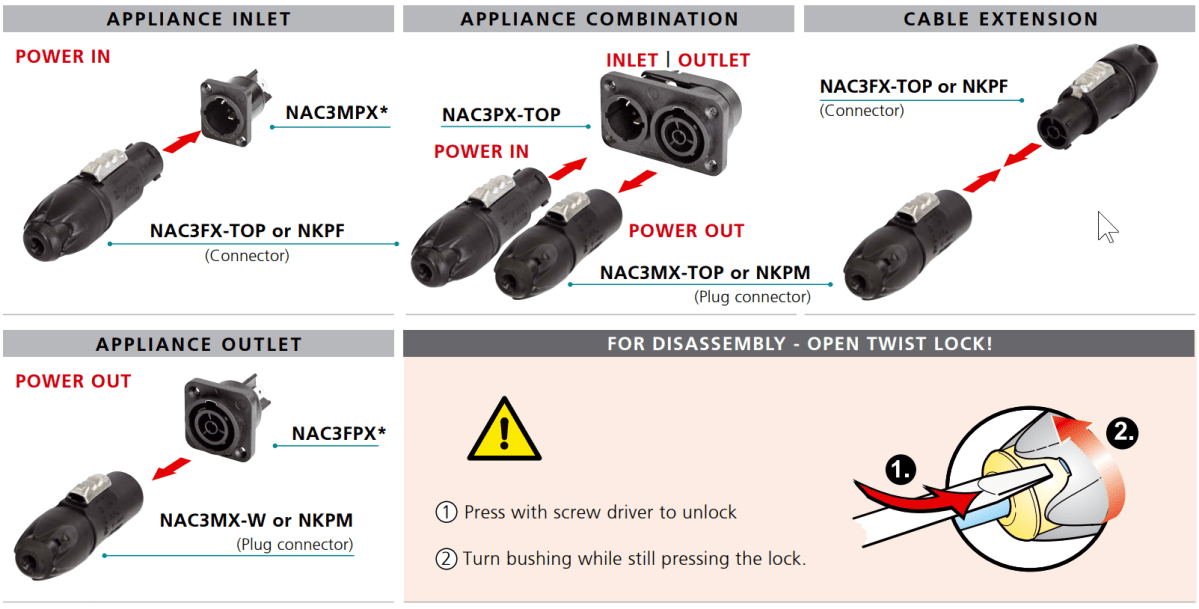
It is also a locking connector like the original PowerCon with male and female connectors and good for up to 16A. But they are a little more expensive. Interestingly, Thomann was the cheapest supplier I could find in Switzerland. Below you find a simple overview with the existing connectors and sockets along with their part numbers (taken from the Neutrik web site).
As you can see, there is no colour-coding for power inlets and outlets any more. Water-proof caps for the (wall) sockets are around 1.50 CHF per cap and therefore relatively expensive.
But what problem was I trying to solve in the first place?
We have AC electricity in our cars, the caravan and the trailers and soon in the barn and shed at the Loch. And we have appliances with UK, Swiss and EU (Schuko, Euro) plugs as well. And a plethora of adapters with the right one always not at hand. It was time to change that.
And the one thing I knew for sure was: I did not want to install UK sockets in the barn and shed. So, my idea was to install some more space-saving sockets. I already had good experience with the original PowerCon connector. However, they are not meant to be switched under load. Something that I definitely wanted to have with my new solution.
I could have sticked to plain Swiss connectors, as most of my appliances are already equipped with it. However, the typical Swiss triple T13 adapters tend to be occupied quite quickly as soon as we use AC/DC adapters or the Schuko fix-adapters. And if you get a quality product from a company like Feller, each triple socket costs around 50,00 CHF to 60,00 CHF. Compared to 3 Neutrik sockets this is way more expensive.
So, instead of researching any further, I quickly made a decision and went for the TRUE1 TOP system (from Liechtenstein). And it seems that I am not the only one with that idea, as I could see from various videos here, here, here and here.
My only real concern is, that after the “true” TRUE1 and the recent successor TRUE1 TOP, there will soon be an even “truer” replacement in the form of another imcompatible connector. But hey, what would one know anyway these days?
So, after last week the first batch of sockets and connectors arrived, this weekend I started with the conversion.
Inside our caravan, I added a couple of Neutrik sockets in the living room. See here:
Neutrik PowerCon True1 Top in our UK Swift Sprite Major 4 EB
I then updated the connections on the Toyota Hilux and relaced all the inputs, outputs and appliances. With this I could get rid of quite some adapters (from and to EU, UK, CH, CEE16-1, CEE16-3 etc).
Cooking with Neutrik PowerCon True1 Top in our Toyota Hilux
So what do I think so far? I am positively surprised.
Exchanging the connectors is simple and quick.
Even the thick 3-core 2.5mm2 H07RN-F cables fit in the connectors.
All the screws in the connectors are Torx (TX).
The connectors are not too bulky.
The adapters I made (e.g. from UK to Neutrik) are all rated for 16A (or 13A if we reuse the existing UK plugs). Travel adapters like the ones from Skross are typically only rated to 7A or 8A.
So, I will keep changing more and more of my appliances and will resurrect this post when I have news on this …
While we were building our washroom on the plot, we were thinking of having a hot water shower in there as well. But instead of having a boiler and keeping the water hot for an extended unused time, we were thinking of sth different:
1* immersion heater with a power rating to your liking, such as “Rommelsbacher TS2003” (with 2000W with AC). You can also go for a DC model that can be run directly from a (12VC) battery or DC source. Just make sure, that the heater is not longer than the height of the canister.
1* thermometer, such as “TFA Butter Quark Cheese Thermometer“ I opted to an analogue one going up to 100°C and made from glas instead of plastic.
1* short USB-C to USB-C cable for transmitting at least 36W
30cm of 1.5mm2 some cable
1* plastic bag or similar to fit the power bank and the trigger board
some plastic tape to “seal” the plastic bag
an energy source
How it works
Fill the canister with water (20l max).
Place the thermometer into the canister.
Place the heater into the canister and hook it to the opening of the canister. Make sure the metal of the heater does not touch the plastic or the thermometer.
Power on the heater (either from your battery or your inverter) and wait until the water gets to the destination temperature. For the actual duration see “The maths” section below.
Remove the heater.
Insert the immersion pump of the shower into the canister.
Connect the power bank to the USB-C trigger board via the USB-C cable.
Have the trigger board output voltage to be set to 12V permanently or set it manually to 12V.
Connect the power calbes of the shower to the trigger board.
Have a shower.
The maths
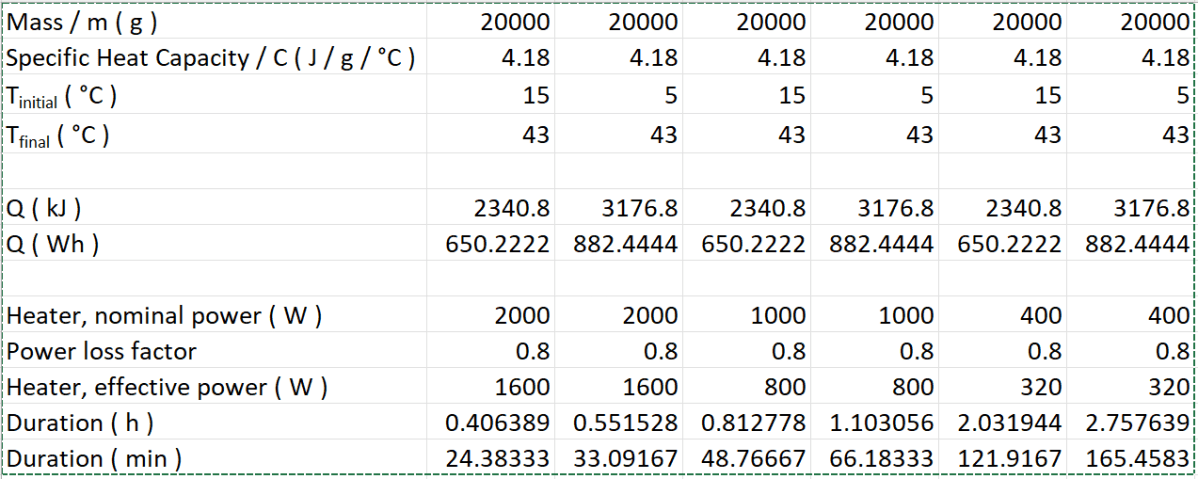
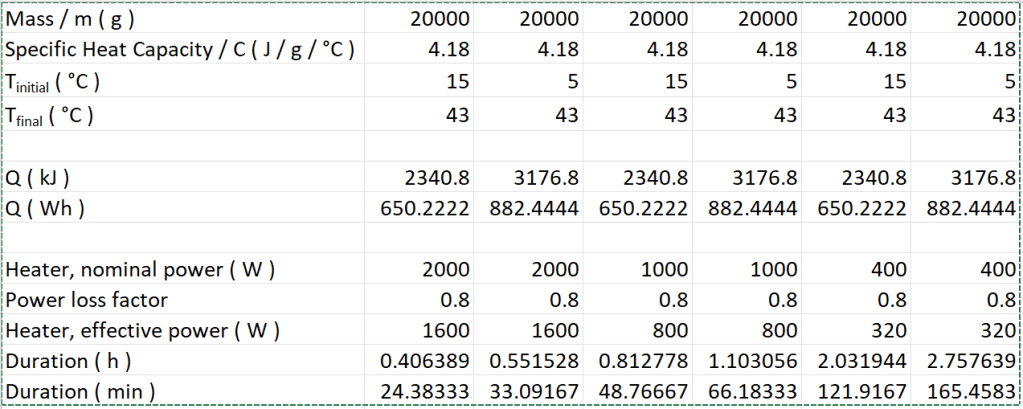
In case you are wondering, how it would take to heat up the water, here is my calculation (with the formula taken from various sources on the internet).
Q = m * C * delta(T)
So in case we want to heat 20l to 43°C from an initial temperature of 15°C with a 2000W immersion heater, we might need to wait for approx. 25min. If we did same but with an initial water temperature, it took us roughly 33min.
With a 1000W immersion heater, the numbers would change to 49min and 66min. And with a 400W we would have to wait 122min or 166min.
The amount of power needed is also shown on the above table. As you can see, it uses between 650Wh and 885Wh. So be careful when using a 12V immersion heater with your 90Ah car battery – don’t …
Conclusion
It quickly becomes obvious that a heater with only 400W will take too long to heat the water. At least I would put it over night into the motorhome, caravan, trailer or wahtever place so it can “pre-warm” a little bit. This might save you between 45min – 60min.
With 20l of water the shower experience will be limited to under 6min on “full throttle”. But with careful “breaks”, I still think the amount of water is sufficient for a full shower (not including washing long hair, of course). And if this does not provide sufficient water, there is always the option to add another 20l.
And: we will post a video with visual evidence as soon as it gets warmer …
Living in the north of the northern Highland comes with its own kind of specific “challenges” (as one would euphemistally phrase in today’s project world).
One of it would be that most delivery is only to “Mainland UK” which is sort of extends only to south of Inverness (which is only somehow understandable when one looks far back at the “Caledonian orogeny“). Anyway.
But even worse: Along with that delivery restriction comes the fact that there are also only very little shops with proper (or professional) selection of material up here. And this is also quite logical in itself. What could be sold in a shop, if nothing can be delivered to it?
This seems to have led to a “What we don’t have, you don’t need” attitude (no offence) and a supply:demand ratio that equates to higher sales prices.
So why am I writing this? I was looking for high current DC connectors for the battery systems I am making, I was looking to buy the Anderson Power Product SB 175 Connector. But the trusted (or only) electrician shop up here (CEF, a nationwide chain of 390 shops across UK) does not stock them, so I would have to resort to Mouser Electronics or Digi-Key Electronics for online ordering. There prices are about the same around 20 GBP per connector, which is not spent easily and about twice as much as other resellers or distributors charge (according to the Anderson web site).
In Switzerland I saw Distrelec selling compatible connectors under its house brand “RND Connect” for a converted price of 15 GBP (depending on the current exchange rate). This is not much of a saving taking into consideration that these are only rated for 175A instead of 280A.
And then there are numerous sellers on Aliexpress where we do not know beforehand what we actually get – but at a much lower price point.
So I went shopping to see the quality of the different manufacturers. My criteria for ordering were availability, low shipping cost and good reviews.
A selection of Anderson SB175 clones
I also ordered a shop with pre-manufactured cables and one with handles (where the price difference is even bigger).
I post an update when the items arrived and I had time to test them. So then we will see if these connectors can compete and are really compatible.
The foundation works for our barn are progressing, so hopefully the barn will be finished by the end of the year and we can start setting up a workshop – and our main electricity installation.
Last year, when I did a rough planning of our electricity needs and installation I decided to go for a battery system from Pylontech or BYD. But now, it is very hard to find a reseller or dealer that can actually deliver these batteries in the UK.
So our current plan is to “build” the batteries ourselves. And thanks to Stuart Pittaway (support him on Patreon, he created the DIYBMS) I found Fogstar, a company that imports and sells Eve battery cells. And this is where I ordered my 112 Eve 3.2V 280Ah 0.5C cells – to be delivered in late November (hopefully).
In the following sections I will explain why I ordered these cells and how I will connect them. So let’s start …
The generator
Our system will be completely off from the main electricity grid. We only have a JCB G20QS as a backup generator that can produce a constant power of 20kVA or 14.4kW. Running this generator at around 75% capacity is the most energy efficient way and will consume roughly 3.29 l per hour. This means I will have an output of 10.86kW and get a 3.3kW per litre of diesel.
Consumption calculation for JCB G20QS
The load
Despite my previous thoughts I will run the whole system on a single phase. This is due to the nature of “electric showers” in the UK all being single phase and using power between 8kW and 10.5kW. As I will use eneergy from the batteries for heating as well, I plan for a daily power consumption of 16kWh per day with a peak consumption of 12kW.
The batteries
I want to be able to run at least 3 days completely on batteries, resulting in a storage capacity of 48kWh to 64kWh.
Currently available LiFePO4 cells range between 280Ah and 320Ah and have normally a C rating of 0.5C. So if use 4 parallel batteries with 16 280Ah cells each I will end up with a capacity of 4* 16 * 3.2V * 280Ah = 4 * 14’336 VAh = 57’344 VAh.
The maximum current draw would be 4* 140A = 560A with a resulting available power between 28’672VAh and 22’400VAh (when the cells run at 2.5V just before shutting off). As it is hard to find DC breakers for that current rating, I actually restrict the maximum draw to 125A per battery giving me a draw of maximum 500A and a resulting available power range between 25’600VAh and 20’000VAh. This will give me at least 16’000Wh.
Side note: I was not sure, if I should really go for LiFePO4 batteries, as I do have the space and storing weight is not a problem either. But in the end I opted against lead acid batteries as the LiFePO4 has become so much cheaper. Temperature is not a problem for me in Scotland as it does not really get cold and the batteries are not outside below 5°C.
And the main reason why I went for the 280Ah cells (instead of bigger ones) is, that
( a ) I do not need the bigger capacity of 4 batteries with larger Ah, and
( b ) I see the remaining power of the system, when one battery is offline, as too little with a 3 battery system (instead of a 4 battery system), and
( c ) I would need bigger circuit breakers (with the 304Ah cells), and
( d ) I can still draw 15’000VA with only 3 batteries on the 280Ah setup.
Comparison between 280Ah, 304Ah and 320Ah cells
So the whole system is wired as a 4p16s system (instead of a 16s4p). Or was it the other way round? I always mix it up …
The inverters
I will use 3 parallel connected Victron MultiPlus II 48/5000/70-50 inverters that can deliver a constant power of 15’000VA or 12’000W (and peak up to a total of 27’000W).
One good thing about the model 5000 inverters is that they are relatively energy efficient (rated at 96%) and use only 18W per inverter. So during normal operation I might be running only 2 inverters at a time (with 36W), but I can easily add the 3rd inverter (with a total 48W). And given the output the batteries I could also add a 4th inverter later, if I really needed more peak power without having to add another 16s battery.
The connections
For this system I will use the Victron Lynx DC distribution system that is rated for 1’000A. The main fuse in the Lynx Shunt VE.Can (which is also rated for 1’000A) will run with a 500A fuse. The shunt itself is necessary as the Victron Cerbo GX controller cannot handle more than a single BMS. The shunt will tell the GX via the CAN bus the load level of the 4 batteries and thus hiding the individual batteries from the GX.
Charging will be done via the 3 MultiPlus inverters where each inverter can handle a 70A. This is slightly under the 212A that the generator can produce at 75% load (see above).
This means we would theoretically run the generator for 320min to charge all 4 batteries completely (needing roughly 17l of diesel).
If we only used the generator to charge the batteries for the whole year, we would end up with around 540h of running the generator, costing us 2’040GBP (at a current price of 1.15GBP per litre).
Side note: Though the generator is able to run constantly 24/7, the service package covers an 800 h per year. So even with these 540h we are well below this threshold.
Discharging
As already written, I restrict the discharge per battery to 125A, but the realistic discharge current should be between 75A and 98A per battery on full load (so I could actually also use a 100A DC circuit breaker). These number take into consideration the loss of the inverter, reactive power and the minimum cell voltage before shutdown.
With these parameters we could draw 12kW for a period of roughly 3.6h.
The Eve cells claim to have a lifetime of 5’000 cycles. With the estimated power consumption of 16’000W per day, we would end up in 102 full cycles per year and have a theoretical life time of over 49 years. Probably not …
Accessories
As the battery of the generator runs on 12V there will be a 48V/12V charger that will take power from the main batteries and keeps the generator charged.
In addition, I will have a direct 48V connection for additional 48V portable power packs that can be charged from the main battery system.
Scalability
The inverters can be scaled up to 6 parallel systems with a maximum power delivery of 24’000kW. But even better, I could easily change the whole system to a 3-phase system and still scale it up, uilising 3, 6 or nine inverters if needed.
And the batteries could be scaled easily to 8 parallel batteries before hitting the 1’000A rating of the bus bars and the shunt.
And if we went for a bigger bus bar, we could also replace the Lynx Shunt with a Victron 2000A SmartShunt.
Summary
So this is it. Until the cells have not been delivered I will not know if this works or not.
We will find out …
Side note: I am no Victron Shop at all, but like how their products integrate with each other and are still able to play with hardware from other manufacturers.













 Our Journey to Scotland