
We are getting ready for our next car. Or at least start thinking about it. Roughly, we want something like a MB Sprinter (short version, normal roof) and built the interior ourselves. And of course, when doing this, electricity is one part of it.
In this post we give a brief explanation of our requirements, use cases and possible solutions we came up with.
Storage capacity in our existing Toyota is 5’120Wh brutto with two Liontron 12V @200Ah batteries costing around 1’990,00 CHF, which makes 0,77 CHF / Wh. For our next van we would like to increase the storage capacity and the larger inverter, but keep cost down if possible. Currently we use 35mm2 cables to run our 1’200W inverter, so to run a larger inverter we would have to increase cable sizes in our system significantly – or increase voltage size.
After some thinking, we opted for a 48V system (rather unusual for a car) with two Pylontech Us3000 batteries summing up to a net capacity of 6’400Wh. Considering the price for the batteries (arund 1’730,00 CHF each) this would lower the price to 0,54 CHF / Wh. With this capacity we could run an 3000VA / 2400W inverter and cable sizes could then even stay the same.
However, the main problem with that setup would be to get 48V from a 12V alternator. But luckily, we are not the first tasked with this problem and Safiery has a solution just for that: Safiery Scotty 12V-48V DC/DC converter at different power levels (1000W, 1500W, 3000W). As the car engine would have a 250A alternator, the setup could really benefit from even the largest model. Ideally the DC/DC converter would be installed in the engine compartment, in order to minimise the relative voltage drop on the way into pssenger area.
As we currently do not have a fixed solar system, this is definitely something on our wishlist. But with that large DC/DC inverter and the fact that we are not staying for days at a single spot without moving the van, the initial cost for 400W solar panels just do not seem to be justified. So, we thought we prepare everything, so we can later still install solar panels without having to redo a lot of installation work. Enter Victron Energy EasySolar-II 48/3000/35-32 MPPT 250/70 GX. Now, how does this roll of the tongue?
But in fact, that system really looks promising: in a H 499mm x W 268mm x D 237mm box at a weight of 26kg, you get
- a 3000 VA inverter,
- 250V/70A MPPT solar charger,
- two AC out 230V @13A,
- a communication controller (GX) with Can bus. USB, network connections (wired, wireless),
- a 230V AC/DC battery charger with a 35A DC output (rather small),
- programmable relays;
- everything to be monitored and administered via a tablet,
- options for future expandability such as LTE and GPS exist.
Now this is rather impressive if you consider the price span of 2’248,00 CHF – 2’469,00 CHF.
Considering, both the Scotty and the US3000 also have a CAN bus interface, this really make a neat paclage, as all devices are able to talk to each other. More bang for the buck.
At least in theory. As I have not built it yet. But I think, this is a good starting point. I will contact the vendors to get a response if my setup is supported and if there are any reference installations on it.
Now you might wonder, how I would charge my other 12V devices, as I do not have a single 12V output in the setup. And yes, I thought about this too, and came to the conclusion: I do not need 12V output. Or sort of.
Compressor, winch etc I will power from the alternator directly. All the rest I will power via AC, such as the fridge, mobile, USB, notebook. This of course, comes with a penalty, as I have to convert the energy twice. But this also saves me an additional device and a lot of cabling and extra fuse boxes (and this is all saved space).
Now about the weight:
- the inverter I already mentioned
26kg: EasySolar-II 48/3000 GX - 64kg: 2* Pylontech US3000
- plus additional devices, such as 12V/48V DC/DC converter, bus bar, fuses, cables,
- future solar panels would come on top (no pun intended).
The van (2-seater) has a total loading capacity of 1080kg, so I think this is a justifiable weight for a pretty massive power system.
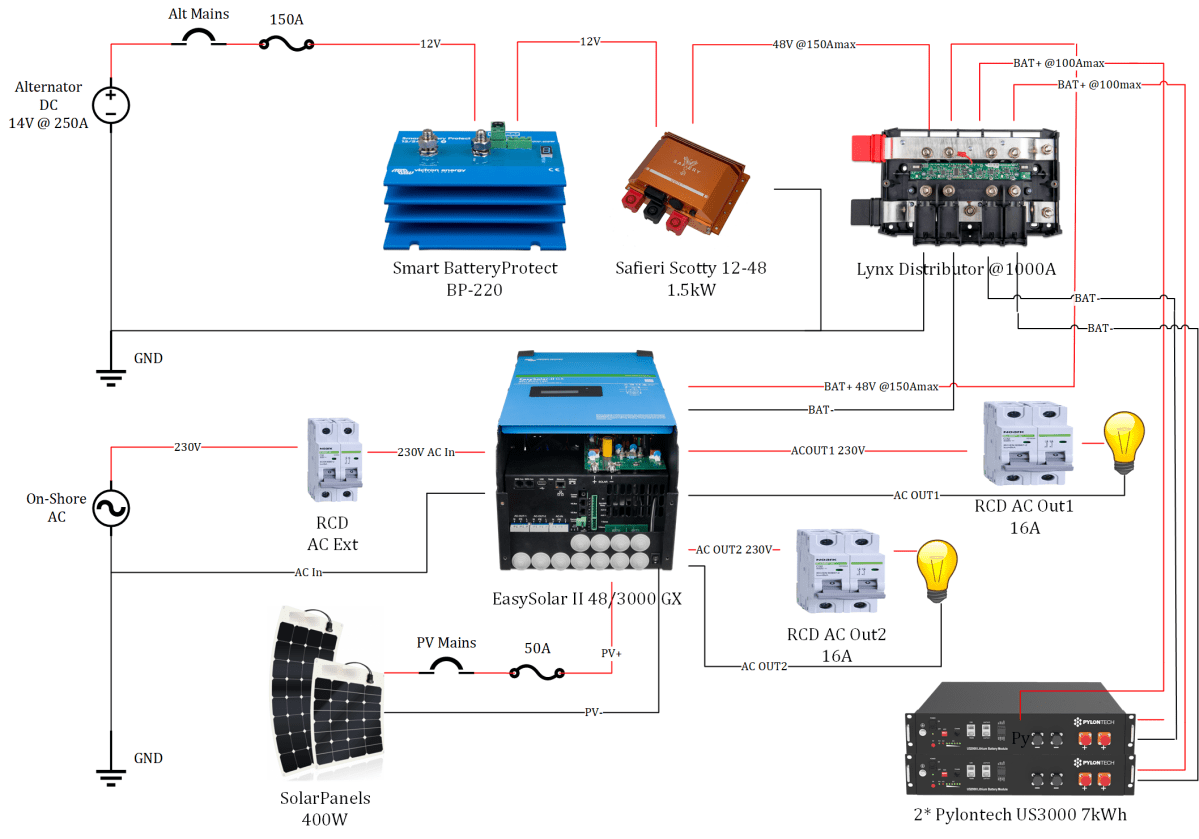
For connection of these systems, I opted for a bus bar with integrated fuses, the Victron Energy Lynx Distributor, though a back-to-back-cabling with extra fuse boxes would also have worked.
In case, the interaction with Safiery, Victron and Pylontech via CAN bus does not work out as expected, I would insert a Smart BatteryProtect BP-220 in front of the Scotty, so I can switch the converter on and off depending on the ATD and ATC signal in the EasySolar via a relay.
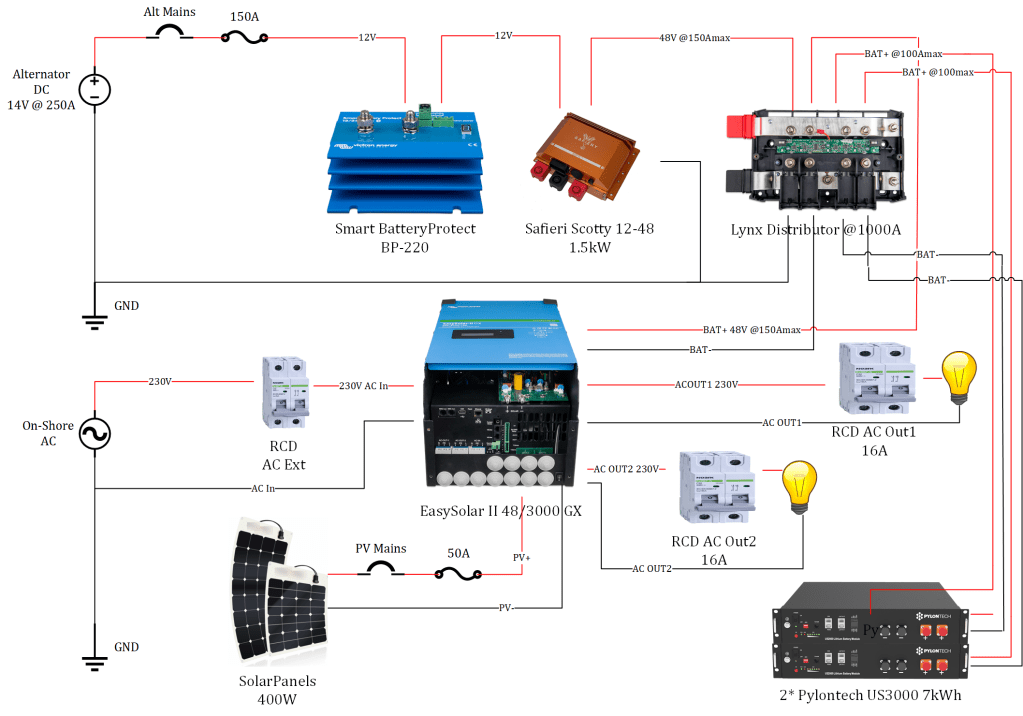
So these are my plans for the next van. I am curious, what response I get from the vendors and how it all works out.
In case you have questions or recommendations for improvement, I am more than happy to hear from you.

 Our Journey to Scotland
One thought on “New car – new electricity”